
Insights
10 November 2026
Restraint of Trade in Employment in Kenya and South Africa: Non Compete Clauses, Garden Leave and the Price of Moving On
Can a former employer stop you from joining a competitor? This edition of The BOLD explains the law of restraint of trade in employment in Kenya and South Africa, from the Contracts in Restraint of Trade Act and Magna Alloys to Mwaura v Taxify, Vodacom v Motsa on garden leave and the 2025 Labour Appeal Court ruling that dismissal does not end a restraint.
Read article
3 November 2026
Mergers and Brand Exits in Kenyan Fuel Retail. Change of Control, Dealers and the Station Lease
A change of owner at the top does not rewrite the documents at the station. This edition of The BOLD explains merger control under the Competition Act, the conditions imposed in the Vivo and Engen, Rubis and KenolKobil and Gulf Energy transactions, and the effect of a sale on leases, dealer agreements, licences and employees.
Read article
3 November 2026
LPG Cylinder Ownership and Cross Brand Refilling in Kenya. Whose Cylinder Is It?
A gas cylinder belongs to its brand, not to the household that holds it. This edition of The BOLD explains the Petroleum (Liquefied Petroleum Gas) (No 2) Regulations 2025, cylinder ownership, consent to fill and sell, deposits and mutual exchange, enforcement disputes involving independent dealers, and liability for accidents.
Read article
3 November 2026
Termination of Petrol Station Dealer Agreements in Kenya. Notice, Repossession and the Road Out
Every dealer agreement ends, and many end in a dispute. This edition of The BOLD explains termination for convenience and for breach, remedies for wrongful termination, the steps of exit from handover to debranding, post termination restraints under the Contracts in Restraint of Trade Act, and claims for goodwill.
Read article
3 November 2026
Dealer Credit and Stock Financing at Kenyan Petrol Stations. Credit, Security and the Monthly Price Change
Fuel is expensive and prices change every month. This edition of The BOLD explains cash, credit and consignment models, bank guarantees and security under the Movable Property Security Rights Act, the effect of the monthly EPRA price review on stock, hoarding and overpricing rules, and the recovery of dealer debts.
Read article
3 November 2026
Exclusive Supply and Tied Petrol Stations in Kenya. Competition Law at the Forecourt
Most branded petrol stations in Kenya are tied to one supplier. This edition of The BOLD explains exclusive purchasing, minimum volumes, pump price control, lubricant ties and radius clauses, and how sections 21, 24 and 24A of the Competition Act and the petroleum pricing rules apply to them.
Read article
2 November 2026
Licence Suspensions at Kenyan Petrol Stations. Adulteration, Hoarding and Who Pays
When the regulator closes a station, the licence holder bears the sanction but the cause may lie elsewhere. This edition of The BOLD explains EPRA enforcement against adulteration, export dumping, hoarding and overpricing, suspension and appeal under the Petroleum Act, and how losses are allocated between oil companies, dealers and transporters.
Read article
2 November 2026
Petrol Dealer Agreements as Franchises in Kenya. Implied Terms, Good Faith and the Operations Manual
Kenya has no franchise statute, so a petrol dealer agreement is governed by the general law. This edition of The BOLD explains what makes a dealer agreement a franchise, the terms the courts imply, the developing question of good faith, the legal effect of operations manuals and unilateral variation, and contracts formed without signature.
Read article
2 November 2026
Petrol Station Leases and Subleases in Kenya. Licence, Tenancy and the Rent Tribunal
Behind most branded stations is a chain of land rights. This edition of The BOLD explains the head lease and the dealer arrangement, the land requirements of the 2025 retail regulations, the line between licence and tenancy, controlled tenancies under Cap 301, and disputes between landowners and oil companies over holding over, restoration and change of control.
Read article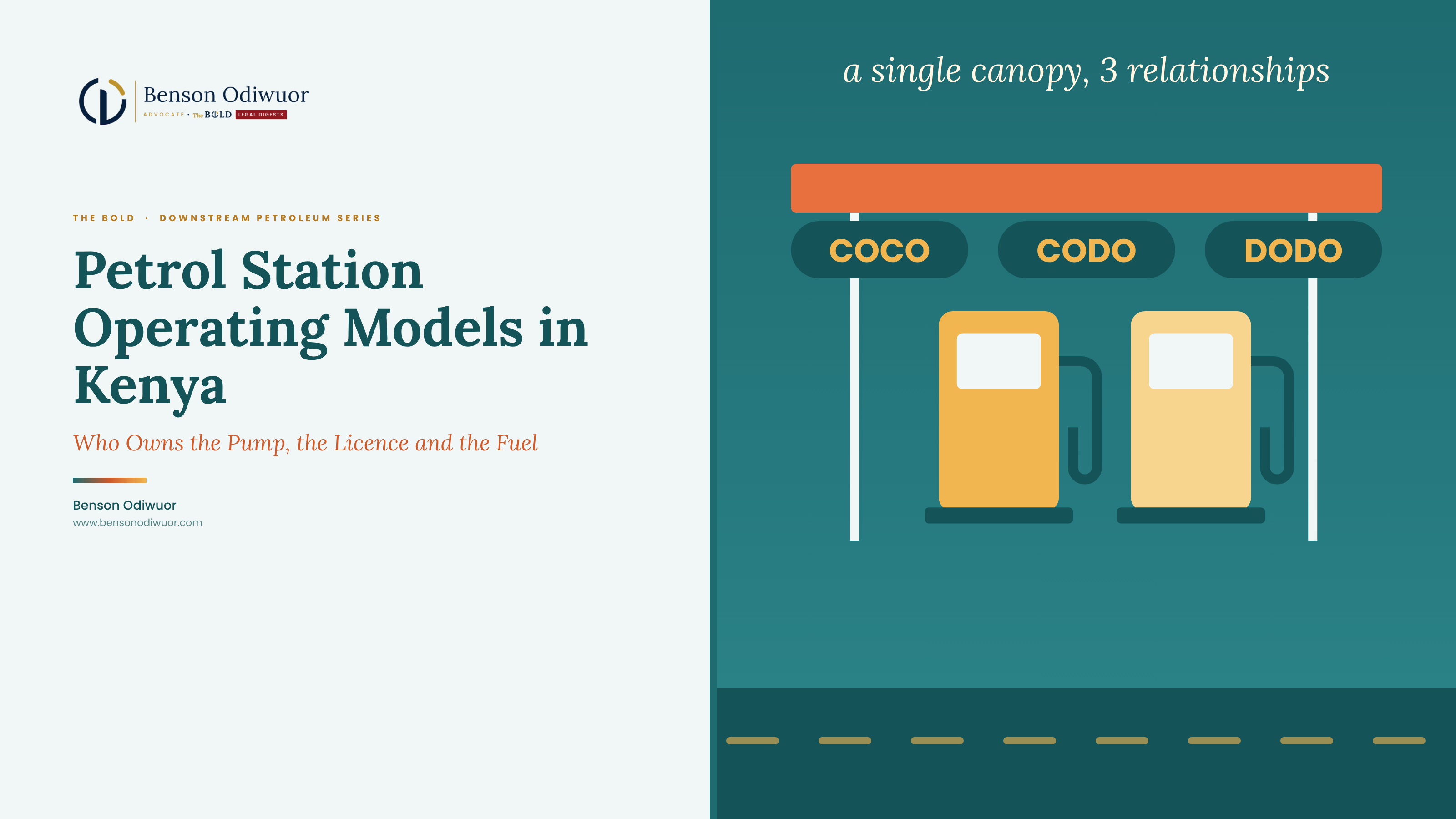
2 November 2026
Petrol Station Operating Models in Kenya. Who Owns the Pump, the Licence and the Fuel
Behind every branded petrol station in Kenya there are at least 3 legal relationships. This edition of The BOLD explains the COCO, CODO and DODO models, the retail licence under the 2025 regulations, ownership of fuel under the Sale of Goods Act, the Njane judgment against TotalEnergies and the 2025 findings of the regulator on CODO agreements.
Read article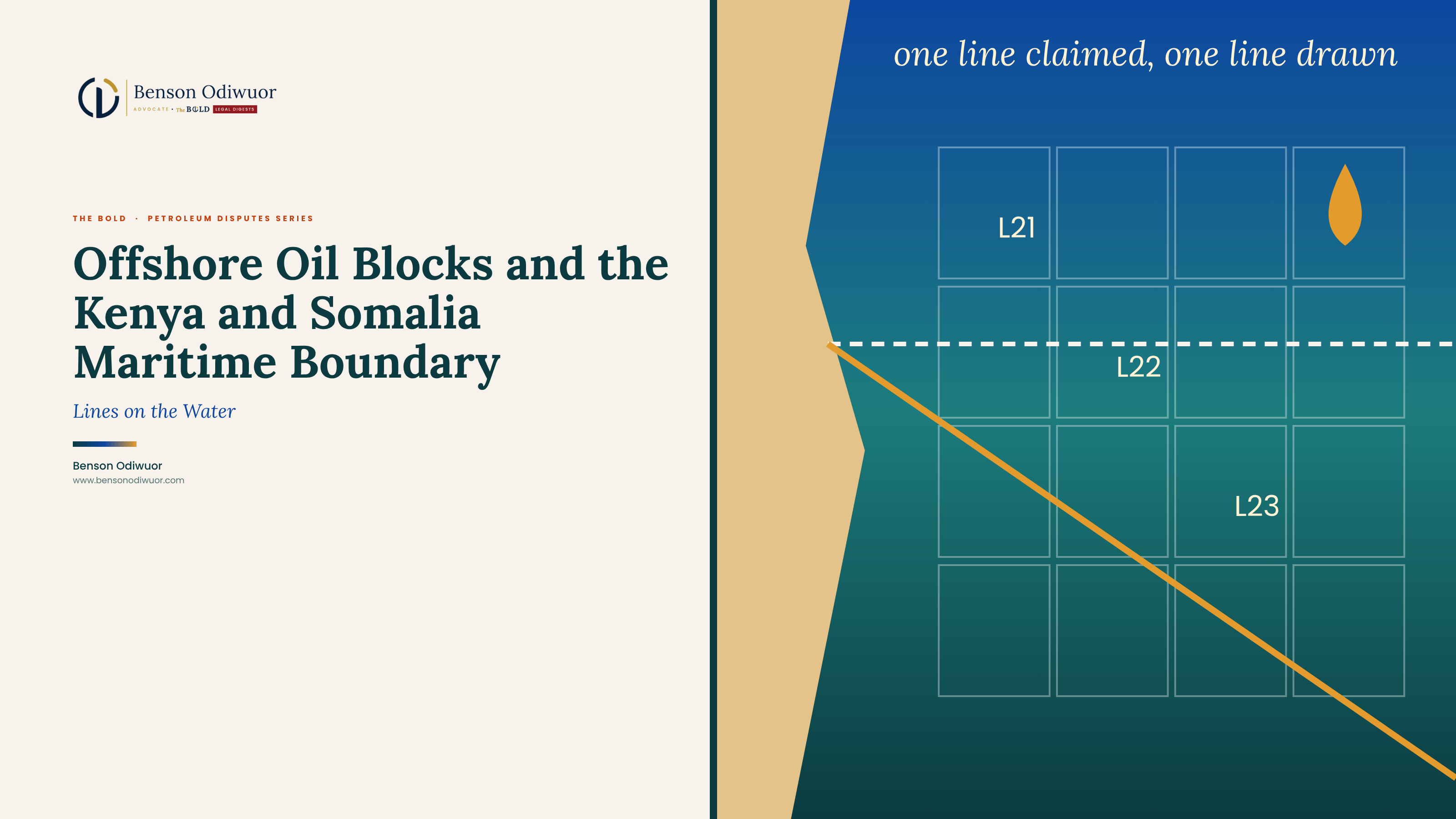
2 November 2026
Offshore Oil Blocks and the Kenya and Somalia Maritime Boundary. Lines on the Water
In 2021 the International Court of Justice drew the sea boundary between Kenya and Somalia across licensed oil blocks. This edition of The BOLD explains the maritime zones under UNCLOS, how boundaries are drawn, what the Court decided, the reaction of Kenya, what has happened to blocks L21 to L24, and the contractual and treaty options for licence holders.
Read article
2 November 2026
Government to Government Fuel Import Deals in Kenya. Credit, Control and the Open Tender
Since 2023 most of the fuel Kenya imports has come on credit from Gulf state oil companies. This edition of The BOLD explains the Petroleum (Importation) Regulations 2023, the procurement exemption for agreements with foreign governments and entities, the challenge by oil marketers, the reference by Uganda to the East African Court of Justice, the emergency cargo of 2026 and the calls for a forensic audit.
Read article
2 November 2026
Fuel Pricing Disputes and the Regulator in Kenya. The Price at the Pump
Every month the Energy and Petroleum Regulatory Authority sets the maximum price of fuel, and every month the price is contested. This edition of The BOLD explains the Petroleum (Pricing) Regulations 2022, stabilisation and cross subsidy, the Ithagi and Kituo cha Sheria judgments, the VAT changes of 2026 and the consolidated petitions on transparency.
Read article
1 November 2026
Raw Mineral Export Restrictions and Beneficiation in Kenya. Value before the Port
In 2026 Kenya announced that raw minerals would no longer be exported. This edition of The BOLD explains the export permit system under the Mining Act, the provisions that already promote beneficiation, the Rockland litigation and the 2025 judgment on the Mining Regulations 2024, the trade law limits on export bans, and the legal routes to a lawful restriction.
Read article
1 November 2026
Mining in Protected Areas in Kenya. Beneath the Forest Floor
Some of the richest mineral ground in Kenya lies under forests, parks and sacred sites. This edition of The BOLD explains excluded and restricted areas, the approvals required by section 36 of the Mining Act, the forest and wildlife rules on changing protected boundaries, the Cortec cases, Kasigau Ranching, the Lamu coal judgment and the questions raised in 2026 at Mrima Hill and in Tsavo.
Read article
1 November 2026
Ratification of Mining Agreements in Kenya under Article 71. Signed for the People
Article 71 gives Parliament the last word on the largest bargains over Kenyan minerals. This edition of The BOLD explains the Natural Resources (Classes of Transactions Subject to Ratification) Act 2016, mineral agreements under the Mining Act, the Mui Coal Basin judgment, the first ratification in Turkana and the questions raised by the Mrima Hill petition of 2026.
Read article
1 November 2026
Ministerial Powers to Suspend and Revoke Mining Rights in Kenya. Suspension by Letter
A mining licence can be suspended or revoked, but only on a lawful ground, on the recommendation of the Mineral Rights Board and after the notice the law requires. This edition of The BOLD explains the statutory grounds and procedure, the constitutional right to fair administrative action, the decided cases from Cortec to the 2023 judgment on a suspension letter, and the questions raised by the suspension at Magadi in 2026.
Read article
1 November 2026
Artisanal Miners and the Law in Kenya. Licensed to Dig
The Mining Act 2016 made artisanal mining lawful, but many miners still dig without permits. This edition of The BOLD explains the artisanal mining permit, the county Artisanal Mining Committees, landowner consent and compensation, the moratorium and its aftermath, the disputes at Chemase and Ikolomani, and the gaps that keep formalisation incomplete.
Read article
1 November 2026
Mine Closure and Liability after Exit in Kenya. When the Ore Runs Out
Every mine has a last day. Drawing on the closure of the Kwale mineral sands mine, the first large closure under the Mining Act 2016, this edition of The BOLD explains closure plans, environmental protection bonds, decommissioning and rehabilitation, who pays when the work is not done, and how the courts are holding miners to account after production ends.
Read article
1 November 2026
Community Consent and Representation in Kenyan Mining. Who Speaks for the Community?
Before a community can say yes or no to a mine, the law must decide who the community is and who may speak for it. This edition of The BOLD examines consent under the Mining Act and the Community Land Act, the unresolved overlap over unregistered community land, the Siaya judgment of October 2026, representative litigation in the Kwale cases and the regional standard of free, prior and informed consent.
Read article
31 October 2026
Who May Take a Share of Mineral Wealth in Kenya? Royalties, Levies and Cess
When a mineral leaves the ground in Kenya, the national government, county governments and host communities all claim a share of its value. This edition of The BOLD explains, from the ground up, how the courts have decided who may charge for minerals, how a lawful charge must be made, and what happens to money collected under a charge that is later struck down.
Read article
30 October 2026
Regulatory Disputes in Kenya’s Mining Sector and How to Avoid, Manage and Win Them
Excerpt A mining licence in Kenya is only as secure as the investor’s ability to defend it. This edition of The BOLD sets out where licence, royalty and enforcement disputes come from, the safeguards investors and lenders should build in before capital is committed, and the forum, exhaustion and pleading choices that decide these cases before the merits are reached.
Read article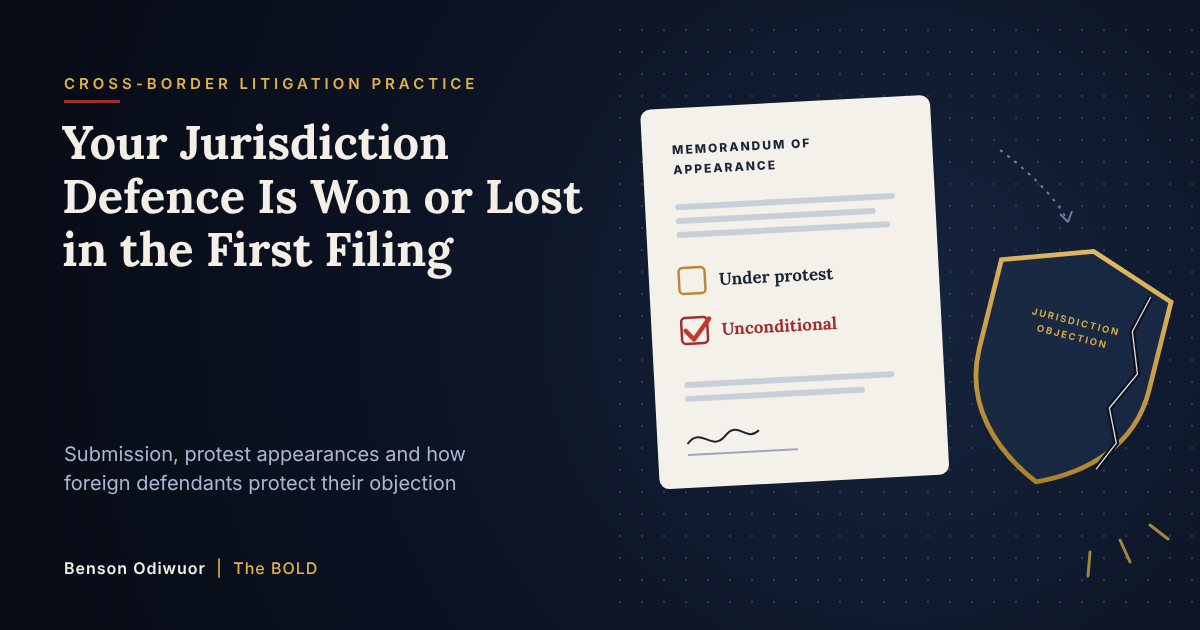
27 October 2026
Your Jurisdiction Defence Is Won or Lost in the First Filing
A foreign company sued in Kenya may have a strong objection to the court's jurisdiction, and still lose it by the way it responds to the suit. This article explains the doctrine of submission, how Kenyan courts distinguish a protest from an acceptance, and the steps foreign defendants should take from day one.
Read article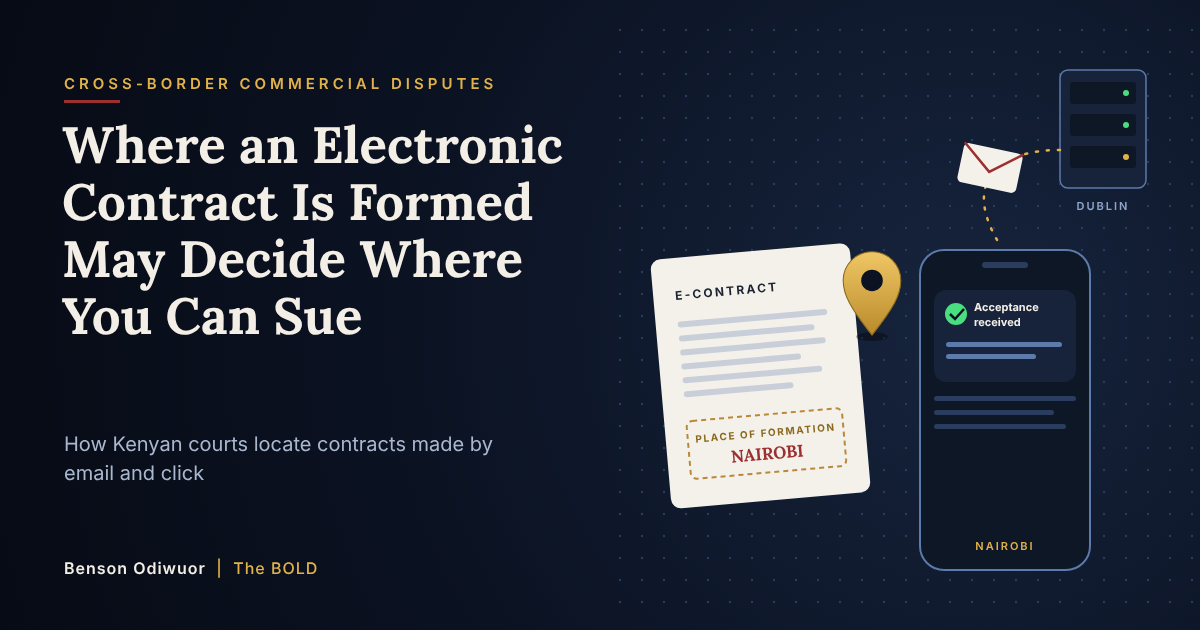
27 October 2026
Where an Electronic Contract Is Formed May Decide Where You Can Sue
When a Kenyan business contracts online or by email with a foreign company, the place where the contract was made can decide whether a Kenyan court can hear the dispute. This article explains how that place is found, why it often depends on who sent the last message, and how businesses can protect themselves.
Read article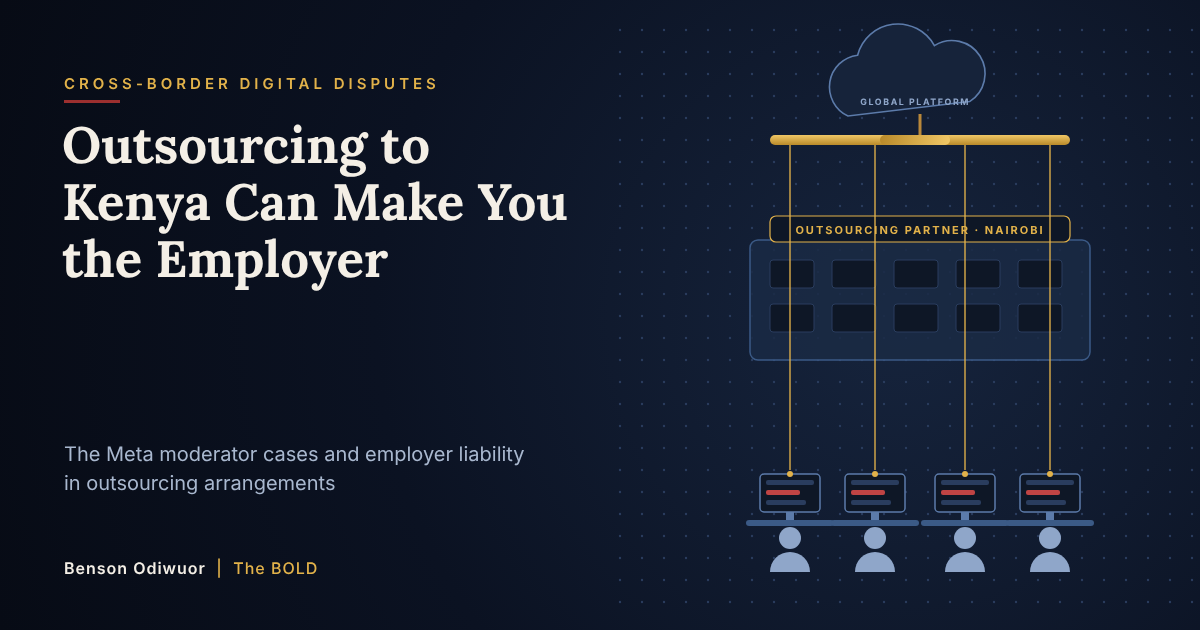
27 October 2026
Outsourcing to Kenya Can Make You the Employer
Global companies outsourcing work to Kenya usually assume the local provider is the employer. The Meta content moderator cases have put that assumption under strain. This article explains what the courts decided, what remains open, and how multinationals can manage the risk.
Read article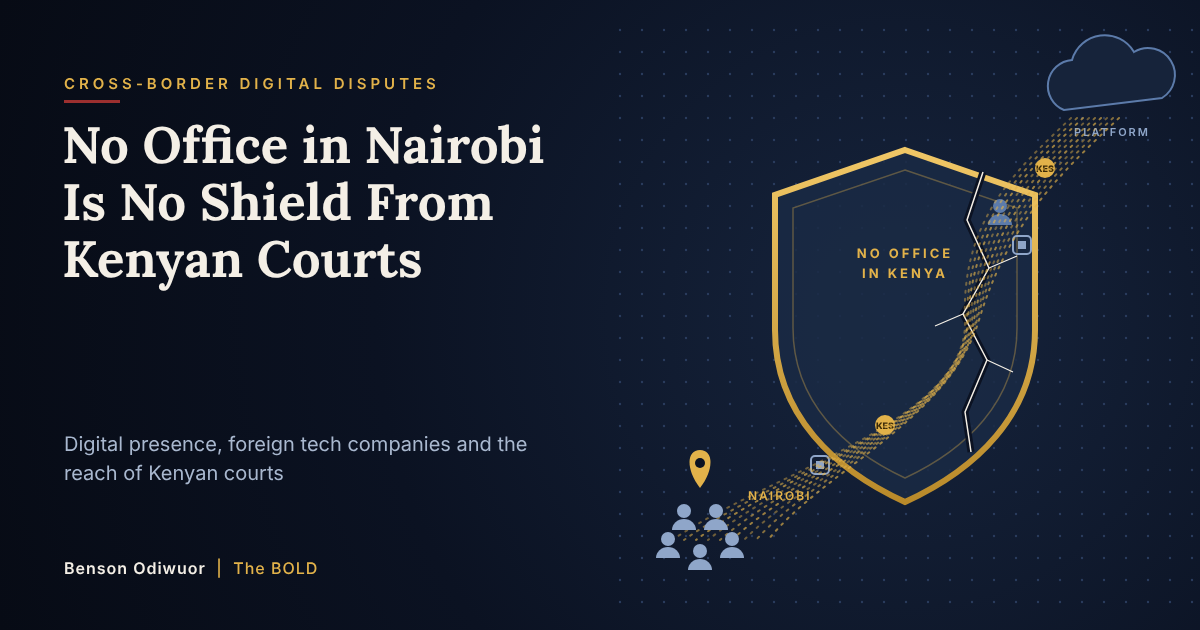
27 October 2026
No Office in Nairobi Is No Shield From Kenyan Courts
Global technology companies often assume that having no office in Kenya keeps them out of Kenyan courts. The Meta litigation shows otherwise. This article explains why digital presence is now a question of evidence in Kenya, and what that means for foreign companies and the people who sue them.
Read article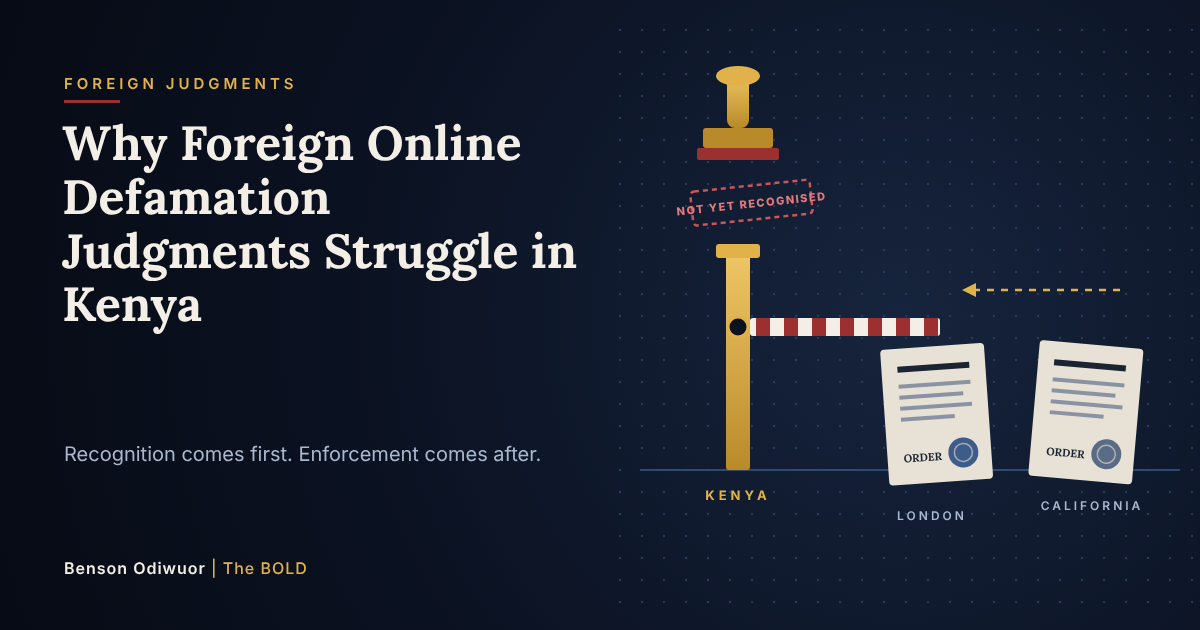
27 October 2026
Why Foreign Online Defamation Judgments Struggle in Kenya
A foreign court order has no force in Kenya until a Kenyan court recognises it. This article explains when foreign judgments can be registered, why online defamation judgments and takedown orders often fall outside the Kenyan Act, and how both recipients and foreign claimants should respond.
Read article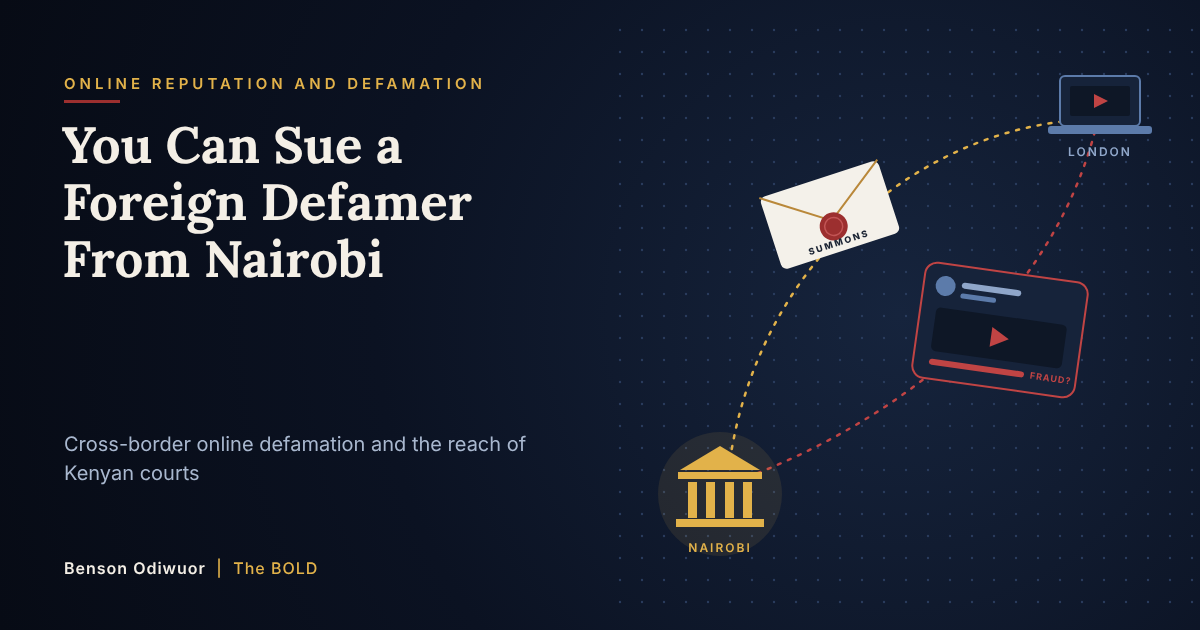
27 October 2026
You Can Sue a Foreign Defamer From Nairobi
When someone abroad defames you online and the damage is felt in Kenya, you may be able to sue at home. This article explains where online defamation is committed, how to bring a foreign defendant before a Kenyan court, the pitfalls shown by Mwilu v BBC, and whether a Kenyan judgment can be enforced.
Read article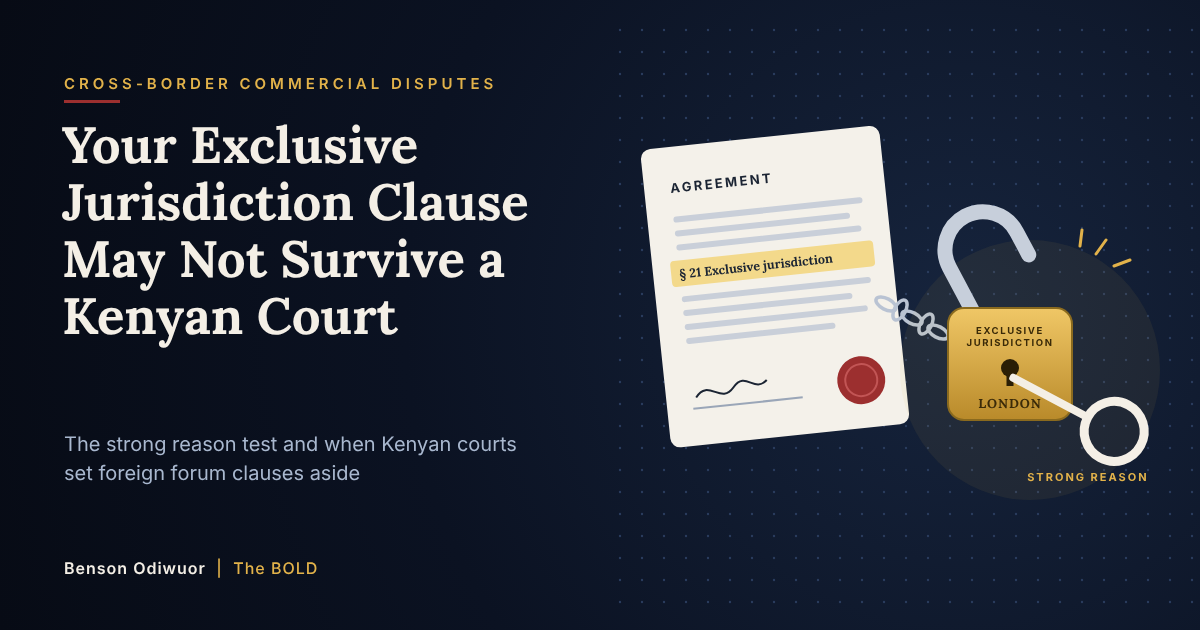
27 October 2026
Your Exclusive Jurisdiction Clause May Not Survive a Kenyan Court
International contracts with Kenyan parties often send every dispute to London, Dubai or another foreign court. Kenyan courts respect those clauses, but not always. This article explains when a Kenyan court will set an exclusive jurisdiction clause aside, and how businesses can protect theirs.
Read article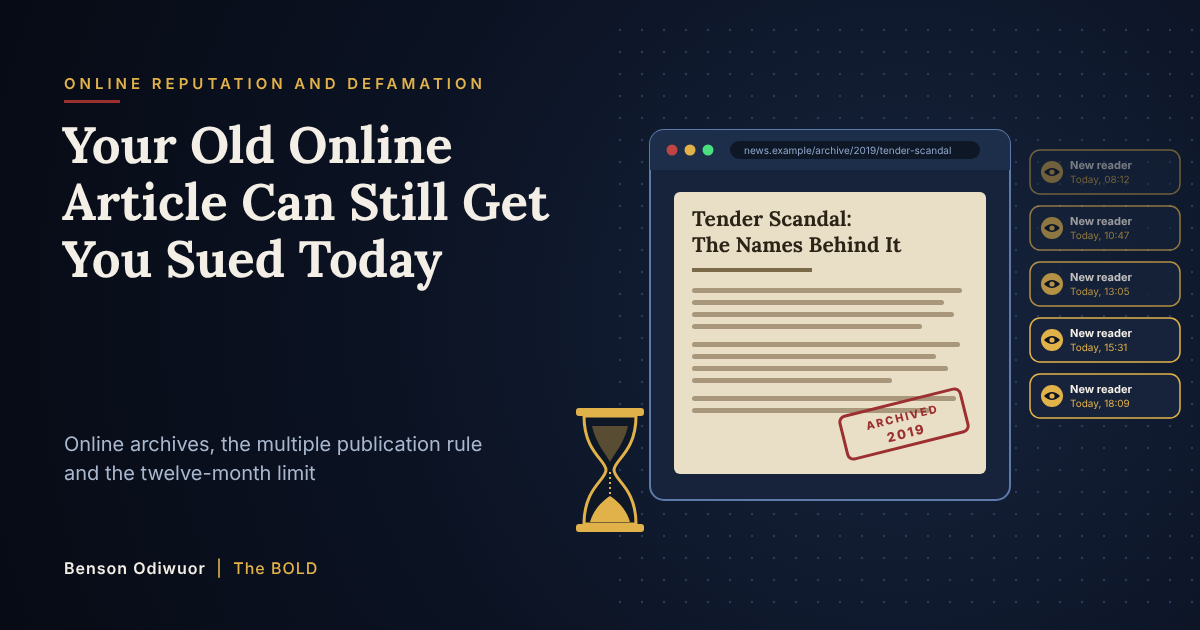
26 October 2026
Your Old Online Article Can Still Get You Sued Today
Kenyan law requires a defamation claim to be brought within twelve months. But under the multiple publication rule, an article that stays online may be published afresh every time it is read. This article explains the rule, how other countries have replaced it, and what it means for Kenyan publishers and claimants.
Read article
24 October 2026
Kenya's Data Law Follows Your Company Across the Border
Kenya's Data Protection Act applies to foreign companies that process the personal data of people located in Kenya, even if they have no office here. This article explains how far the Act reaches, how it compares with the GDPR, what the Worldcoin case shows, and what foreign companies should do.
Read article
23 October 2026
Kenyans Are Turning to the Constitution to Sue Big Tech
The most momentous cases against global platforms in Kenya have been brought as constitutional petitions. This article explains why, what Meareg v Meta and the Worldcoin case decided, how the route sidesteps foreign forum clauses, and the limits that claimants and platforms should keep in mind.
Read article
23 October 2026
How Claimants Lose Cases Against Big Tech Before Trial Begins
how to serve a foreign company in Kenya; electronic service of summons Kenya; serving Meta in Kenya; default judgment set aside foreign defendant; conditional appearance Kenya; civil procedure Kenya
Read article
23 October 2026
Clicking "I Agree" May Not Send Your Case to California
Platform terms of service often require every dispute to be decided in California, Ireland or by foreign arbitration. This article explains when Kenyan courts will enforce those clauses, and when a Kenyan user or business can still sue at home.
Read article
22 October 2026
Can Kenyan Courts Order Content Off the Entire Internet?
remove defamatory content Kenya; worldwide injunction internet; geo-blocking court order; Kenyan court jurisdiction over Facebook; right to erasure Kenya Data Protection Act; Google v Equustek; cross-border online defamation
Read article
22 October 2026
Accepting M-Pesa Can Get Your Brand Sued in Kenya
A foreign brand with no office in Kenya can still find itself before a Kenyan court if its website targets Kenyan customers. This article explains the targeting test developed by courts in Europe, the United Kingdom and India, how it is likely to apply in Kenya, and what brands should do about it.
Read article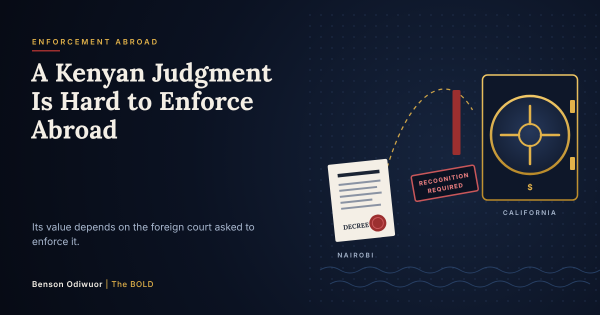
22 October 2026
A Kenyan Judgment Is Hard to Enforce Abroad
A Kenyan judgment against a foreign technology company is only as valuable as the foreign courts that must enforce it. This article explains how courts in the United States and England treat Kenyan judgments, the paradox of a defendant that never appears, and how claimants should plan enforcement from the start.
Read article
18 October 2026
Why Kenyan PPPs End Up in Court and How to Keep Them Out
Read article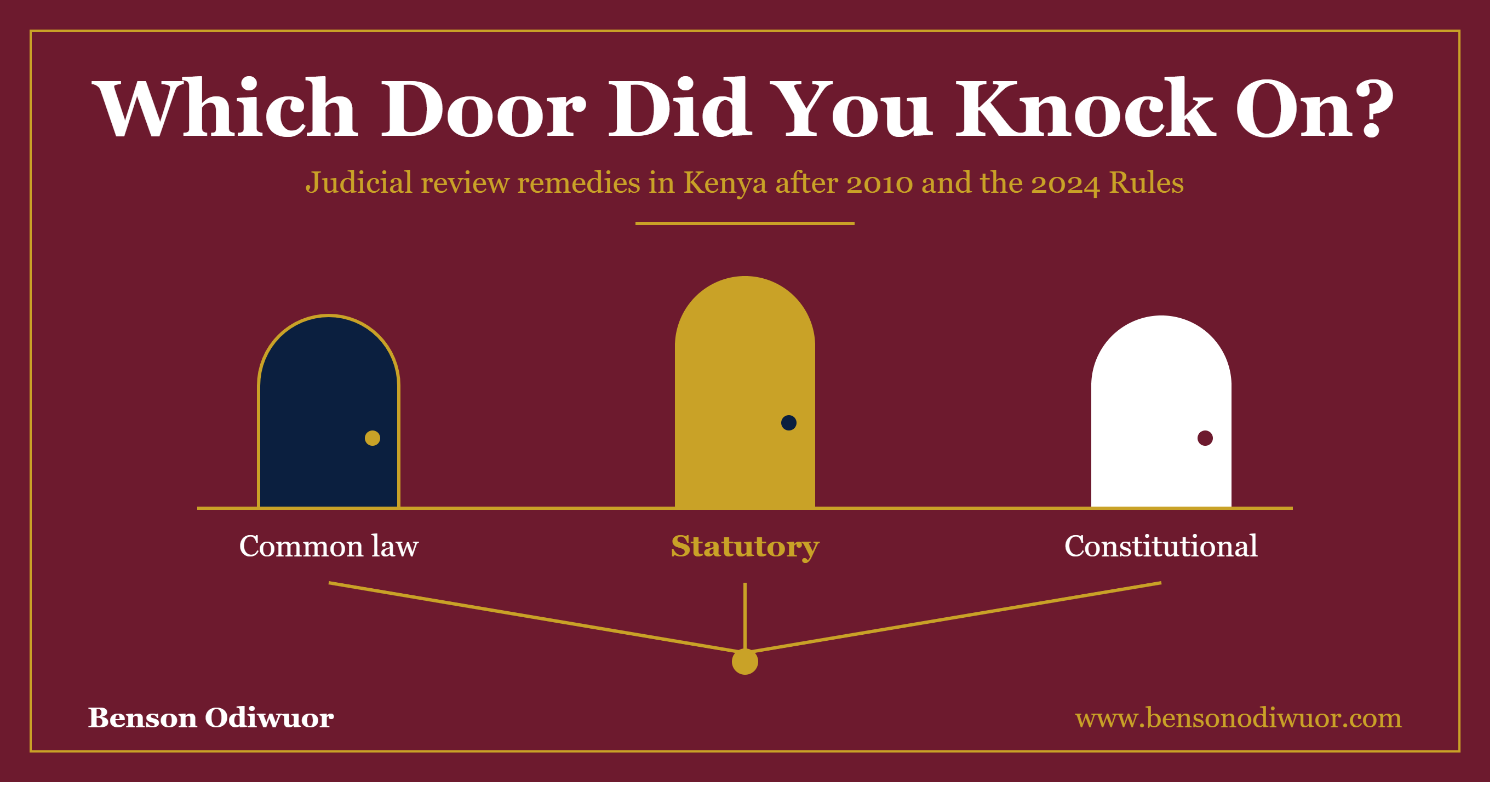
13 October 2026
Judicial Review Remedies in Kenya After 2010 and after the 2024 Rules
Should you seek leave before filing for judicial review in Kenya? Can the court award damages, examine the merits of an administrative decision or substitute its own decision? The answers depend on the legal procedure you choose. This article explains the distinction between judicial review under Order 53, the Fair Administrative Action Act and the Constitution, and examines how the Fair Administrative Action Rules, 2024, including the provisions suspended by the High Court, affect the way applications should be brought and remedies sought.
Read article
4 October 2026
Everything You Need to Know About the Trust Administration Act, 2026
Kenya now has a new law governing trusts. The Trust Administration Act, 2026 introduces new rules on the creation, registration and management of trusts, with important consequences for trustees, settlors, beneficiaries and advisers.
Read article
30 September 2026
Does the Power to Appoint an Administrator Come from the Contract or the Statute?
When does the power to appoint an administrator arise? This article examines whether the power is derived from the debenture or arises independently under the Insolvency Act once a creditor holds a qualifying floating charge.
Read article
27 September 2026
Why Documents in Interlocutory Applications Cannot Cure Omissions in Your Main Suit
Documents filed later in litigation may not cure omissions in your main suit. Explore the relationship between pleadings, interlocutory applications and evidence.
Read article
25 September 2026
Courts Award Interest from the Date of Filing Suit to Prevent Court Delays from Becoming a Windfall for Debtors
When should interest begin running on money owed? Kenyan courts have generally recognised the date of filing suit as the starting point for interest on liquidated claims. This article examines the principle, leading authorities and its practical implications for creditors and commercial litigation.
Read article
19 September 2026
Emerging Trends in Banking, Fintech and Telecommunications Consumer Disputes in Kenya
Bank fraud, unauthorised transactions, digital lending, SIM swaps and data breaches are reshaping consumer protection in Kenya. This article examines recent decisions and the emerging legal duties of banks, fintechs and telecommunications providers.
Read article
13 September 2026
Surrogacy: You Can Contract for a Pregnancy. Can You Contract for a Child?
What happens when the child born through surrogacy is not the child the commissioning parents expected? A disturbing surrogacy dispute in the United States exposes a question that Kenya has yet to answer adequately. Kenya has no comprehensive surrogacy statute and no parental order mechanism, leaving courts to improvise through adoption law, constitutional principles and the best interests of the child. This Litigation Practice Note examines the legal vacuum surrounding surrogacy, the rights of surrogate mothers, the status of commissioning parents, disputed genetic parentage and the urgent questions confronting Kenya as Parliament considers assisted reproductive technology legislation.
Read article
7 September 2026
Employee Stock Ownership Plans (ESOPS) and the Law in Kenya
Employee Stock Ownership Plans (ESOPs) have become an increasingly important tool for attracting and retaining talent, rewarding performance and aligning employees with long-term business growth. But behind the promise of ownership lies a complex framework of corporate approvals, share structures, vesting rules, tax obligations, regulatory requirements and employee rights. This Litigation Practice Note examines how ESOPs work, the legal and tax issues businesses must navigate, and the lessons emerging from recent Kenyan case law.
Read article
6 September 2026
When “May” Becomes a Duty and “Shall” Becomes Discretionary
What is the legal meaning of “shall” and “may” in legal interpretation? The words “shall” and “may” do not always carry an absolute or fixed meaning. Courts generally consider the context, legislative intent, purpose of the provision, statutory scheme and consequences of competing interpretations when determining whether a provision is mandatory or directory. This Litigation Practice Note examines the principles governing the interpretation of “shall” and “may”, with particular reference to leading Kenyan jurisprudence.
Read article
23 August 2026
Restraint of Trade in Kenya vs South Africa: What Employers and Employees Need to Know
A restraint of trade can determine whether an employee is free to work for a competitor, or whether an employer can legally stop them. This comparative analysis breaks down the law in Kenya and South Africa, including non-compete clauses, trade secrets, goodwill, public interest, burden of proof, garden leave and the limits of post-employment restraints.
Read article
23 August 2026
Unregistered Foreign Companies Can Sue in Kenyan Courts
The Court of Appeal has settled a long-running dispute over whether an unregistered foreign company can sue in Kenyan courts. The decision clarifies Section 974 of the Companies Act, the meaning of “carrying on business” in Kenya, and when non-registration can—and cannot—defeat a foreign company’s claim.
Read article
15 August 2026
Teachers and the TikTok Classroom in Kenya
TSC Circular No. 14/2026 has put teachers’ TikTok and social media activity under renewed scrutiny. Here is what Kenyan law says about teacher conduct, learners’ privacy, parental consent, freedom of expression, data protection and disciplinary action.
Read article
15 August 2026
The Law on Cross-Border Insolvency in Kenya
Cross-border insolvency in Kenya is governed principally by the Insolvency Act 2015 and its Fifth Schedule, which incorporates the UNCITRAL Model Law on Cross-Border Insolvency. This article examines the legal framework for recognition of foreign insolvency proceedings, the role of foreign representatives, the concept of Centre of Main Interests (COMI), the public policy exception, protection of Kenyan creditors, the effect of recognition on ongoing proceedings and enforcement, and the treatment of claims by the Kenya Revenue Authority. Drawing from key Kenyan decisions including CMC DI Ravenna, Zarara Oil & Gas, HP Gauff Ingenieure and Benisa Limited, the article provides practical insights for creditors, insolvency practitioners, companies and lawyers dealing with cross-border insolvency matters in Kenya.
Read article
15 August 2026
Contradicting Court of Appeal Decisions on Statutory Power of Sale: Teleposta v City Finance
Two recent Court of Appeal decisions—Teleposta Pension Scheme Registered Trustees v Intercountries Exporters Limited [2024] KECA 870 and City Finance Limited v Nyanja Holdings Limited [2026] KECA 106—provide conflicting answers on the protection afforded to an innocent purchaser who acquires land through a statutory power of sale where the chargor’s underlying title is subsequently found to be defective. This article examines the apparent contradiction and its implications for purchasers, lenders, borrowers and property lawyers in Kenya.
Read article
15 August 2026
When General Damages Might Be Awarded for Breach of Contract
Can a claimant recover general damages for breach of contract in Kenya? The general rule is that they cannot. But the courts recognise a narrow exception where the defendant's conduct is oppressive, high-handed, outrageous, insolent or vindictive. This Litigation Practice Note examines the settled position, the exceptional circumstances that may justify an award, the distinction between general, special and nominal damages, and the pleading and evidentiary requirements practitioners must satisfy.
Read article
15 August 2026
The Procedural and Compensatory Framework for Workplace Injuries in Kenya
The Work Injury Benefits Act, 2007 establishes a structured process governing reporting, medical treatment, compensation, assessment of disability, objections, appeals and enforcement. This Litigation Practice Note examines the procedural and compensatory framework under WIBA, including the statutory deadlines employers and employees must observe and the principles established by the Supreme Court and Court of Appeal.
Read article
14 August 2026
Can a Company Sue Without a Board Resolution? Understanding Corporate Authority to Litigate in Kenya
Can a company file a suit in Kenya without producing a board resolution? The Court of Appeal in Arthi Highway Developers Ltd v West End Butchery Ltd settled the position that a company is not required to file a board resolution alongside its plaint. This Litigation Practice Note examines corporate authority to sue, Order 4 Rule 1(4), the burden of proof, and why a preliminary objection is generally not the proper way to challenge a company's authority to institute proceedings.
Read article
2 August 2026
When does a data processor become a data controller?
What happens when a contractor processes personal data outside your instructions? Under Kenya's Data Protection Act, they may cease to be a data processor and become a data controller, assuming direct legal liability. This article examines the landmark Christine Ochola determination and explains why every service agreement should contain a robust Data Processing Agreement, together with the practical lessons businesses need on controller-processor relationships, consent, liability, and regulatory compliance.
Read article
2 August 2026
You Cannot Use Someone's Name on Your Website Without Their Consent
Can a business publish a professional's name, qualifications, and profile on its website without their permission? The Office of the Data Protection Commissioner says no. This article examines the KES 1,012,500 decision against Brainstorm Insurance Brokers, explains why "web developer error" is not a legal defence, and outlines the practical lessons every business should know about website content, consent, and data protection compliance under Kenya's Data Protection Act.
Read article
2 August 2026
What Every Employer Must Know About Former Employee Image Rights Under Kenya's Data Protection Act
Can an employer continue using a former employee's image to promote its business after the employment relationship has ended? The High Court and the Office of the Data Protection Commissioner say no. This article examines the landmark Moja Expressway decision, explains why employment-based consent does not survive termination, and outlines the practical lessons every employer, HR professional, and marketing team should know about image rights and data protection compliance in Kenya.
Read article
2 August 2026
The Data Controller-Processor Relationship Explained: Lessons from a KES 450,000 ODPC Decision
Who bears liability when a data processor acts outside a controller's instructions? The Office of the Data Protection Commissioner's decision in Christine Ochola v. NSSF & Off Grid Concepts provides a landmark interpretation of the controller-processor relationship under Kenya's Data Protection Act. This article examines the KES 450,000 determination and explains the practical lessons every organisation should understand about consent, liability, processor agreements, and data protection compliance.
Read article
2 August 2026
“Human Error” Cost St. Luke’s Hospital KES 525,000: What Every Healthcare Provider Must Know About Patient Data Sharing
A hospital was ordered to pay KES 525,000 for unlawfully sharing patient data. Learn the key healthcare data protection and consent lessons under Kenya's Data Protection Act.
Read article
31 July 2026
Event Photography and Consent for Commercial Use in Kenya. Why a Ticket Is Not a Model Release
Does buying a ticket give an organiser the right to put your face in its next advert? This edition of The BOLD explains the 2026 decision of the Data Commissioner against the organiser of Blankets and Wine, the rules on express consent and commercial use in the Data Protection Act and the General Regulations, and the line of image decisions from Casa Vera Lounge to Moja Expressway.
Read article