
Raw Mineral Export Restrictions and Beneficiation in Kenya. Value before the Port
1 November 2026
In 2026 Kenya announced that raw minerals would no longer leave the country. The law answers 3 questions before that promise binds. What does the law in force require today? What instrument would make a ban binding, and when? How would it apply to existing licences and contracts? This edition answers each of them from the law and the decided cases.
| KEY POINTS AT A GLANCE No mineral may be exported from Kenya without an export permit. The Mining Act gives the power to grant it to the Cabinet Secretary, and the Dealings in Minerals Regulations 2017 set out who may apply and how. The Act already encourages beneficiation. Applicants for mining licences must set out options for beneficiation, and mineral agreements may deal with processing in Kenya. The Act does not, however, contain a general ban on exporting minerals in raw form. In 2026 the national government announced that raw minerals would no longer be exported. The President applied the policy to soda ash in September 2026 and to unprocessed gold later that month. A draft Minerals, Mining and Beneficiation Policy 2026 proposes legislation for export restrictions and bans. An announced policy is not yet law. Under Article 94(5) of the Constitution, a rule with the force of law must come from Parliament or from a power that Parliament has conferred, and regulations must pass public participation and parliamentary scrutiny. The courts have twice set aside mining rules and directives on process grounds. Rockland (2023) concerned a directive on export permits, and in September 2025 the High Court declared the Mining Regulations 2024 unconstitutional. Every exporter now faces 3 questions. What does the law in force require today? What instrument would make a ban binding, and when? How would it apply to existing licences and contracts? |
I. Introduction
Kenya has long exported much of its mineral output in raw or lightly processed form. Titanium mineral sands, soda ash, fluorspar, gemstones and gold have left the country with little done to them beyond extraction and concentration. The policy case for changing that is familiar. Processing at home can create jobs, build industry and capture more of the value of the resource. The Constitution itself requires the State to ensure the equitable sharing of the benefits of natural resources.1
In 2026 the national government made beneficiation the centre of its mining policy. In April the Cabinet Secretary for Mining told a parliamentary committee that the Cabinet had resolved that no mineral should be exported in raw form.2 In September the President directed that soda ash from Magadi should never again be exported raw, and later announced plans to outlaw the export of unprocessed gold.3 A draft Minerals, Mining and Beneficiation Policy 2026 proposes legislation to curb raw exports through restrictions and bans.4
This edition of The BOLD explains, from the ground up, what the law says today and what it would take to turn the policy into binding law. It begins with the vocabulary of export and beneficiation. It then sets out the statutory framework, the cases that show how courts treat mining directives and regulations, and the international trade rules that apply to export restrictions. It closes with an analysis of the legal route to a lawful ban and practical guidance for exporters, investors and the State.
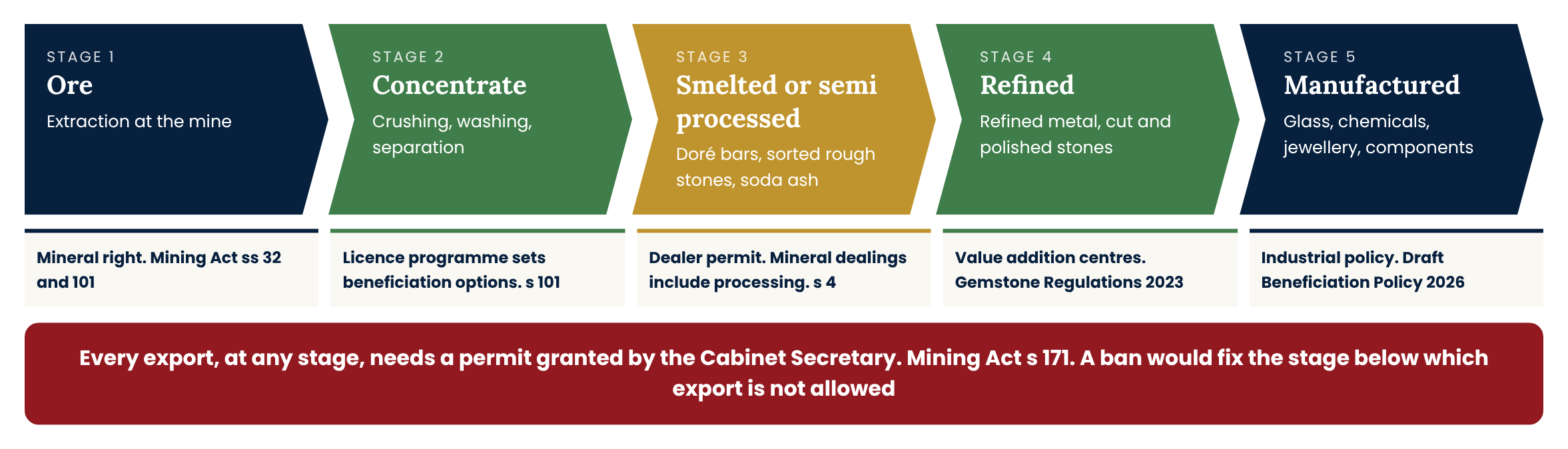
Figure 1. Mineral value chain, from ore to finished product, and where Kenyan law touches each stage
II. Foundational concepts
2.1 Beneficiation and value addition
Beneficiation is the processing of a mineral to increase its value, from crushing and concentration through smelting and refining to the manufacture of finished goods. Value addition is the wider idea of capturing more of the value chain at home, whether by processing, cutting and polishing, or manufacturing. The Mining Act uses both ideas. Its definition of mineral dealings includes cutting, polishing, processing, refining and treating minerals.5
2.2 Raw mineral
There is no statutory definition of a raw mineral. In ordinary usage it means ore or concentrate that has not been processed beyond the mine. The point matters because any ban must say where processing ends. A ban on raw gold may mean ore and concentrate, or it may also catch doré bars that have been smelted but not refined. A ban on raw gemstones may or may not catch stones that have been sorted and graded but not cut. A workable law must draw that line expressly for each mineral.
2.3 Export permit, export restriction and export ban
An export permit is an authorisation for a particular export. An export restriction limits exports, for example by quota, by duty or by a requirement of prior processing. An export ban prohibits the export of a product altogether. Kenya already operates the first. The policy announced in 2026 would add the second or the third.
III. Legal framework
3.1 Constitution
Minerals are public land, held by the national government in trust for the people of Kenya.6 The State must ensure sustainable exploitation of natural resources and the equitable sharing of the accruing benefits.7 Those provisions give a strong constitutional basis for a policy of beneficiation.
The Constitution also controls how such a policy is made. No person or body other than Parliament has power to make provision having the force of law in Kenya, except under authority conferred by the Constitution or by legislation.8 The national values in Article 10 include public participation, and Article 47 guarantees fair administrative action.9 General rules of international law and treaties ratified by Kenya form part of the law of Kenya.10
3.2 Mining Act
The Mining Act regulates export through a permit system. A person may export a mineral only under an export permit granted by the Cabinet Secretary, and applications are made to the Director of Mines.11 The Act does not itself prohibit the export of any class of mineral in raw form.
The Act encourages beneficiation in 3 ways. An applicant for a mining licence must submit a programme of mining operations that includes options for the beneficiation of minerals.12 A mineral agreement for a large investment may deal with the processing of minerals, whether wholly or partly in Kenya.13 The State also has a right of preemption over strategic minerals before they are sold.14 Each of these tools operates case by case. None is a general ban.
3.3 Regulations
The Mining (Dealings in Minerals) Regulations 2017 provide that a person shall not export a mineral unless that person holds a permit granted by the Cabinet Secretary.15 Only the holder of a mining licence, a mining permit or a dealer permit may apply.16 The application is made to the Director of Mines.17 The Regulations also govern the form and term of the permit and the records that exporters must keep.18 A separate set of regulations prescribes fees for gemstone identification and value addition at the Voi Gemstone Centre.19
Table 1. Present legal framework for mineral exports and beneficiation
| Instrument | What it does | Is it a ban? |
|---|---|---|
| Mining Act s 171 | Requires an export permit granted by the Cabinet Secretary for every export | No. It is a permit system |
| Mining Act s 101 | Requires licence applicants to set out options for beneficiation | No. It is a planning requirement |
| Mining Act s 117 | Allows mineral agreements to deal with processing in Kenya | No. It operates by agreement |
| Mining Act s 8 | Gives the State a right of preemption over strategic minerals | No. It gives a right to buy |
| Dealings in Minerals Regulations 2017, regs 18 to 23 | Set out eligibility, application and reporting for export permits | No |
| Draft Minerals, Mining and Beneficiation Policy 2026 | Proposes legislation for export restrictions and bans | Not yet. It is a draft policy |
3.4 International trade rules
Kenya is a member of the World Trade Organization. The General Agreement on Tariffs and Trade forbids prohibitions or restrictions on exports other than duties, taxes or other charges, subject to limited exceptions.20 The exceptions include measures temporarily applied to prevent or relieve critical shortages, and measures relating to the conservation of exhaustible natural resources if made effective in conjunction with restrictions on domestic production or consumption.21
Those exceptions have been read narrowly. The Appellate Body held that export restrictions imposed by China on raw materials, and later on rare earths, tungsten and molybdenum, were not justified under them.22 A panel reached a similar conclusion in 2022 on the ban by Indonesia on the export of nickel ore.23 These rulings do not stop a State from encouraging beneficiation. They mean that an outright ban is more exposed to challenge than an export duty, an incentive for local processing, or a condition negotiated in a mineral agreement.
IV. Decided cases
4.1 Rockland and directive of 2017
On 7 September 2017 the then Cabinet Secretary issued a directive on the processing of export permits. It required applications to be made to the Cabinet Secretary rather than to the Director of Mines, and it named only a small number of companies as licensed to deal in minerals.24 Rockland Kenya Limited, which mines gemstones in Taita Taveta, applied for an export permit in November 2020 and was told that the directive applied.25
In its ruling on interim relief, the High Court found that the company had an arguable case but declined to suspend the directive, because the company had not shown that it had applied to the Cabinet Secretary and been refused.26 In its final judgment in September 2023, the court found the directive constitutionally infirm.27 The case shows that an executive directive cannot alter a procedure set by statute and regulation, and that a party who challenges a directive should still seek the permit through every available route.
4.2 Mining Regulations 2024
On 10 September 2025 the High Court declared a group of mining regulations made in 2024, including amendments to the regulations on gemstone identification and value addition fees, unconstitutional and void for violating the constitutional principles on public participation.28 The judgment did not concern an export ban. It is relevant because any ban made by regulation will be tested against the same standard.
4.3 Magadi
On 29 July 2026 the Cabinet Secretary suspended all mining operations of Tata Chemicals Magadi Limited for failure to comply with the Mining Act.29 In September 2026 the President directed that soda ash should never be exported in raw form and that it must be processed in Kajiado County, and the Cabinet Secretary said that the government would advertise again for investors who would add value locally.30 The dispute over the suspension is before the courts, and nothing in this edition comments on its merits. It is the clearest example so far of the beneficiation policy being applied to a particular operation.

Figure 2. From directive to policy, 2017 to 2026
V. Policy of 2026
5.1 Announcements
The government set out the policy in a series of statements in 2026. In April the Cabinet Secretary told the Committee on Delegated Legislation that the Cabinet had resolved that no mineral shall be exported in its raw form.31 In the same month the President announced at a summit in Nairobi that minerals would be processed in Kenya before export.32 In September the President applied the policy to soda ash and announced plans to outlaw the export of unprocessed gold, with the Central Bank of Kenya as a priority buyer of locally refined gold.33 A gold refinery in Kakamega is reported to be under development rather than in commercial operation.34
5.2 Draft policy
The draft Minerals, Mining and Beneficiation Policy 2026 identifies the export of raw minerals as a major weakness of the mining economy. It proposes legislation to encourage domestic processing through measures that include export restrictions and bans, it identifies 14 minerals of strategic importance, and it aims to raise the contribution of mining to gross domestic product from about 1 per cent to 10 per cent by 2030.35 The State Department for Mining has said that the draft aligns Kenyan policy with the Africa Mining Vision, which encourages beneficiation before export.36
5.3 Legal status
As at the date of this edition, no Act of Parliament or published regulation imposing a general ban on the export of raw minerals has been identified. Commentators have noted that the announcements set a political direction but do not yet prove that a comprehensive ban is legally in force.37 Export permits continue to be governed by section 171 and the Dealings in Minerals Regulations.
A policy announced is a direction of travel. A prohibition with the force of law must still come from Parliament, or from a power that Parliament has given.
VI. Analysis
6.1 Legal routes to a ban
There are 3 possible routes. The first is an amendment to the Mining Act that prohibits or restricts the export of specified minerals in specified forms. That route is the most secure, because it rests directly on the legislative power of Parliament. The second is regulations made under the existing power of the Cabinet Secretary to regulate dealings and exports. That route is possible, but the regulations would have to fall within the power conferred, undergo public participation and be laid before Parliament for scrutiny.38 The Rockland litigation and the judgment of 2025 on the Mining Regulations 2024 show the cost of shortcuts. The third is the refusal of export permits case by case on the ground of policy. That route is the weakest. A permit system that is administered to achieve a ban that no law has enacted invites challenge under Article 47 and the Fair Administrative Action Act.39
6.2 Existing licences and contracts
A ban applied to existing operations raises further questions. A licence holder may have planned and financed its project on the basis that concentrate could be exported. Where a mineral agreement deals with processing, its terms will matter. Where the State has represented that exports would be allowed, the holder may argue legitimate expectation. These arguments do not prevent the State from changing the law. They do mean that a change should be prospective, should give a reasonable transition period, and should be accompanied by a realistic path to processing in Kenya.
6.3 Design of a lawful and effective measure
The experience of other States shows that the design of the measure decides much of its success. A measure should list the minerals and the stage of processing it requires. It should set a transition period that matches the time needed to build processing capacity. It should prefer instruments that are easier to defend under trade law, such as export duties, processing incentives and negotiated beneficiation obligations, over outright bans. Finally, it should be paired with steps against smuggling, because a ban on raw exports that cannot be enforced will divert minerals into illegal channels rather than into local refineries.40
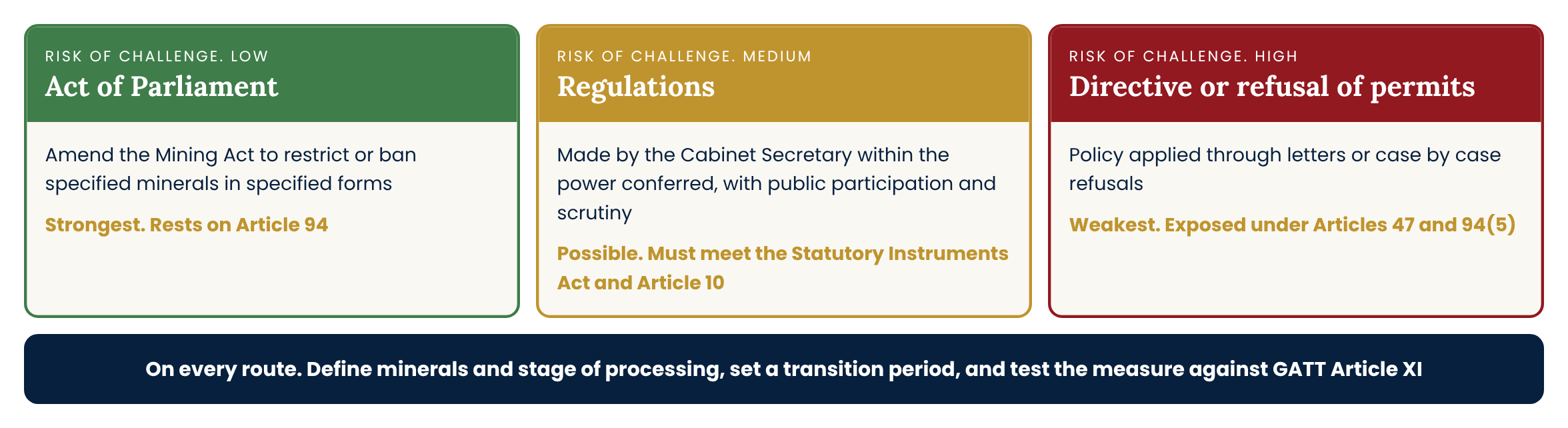
Figure 3. 3 legal routes to a restriction on raw mineral exports, and their exposure to challenge
Table 2. Legal questions raised by a ban on raw mineral exports
| Question | Present position |
|---|---|
| Is a general ban on raw mineral exports in force? | No general ban has been identified in an Act or published regulation as at 1 November 2026 |
| Can a ban be imposed by directive? | Not safely. Article 94(5) and the Rockland litigation point against it |
| Can a ban be imposed by regulation? | Possibly, if within the power conferred and made with public participation and parliamentary scrutiny |
| Does a ban comply with WTO rules? | It is exposed to challenge under Article XI of GATT unless an exception applies, which has been read narrowly |
| How would a ban apply to existing projects? | Depends on the instrument, the licence and any mineral agreement. A prospective rule with a transition period is easier to defend |
VII. Next round
7.1 Questions every exporter should answer
Table 3. Questions every exporter of minerals should be able to answer
| Question | Why it matters |
|---|---|
| Does the exporter hold a mining licence, mining permit or dealer permit? | Only those holders may apply for an export permit |
| Is every consignment covered by an export permit? | Section 171 requires it, and exports without a permit are unlawful |
| What does the licence, programme of operations or mineral agreement say about beneficiation? | Those documents may already contain processing obligations |
| Which minerals and forms would be caught by the announced policy? | A ban will turn on the stage of processing it requires |
| What processing capacity exists in Kenya for the mineral? | Without it, a ban halts exports rather than adding value |
7.2 What each party should do
Table 4. Practical guidance drawn from the law and the cases
| Party | What the law and the cases counsel |
|---|---|
| Exporters | Keep export permits current and records complete. Engage in public participation on any draft regulations. Plan for processing options now, and document the cost and time they require |
| Investors and lenders | Review licences and mineral agreements for beneficiation terms. Model the effect of a ban or duty on project economics, and seek clarity on transition before committing capital |
| The Ministry | Bring any restriction through an Act or properly made regulations. Define the minerals and processing stages, give a transition period, and prefer measures that comply with trade obligations |
| Parliament | Scrutinise any regulations closely for consistency with the Mining Act, Article 10 and international obligations |
VIII. Conclusion
The case for beneficiation is strong, and the Constitution supports it. The Mining Act already gives the State tools to promote processing, through licence programmes, mineral agreements and the export permit system. What the Act does not contain is a general ban on raw exports, and the policy announced in 2026 has not yet been turned into one.
Whether and how that happens will determine whether the policy endures. A ban enacted by Parliament, or made by regulation with full public participation and parliamentary scrutiny, defined mineral by mineral, phased in over a realistic period and backed by processing capacity, stands a good chance of surviving both domestic and international challenge. A ban imposed by directive or by the quiet refusal of permits does not. For exporters, the task is to comply with the law in force while preparing for the law to come. For the State, it is to make the change in the way the Constitution requires.
Benson Odiwuor is an Advocate of the High Court of Kenya based in Nairobi, whose practice focuses on dispute resolution in the regulated industries, including mining, oil and gas, banking and project finance. He is the editor of The BOLD, Benson Odiwuor’s Legal Digests, a legal newsletter on dispute strategies and legal developments in the regulated industries of Kenya. Subscribe to The BOLD here.
For inquiries, contact the author at info@bensonodiwuor.com.
References
- Constitution of Kenya 2010 art 69(1)(a). ↩
- ‘Kenya Bans Export of Raw Minerals, Introduces New Mining Royalty Sharing Rules’ The Kenya Times (Nairobi, April 2026) <https://thekenyatimes.com/national/kenya-bans-raw-mineral-exports-under-new-mining-rules/>. ↩
- ‘Ruto Directs CS Joho to Open Magadi Mining Industry to New Investors’ Citizen Digital (Nairobi, September 2026) <https://citizen.digital/article/ruto-directs-cs-joho-to-open-magadi-mining-industry-to-new-investors-n392855>; ‘Kenya Moves to Outlaw Raw Mineral Exports’ Africa Briefing (16 September 2026) <https://africabriefing.com/kenya-moves-to-outlaw-raw-mineral-exports/>. ↩
- ‘Kenya Moves to Outlaw Raw Mineral Exports’ (n 3); ‘Kenya Targets 10 Per Cent GDP Contribution from Mining under New 2026 Policy’ Eastleigh Voice (Nairobi, 2026) <https://eastleighvoice.co.ke/business/374256/kenya-targets-10-per-cent-gdp-contribution-from-mining-under-new-2026-policy>. ↩
- Mining Act 2016 (No 12 of 2016), now Cap 306 of the Laws of Kenya s 4 <https://new.kenyalaw.org/akn/ke/act/2016/12/eng@2022-12-31>. ↩
- Constitution of Kenya 2010 art 62(1)(f) and (3). ↩
- Constitution of Kenya 2010 art 69(1)(a). ↩
- Constitution of Kenya 2010 art 94(5). ↩
- Constitution of Kenya 2010 arts 10 and 47. ↩
- Constitution of Kenya 2010 art 2(5) and (6). ↩
- Mining Act 2016 s 171; ‘Four Companies on the Spot for Mining Salt Illegally’ Daily Nation (Nairobi, 2021) <https://nation.africa/kenya/business/companies/four-companies-on-the-spot-for-mining-salt-illegally-3440044>; Rockland Kenya Limited v Cabinet Secretary Ministry of Petroleum and Mining & another (Constitutional Petition E008 of 2021) [2021] KEHC 13595 (KLR) <https://new.kenyalaw.org/akn/ke/judgment/kehc/2021/13595/eng@2021-12-21>. ↩
- Mining Act 2016 s 101. ↩
- Mining Act 2016 s 117. ↩
- Mining Act 2016 s 8. ↩
- Mining (Dealings in Minerals) Regulations 2017 (LN 88 of 2017) reg 18 <https://new.kenyalaw.org/akn/ke/act/ln/2017/88/eng@2022-12-31>; ‘Four Companies on the Spot’ (n 11). ↩
- Dealings in Minerals Regulations 2017 reg 19; ‘Queries over KRA Role in Irregular Mineral Exports’ Business Daily (Nairobi, 2021) <https://www.businessdailyafrica.com/bd/markets/market-news/queries-over-kra-role-in-irregular-mineral-exports-3432230>. ↩
- Dealings in Minerals Regulations 2017 reg 20; Rockland (2021 ruling) (n 11). ↩
- Dealings in Minerals Regulations 2017 regs 21 to 23. ↩
- Mining (Gemstone Identification and Value Addition) (Fees) Regulations 2023 (LN 75 of 2023) <https://new.kenyalaw.org/akn/ke/act/ln/2023/75/eng@2023-08-04>. ↩
- General Agreement on Tariffs and Trade 1994 art XI:1. ↩
- GATT 1994 arts XI:2(a) and XX(g). ↩
- WTO, China: Measures Related to the Exportation of Various Raw Materials, Reports of the Appellate Body (30 January 2012) WT/DS394/AB/R, WT/DS395/AB/R, WT/DS398/AB/R; WTO, China: Measures Related to the Exportation of Rare Earths, Tungsten, and Molybdenum, Reports of the Appellate Body (7 August 2014) WT/DS431/AB/R, WT/DS432/AB/R, WT/DS433/AB/R. ↩
- WTO, Indonesia: Measures Relating to Raw Materials, Report of the Panel (30 November 2022) WT/DS592/R. ↩
- ‘Inside Muthama’s Court Battle for Gemstone Export’ Business Daily (Nairobi, 2018) <https://www.businessdailyafrica.com/bd/news/inside-muthama-s-court-battle-for-gemstone-export--2191902>; Rockland (2021 ruling) (n 11). ↩
- Rockland (2021 ruling) (n 11). ↩
- Rockland (2021 ruling) (n 11); ‘Muthama Firm Fails to Stop Gemstone Export Permits Directive’ Business Daily (Nairobi, January 2022) <https://www.businessdailyafrica.com/bd/economy/muthama-firm-fails-gemstone-export-permits-directive-3671436>. ↩
- Rockland Limited v Cabinet Secretary, Ministry of Petroleum & Mining & another (Constitutional Petition E008 of 2021) [2023] KEHC 22403 (KLR) <https://new.kenyalaw.org/akn/ke/judgment/kehc/2023/22403/eng@2023-09-21>. ↩
- Kenya Chamber of Mines v Cabinet Secretary, Ministry of Mining Blue Economy and Maritime Affairs [2025] KEHC 12697 (KLR). ↩
- ‘Joho Suspends Tata Chemicals Magadi Mining over Compliance Failures’ The Standard (Nairobi, 29 July 2026) <https://www.standardmedia.co.ke/counties/article/2001554023/joho-suspends-tata-chemicals-magadi-mining-over-compliance-failures>. ↩
- ‘Ruto Directs CS Joho’ (n 3). ↩
- ‘Kenya Bans Export of Raw Minerals’ (n 2). ↩
- ‘Ruto Bans Raw Mineral Exports as Kenya Pivots to Local Processing and Industrialisation’ Vivid Voice News (23 April 2026) <https://www.vividvoicenews.com/2026/04/23/ruto-bans-raw-mineral-exports-as-kenya-pivots-to-local-processing-and-industrialisation/>. ↩
- ‘Ruto Directs CS Joho’ (n 3); ‘Kenya Moves to Outlaw Raw Mineral Exports’ (n 3). ↩
- ‘Kenya Moves to Outlaw Raw Mineral Exports’ (n 3). ↩
- ‘Kenya Moves to Outlaw Raw Mineral Exports’ (n 3); ‘Kenya Targets 10 Per Cent GDP Contribution’ (n 4). ↩
- ‘Government Unveils New Mining Bills to Strengthen Governance, Safety and Value Addition’ (Kenya News Agency, 2026) <https://www.kenyanews.go.ke/government-unveils-new-mining-bills-to-strengthen-governance-safety-and-value-addition/>. ↩
- ‘Kenya Moves to Outlaw Raw Mineral Exports’ (n 3); ‘Kenya’s Raw-Mineral Ban Makes Value Addition the Test’ Fikiria (17 September 2026) <https://fikiria.cabanga.africa/kenya-s-raw-mineral-ban-makes-value-addition-the-test/>. ↩
- Statutory Instruments Act 2013 (No 23 of 2013) ss 5 and 11. ↩
- Fair Administrative Action Act 2015 (No 4 of 2015) s 7. ↩
- ‘Value Addition the Test’ (n 37). ↩