
Ministerial Powers to Suspend and Revoke Mining Rights in Kenya. Suspension by Letter
1 November 2026
A mining licence can be suspended or revoked, and in 2026 the power has been used by letter. The law answers 3 questions. When may the Cabinet Secretary act? What procedure must come first? Where and how can the decision be challenged? This edition answers each of them from the law and the decided cases.
| KEY POINTS AT A GLANCE A mineral right is a grant from the State, but it is not held at the pleasure of the Cabinet Secretary. The Mining Act allows suspension or revocation only on stated grounds, and only on the recommendation of the Mineral Rights Board. The grounds are failure to make a required payment on time, breach of a licence condition or statutory obligation, an offence under the Act, and a false statement in the application. Separate rules apply to failure to begin work and to default in paying royalties. Before a permit is suspended or revoked for failure to begin work, and before certain other licences are suspended or revoked, the Act requires written notice to comply within a reasonable time or to show cause. The Constitution and the Fair Administrative Action Act add the rights to notice, a hearing and written reasons in every case. The courts have upheld revocations of licences that were unlawfully issued, as in Cortec, and quashed suspensions made without the notice that the Act requires, as in a 2023 judgment on a gold mining licence in Nandi County. In July 2026 the Cabinet Secretary suspended all mining operations of Tata Chemicals Magadi by letter. In October 2026 the High Court declined jurisdiction over the challenge, holding that disputes about mining belong in the Environment and Land Court. The merits remain undecided. Every challenge to a ministerial decision now turns on 3 questions. Was the power exercised on a lawful ground? Was the required procedure followed? Was the challenge brought in the right court? |
I. Introduction
A mining licence is the most valuable asset most mining companies own in Kenya. It is the foundation for the capital they raise, the equipment they import, the people they employ and the royalties they pay. It is also a grant from the State, which retains the power to suspend or revoke it. How that power is exercised, and how it may be challenged, is therefore a question of the first importance for every operator, lender and investor in the sector.
The question has returned to prominence in 2026. On 29 July 2026 the Cabinet Secretary for Mining announced the immediate suspension of all mining operations by Tata Chemicals Magadi Limited, which has mined soda ash at Lake Magadi since 2005, until the company fully complies with the Mining Act and its regulations.1 The suspension was communicated by letter. The company went to the High Court, which declined jurisdiction in October 2026 on the ground that the dispute concerned mining and belonged in the Environment and Land Court.2 The merits of the suspension have not been decided, and nothing in this edition comments on them. The episode does, however, raise questions that every holder of a mineral right should be able to answer.
This edition of The BOLD answers them from the ground up. It begins with the nature of a mineral right and the range of tools available to the Ministry. It then sets out the statutory grounds and procedure for suspension and revocation, and the constitutional guarantee of fair administrative action. With that foundation in place, it examines the decided cases, from the revocations of 2013 to the judicial review of a suspension letter in 2023. It closes with the questions that any court will ask, and practical guidance for operators, lenders and the Ministry.
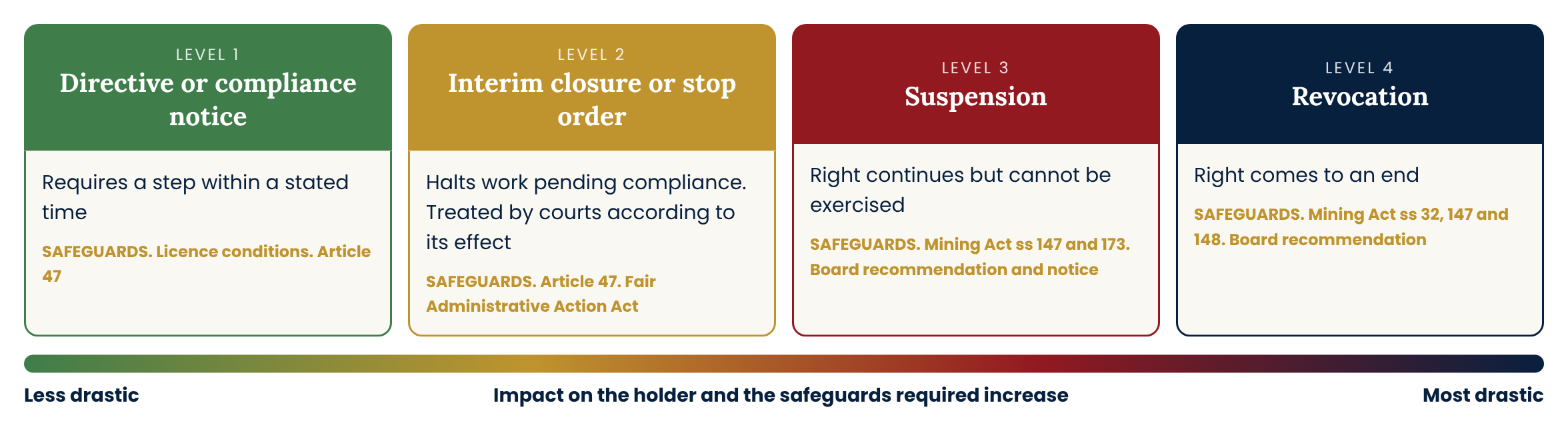
Figure 1. Ministerial tools over a mineral right, from directive to revocation, and the safeguards attached to each
II. Foundational concepts
2.1 Nature of a mineral right
All minerals in Kenya belong to the people of Kenya and are held by the national government.3 A mineral right is the instrument by which the State permits a private party to explore for or extract those minerals. It is granted by the Cabinet Secretary on the recommendation of the Mineral Rights Board, and it may be denied or revoked in the same way.4
A mineral right is created by statute, and its value depends on the statute. In the Cortec arbitration, the annulment committee described a mining licence as a piece of paper whose value, if any, lies exclusively in the consequences attached to it by Kenyan law.5 That observation cuts both ways. A licence obtained in breach of the law may carry no protection at all. A licence lawfully obtained carries all the protection that the law attaches to it, including the protection of the procedures that the law requires before it can be taken away.
2.2 Tools available to the Ministry
The Ministry has several tools for securing compliance, and they are often confused in public debate. Table 1 sets them out.
Table 1. Ministerial tools over a mineral right
| Tool | What it does | Legal basis |
|---|---|---|
| Directive or compliance notice | Requires the holder to take a step or remedy a breach within a stated time | Mining Act and regulations, and the conditions of the licence |
| Suspension | Stops the exercise of the mineral right for a period or until a condition is met. The right continues to exist | Mining Act s 147 and related provisions |
| Revocation | Brings the mineral right to an end, in whole or in part | Mining Act ss 32(1), 147 and 148 |
| Refusal of an application or renewal | Declines to grant or renew a right | Mining Act and Licence and Permit Regulations 2017 |
| Exclusion of an area | Excludes an area from operations under a mineral right | Mining Act, on the recommendation of the Mineral Rights Board |
The distinction between these tools matters because each carries different procedural requirements and different consequences. A suspension leaves the right in place but prevents its exercise. A revocation ends it. A directive may, in substance, operate as a suspension if it stops operations, and a court asked to review it will look at its effect rather than its label.
III. Legal framework
3.1 Grounds for suspension and revocation
Section 147 of the Mining Act sets out the general grounds. The Cabinet Secretary, on the recommendation of the Mineral Rights Board, may suspend or revoke a mineral right if the holder fails to make a payment required under the Act on the due date, fails to comply with a condition of the licence or an obligation under the Act, commits an offence under the Act, or has made or is found to have made a false statement in the application.6 The Cabinet Secretary may also suspend or revoke a prospecting or mining permit if the holder does not commence operations in accordance with the approved programme.7 Before suspending or revoking on that ground, the Cabinet Secretary must give the holder written notice requiring the holder to comply within a reasonable period or to show cause, within that period, why the right should not be suspended or revoked.8
The Act contains a parallel provision for certain licences and permits, which requires written notice to comply with the condition or obligation within a reasonable time or, where that is not possible, to show cause why the licence should not be suspended or revoked.9 It also contains a specific procedure for default in paying royalties, under which outstanding royalties are recorded in the cadastral register and the licence or permit is suspended, and, if royalties remain unpaid within the period prescribed, revoked.10 Subsidiary legislation adopts the same model. The regulations on mine support services, for example, require notice before suspension or revocation and give the licensee 30 days to remedy the breach or, where it cannot be remedied, to show cause.11
3.2 Role of the Mineral Rights Board
The Mineral Rights Board is central to the scheme. Its functions include advising and giving written recommendations to the Cabinet Secretary on the grant, rejection, renewal, suspension, revocation, variation, assignment and transfer of mineral rights, and on the cessation, suspension or curtailment of production under mining licences.12 Section 147 makes its recommendation a condition of the power to suspend or revoke. A decision taken without that recommendation is open to challenge on the ground that a mandatory statutory step was omitted.
3.3 Fair administrative action
The Constitution guarantees every person the right to administrative action that is expeditious, efficient, lawful, reasonable and procedurally fair. A person whose right is likely to be adversely affected by administrative action has the right to be given written reasons.13 The Fair Administrative Action Act gives effect to that right. It requires, among other things, that a person affected be given prior and adequate notice of the nature and reasons for the proposed action, an opportunity to be heard and to make representations, notice of any right of review or appeal, and a statement of reasons.14 The Act sets out the grounds on which a court may review administrative action, including that the decision maker acted without authority, failed to follow a mandatory procedure, was biased, acted for an improper purpose or acted unreasonably.15
These requirements apply to every suspension and revocation, whether or not the Mining Act itself specifies a notice period for the ground relied on. They also apply to directives that, in substance, stop operations.
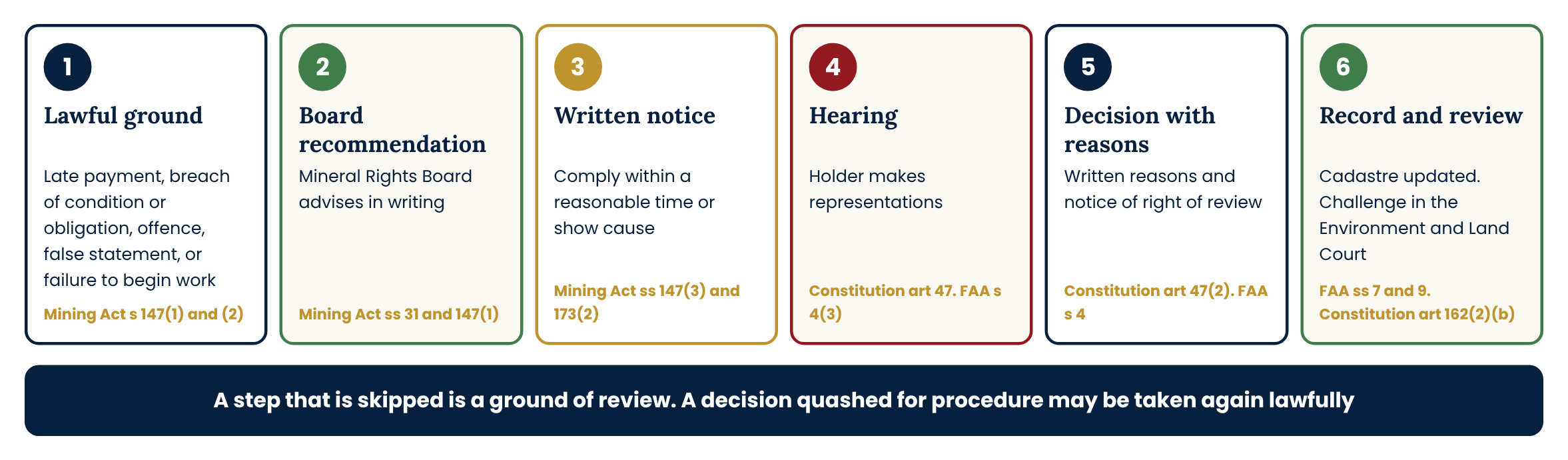
Figure 2. Lawful path to a suspension or revocation under the Mining Act and the Fair Administrative Action Act
IV. Decided cases
4.1 Revocations of 2012 and 2013
The modern law on ministerial power over mineral rights was shaped by the events of 2013. In late December 2012 the Minister for Environment and Mineral Resources cancelled 3 of 4 licences held by Base Resources over about 113 square kilometres in Kilifi County for non-performance. The company argued that the statute did not give the Minister power to revoke the licences, and the High Court suspended the decision pending a hearing.16
Later that year, on 5 August 2013, the newly appointed Cabinet Secretary for Mining revoked a special mining licence that had been granted to Cortec Mining Kenya over Mrima Hill in Kwale County.17 Cortec sought judicial review, arguing that the decision was unlawful, unreasonable and procedurally unfair.18 In March 2015 Justice Mutungi dismissed the application. He held that the Commissioner of Mines could not issue a proper licence over an area protected by the Kenya Forest Service without the consent of the National Museums of Kenya, and that the Cabinet Secretary had a duty to preserve the public interest.19 Cortec appealed to the Court of Appeal and, after losing in the Kenyan courts, took its claim to international arbitration, where the tribunal declined jurisdiction because the licence had been issued contrary to Kenyan law.20
Cortec establishes that the power to revoke is at its strongest where the licence was unlawful from the beginning. A licence that is void cannot found a claim to procedural protection of the kind that a lawful licence attracts, and a court will not order the reinstatement of a right that the law did not permit to be granted.
4.2 Suspension letter quashed
The position is different where a lawful licence is suspended without the procedure the Act requires. In January 2023 the Ministry issued a letter suspending a mining licence for gold, held over an underground mine in Nandi County, for 30 days.21 The holder sought judicial review. It argued that the letter contravened the statutory requirement that, before suspension, the Cabinet Secretary give written notice requiring the holder to comply within a reasonable time or, where that is not possible, to show cause why the licence should not be suspended.22 The Environment and Land Court found that the letter contravened the Act and that the holder had made out a case for the judicial review orders it sought.23
The judgment confirms that the notice requirement is not a formality. A suspension letter that arrives without a prior opportunity to comply or to show cause is vulnerable to being quashed, however serious the underlying concern.
4.3 Directives and additional requirements
The courts have applied the same reasoning to ministerial directives that affect the exercise of mineral rights. In Rockland (2023), a mining company challenged a directive of the Cabinet Secretary that imposed additional requirements for the processing of export permits. The High Court rejected the argument that only the Director of Mines, and not the Cabinet Secretary, could consider export applications. It held, however, that the additional requirements in the directive did not conform to Article 47 of the Constitution and the Fair Administrative Action Act, and declared them constitutionally infirm.24
The decision shows that the source of a power and the manner of its exercise are separate questions. The Cabinet Secretary may have power to act, and still act unlawfully if the action is taken without the procedural fairness that the Constitution requires.
4.4 Rejections and the cadastre
Disputes also arise where the Ministry treats a right as never having been validly granted. In the Bao Gold Hill dispute, the company contended that it had been granted a gold mining licence in Narok County in May 2021. The State contended that the Mineral Rights Board had recommended rejection of the application for failure to submit the required documents, that the Cabinet Secretary approved that recommendation in September 2024, and that a moratorium barred the issue of licences at the relevant time.25 In October 2025 the Environment and Land Court at Narok issued conservatory orders compelling the Ministry to reinstate the details and licence of the company on the mining cadastre, and the State sought a stay from the Court of Appeal.26 The dispute is pending, and this edition does not comment on its merits. It illustrates that the cadastre is not merely a record. Removal of a right from the register is an administrative act with immediate commercial consequences, and the courts will intervene to preserve the position where the lawfulness of that act is in genuine dispute.

Figure 3. Ministerial power over mineral rights in the courts, 2012 to 2026
V. Magadi suspension of 2026
5.1 What was announced
On 29 July 2026 the Cabinet Secretary announced the immediate suspension of all mining operations by Tata Chemicals Magadi Limited until the company fully complies with the Mining Act, its regulations and other applicable laws. The statement said that the decision followed years of engagement with the State Department for Mining over obligations under the Mining Act, the Mining (Licence and Permit) Regulations 2017 and the Mining (Royalty Collection and Management) Regulations 2024, and that several compliance issues remained unresolved.27 The issues reported included royalty reconciliation and payment, implementation of community development agreements, employment and skills transfer, local procurement and environmental compliance.28 The company stated that it had submitted all the information and documents requested, and that its mining operations had remained suspended since 28 July 2026 in observance of the directive, pending review by the Ministry.29
5.2 What the High Court decided
The company challenged the suspension in the High Court. As reported, it argued that it received no notice or invitation to be heard before the letter of 28 July 2026, and that the respondents had not identified the statutory provision that empowered them to suspend its operations. The government argued that the closure was an interim measure pending compliance rather than a suspension of the mineral right, so that the notice requirement for suspension did not apply.30
Justice Musyoka did not decide those arguments. He held that the dispute concerned mining and minerals, that Article 162(2)(b) of the Constitution establishes the Environment and Land Court for such disputes, and that Article 165(5) removes them from the jurisdiction of the High Court. He declined to transfer the matter, holding that a court without jurisdiction cannot make an order of transfer, and he therefore downed his tools.31
5.3 What the episode shows
The ruling settles nothing about the lawfulness of the suspension. It does show 3 things that every holder of a mineral right should note. First, the characterisation of a ministerial act matters. If an act that stops all mining operations is described as an interim closure rather than a suspension, the question whether the statutory notice requirement applies becomes a live issue. The constitutional and statutory rights to fair administrative action, however, apply to administrative action generally, whatever its label. Second, forum is decisive. A challenge filed in the wrong court may fail without any consideration of its merits, and time may be lost that cannot be recovered. Third, the dispute has since widened beyond the suspension, with public statements about the future of the resource and the entry of new investors.32 A holder whose operations are suspended should therefore assume that the commercial and political context will move faster than the litigation.
A power to suspend is a power to be exercised by law, not by letter alone.
VI. How a court will approach a challenge
6.1 Forum
After the decisions of 2026, the forum for a challenge to a ministerial decision on a mineral right is the Environment and Land Court. The High Court has held that it has no jurisdiction over mining and minerals.33 The Supreme Court has held that the Cabinet Secretary has no jurisdiction to determine alleged violations of the Constitution, which must go to the court.34 Where the Fair Administrative Action Act requires internal remedies to be exhausted first, the applicant must either exhaust them or show why the court should hear the matter directly.35
6.2 Grounds of review
Table 2 sets out the grounds on which a suspension, revocation or directive is most likely to be reviewed, and the authority for each.
Table 2. Grounds on which a ministerial decision on a mineral right is likely to be reviewed
| Ground | What the court will ask | Authority |
|---|---|---|
| Lawful ground | Does the decision rest on a ground that the Act permits, and is the ground made out on the evidence? | Mining Act s 147(1) |
| Mineral Rights Board | Did the Board make a recommendation, as the Act requires? | Mining Act ss 31 and 147(1) |
| Notice and opportunity to remedy | Was the holder given written notice to comply within a reasonable time or to show cause? | Mining Act ss 147(3) and 173(2). ML/2018/0049 judgment |
| Fair hearing and reasons | Was the holder heard and given written reasons? | Constitution art 47. Fair Administrative Action Act s 4 |
| Proportionality and reasonableness | Was the measure reasonable in light of the breach alleged, and were less drastic measures considered? | Fair Administrative Action Act s 7 |
| Validity of the original grant | Was the licence lawfully granted in the first place? | Cortec (HC) |
6.3 Remedies
Where the court finds that the decision was unlawful, it may quash it, prohibit its enforcement, compel the Ministry to act lawfully, or grant conservatory orders pending determination. It may also remit the matter to the Cabinet Secretary to be decided again in accordance with the law. A quashing order on procedural grounds does not prevent the Ministry from taking the same decision again after following the correct procedure. The practical value of a successful challenge therefore lies as much in the time and the opportunity to remedy that it secures as in the order itself.
VII. Next round
7.1 Questions every holder should answer
The Ministry has made clear that it intends to enforce the Mining Act more actively, including on royalties, community development, local content and value addition. Holders of mineral rights should expect more compliance notices, more directives and, where compliance does not follow, more suspensions. Table 3 sets out the questions that every holder should be able to answer before that happens.
Table 3. Questions every holder of a mineral right should be able to answer
| Question | Why it matters |
|---|---|
| Is the licence lawfully granted and correctly recorded on the cadastre? | A licence that was not lawfully granted attracts little protection, as Cortec shows |
| Are all payments, including royalties, up to date and reconciled with the Ministry? | Failure to pay on time is a ground for suspension and revocation |
| Are licence conditions, community development obligations and local content plans being met and documented? | Breach of conditions and obligations is a ground for suspension and revocation |
| Is there a complete record of correspondence with the Ministry? | The record will show whether notice was given and whether the holder responded |
| Who will act, and in which court, if a suspension letter arrives? | The challenge must be brought quickly and in the Environment and Land Court |
7.2 What each party should do
Table 4. Practical guidance drawn from the law and the decided cases
| Party | What the law and the cases counsel |
|---|---|
| Holders of mineral rights | Maintain a compliance file for each right, covering payments, conditions, community obligations and correspondence. Respond in writing to every compliance query within the time stated. If a suspension or directive arrives, seek the Board recommendation and reasons in writing, comply with any lawful requirement while reserving your position, and bring any challenge promptly in the Environment and Land Court |
| Lenders and investors | Verify the lawfulness of the grant and its record on the cadastre. Require borrowers to report compliance queries and directives immediately. Build the risk of suspension, and the time needed to challenge it, into financing terms |
| The Ministry | Obtain the recommendation of the Mineral Rights Board. Give written notice identifying the breach and allowing a reasonable time to comply or show cause. Give written reasons. Identify the statutory power relied on. Prefer the least drastic effective measure, and lift a suspension promptly once compliance is shown |
VIII. Conclusion
The power to suspend or revoke a mineral right is a necessary part of a regulatory system. Without it, the State could not enforce royalties, community obligations, environmental standards or the conditions on which rights are granted. The Mining Act therefore gives the Cabinet Secretary that power. It also confines it, by requiring a lawful ground, a recommendation of the Mineral Rights Board and, in the cases the Act specifies, written notice and an opportunity to comply or show cause. The Constitution adds, in every case, the rights to fair administrative action and written reasons.
The decided cases show the courts holding both sides to that bargain. They have upheld the revocation of a licence that should never have been granted, and they have quashed a suspension letter issued without the notice the law requires. The Magadi dispute, whatever its outcome, will add to that body of law once it reaches the right court. For holders, the lesson is to keep their own house in order and to know where to go when the letter arrives. For the Ministry, it is that a decision taken lawfully is a decision that will stand.
Benson Odiwuor is an Advocate of the High Court of Kenya based in Nairobi, whose practice focuses on dispute resolution in the regulated industries, including mining, oil and gas, banking and project finance. He is the editor of The BOLD, Benson Odiwuor’s Legal Digests, a legal newsletter on dispute strategies and legal developments in the regulated industries of Kenya. Subscribe to The BOLD here.
For inquiries, contact the author at info@bensonodiwuor.com.
References
- ‘Joho Suspends Tata Chemicals Magadi Mining over Compliance Failures’ The Standard (Nairobi, 29 July 2026) <https://www.standardmedia.co.ke/counties/article/2001554023/joho-suspends-tata-chemicals-magadi-mining-over-compliance-failures>; ‘Government Suspends Tata Chemicals Operations for Non-Compliance’ KBC (Nairobi, 29 July 2026) <https://www.kbc.co.ke/government-suspends-tata-chemicals-operations-for-non-compliance/>. ↩
- ‘Court Strikes Out Tata Chemicals Suspension Case’ The Standard (Nairobi, October 2026) <https://standardmedia.co.ke/business/national/article/2001560787/court-strikes-out-tata-chemicals-suspension-case>. ↩
- Constitution of Kenya 2010 art 62(1)(f) and (3); Mining Act 2016 (No 12 of 2016), now Cap 306 of the Laws of Kenya s 6 <https://new.kenyalaw.org/akn/ke/act/2016/12/eng@2022-12-31>. ↩
- Mining Act 2016 s 32(1). ↩
- ‘Cortec v Republic of Kenya: Cautionary Tale on Local Due Diligence for International Mining Projects’ Mondaq (2021) <https://www.mondaq.com/canada/mining/1108154/cortec-v-republic-of-kenya-cautionary-tale-on-local-due-diligence-for-international-mining-projects>. ↩
- Mining Act 2016 s 147(1). ↩
- Mining Act 2016 s 147(2). ↩
- Mining Act 2016 s 147(3). ↩
- Mining Act 2016 s 173(2); Judgment of the Environment and Land Court of 25 May 2023 on judicial review of the suspension of mining licence ML/2018/0049 [2023] KEELC 17889 (KLR) <https://new.kenyalaw.org/akn/ke/judgment/keelc/2023/17889/eng@2023-05-25>. ↩
- Mining Act 2016. ↩
- Mining (Mine Support Services) Regulations 2017 (LN 151 of 2017) <https://new.kenyalaw.org/akn/ke/act/ln/2017/151/eng@2022-12-31>. ↩
- Mining Act 2016 s 31(1). ↩
- Constitution of Kenya 2010 art 47(1) and (2). ↩
- Fair Administrative Action Act 2015 (No 4 of 2015) s 4(3). ↩
- Fair Administrative Action Act 2015 s 7. ↩
- ‘Miner Sues Mwakwere over Licences’ Business Daily (Nairobi, January 2013) <https://www.businessdailyafrica.com/bd/corporate/companies/miner-sues-mwakwere-over-licences--2022956>; ‘Licences Cancelled in Latest Snag to Hit Kenya Titanium Industry’ Engineering News (25 January 2013) <https://www.engineeringnews.co.za/article/licences-cancelled-in-latest-snag-to-hit-kenya-titanium-project-2013-01-25>. ↩
- Cortec Mining Kenya Limited v Cabinet Secretary Ministry of Mining & 9 others (ELC 195 of 2014) [2015] eKLR <http://kenyalaw.org/caselaw/cases/view/109485>; ‘UK Mining Firm to Pay Kenya Sh300 Million after Losing Licence Row’ Daily Nation (Nairobi, 2021) <https://nation.africa/kenya/business/uk-mining-firm-to-pay-kenya-sh300-million-after-losing-licence-row-3334138>. ↩
- Cortec (HC) (n 17). ↩
- Cortec (HC) (n 17); ‘Cortec Loses Mining Licence in Court Suit’ The Star (Nairobi, 21 March 2015) <https://www.the-star.co.ke/news/2015-03-21-cortec-loses-mining-licence-in-court-suit/>. ↩
- Cortec Mining Kenya Limited v Cabinet Secretary Ministry of Mining & 9 others (Civil Appeal 105 of 2015) [2017] KECA 515 (KLR) <https://new.kenyalaw.org/akn/ke/judgment/keca/2017/515/eng@2017-06-09>; ‘UK Mining Firm to Pay Kenya Sh300 Million’ (n 17). ↩
- ML/2018/0049 judgment (n 9). ↩
- ML/2018/0049 judgment (n 9). ↩
- ML/2018/0049 judgment (n 9). ↩
- Rockland Limited v Cabinet Secretary, Ministry of Petroleum & Mining & another (Constitutional Petition E008 of 2021) [2023] KEHC 22403 (KLR) <https://new.kenyalaw.org/akn/ke/judgment/kehc/2023/22403/eng@2023-09-21>. ↩
- Attorney General & 2 others v Bao Gold Hill Kenya Limited (Civil Appeal (Application) E125 of 2025) [2025] KECA 2168 (KLR) <https://new.kenyalaw.org/akn/ke/judgment/keca/2025/2168/eng@2025-12-10>; ‘State, China Firm Narok Goldfields Row Escalates’ Business Daily (Nairobi, 2025) <https://www.businessdailyafrica.com/bd/corporate/companies/state-china-firm-narok-goldfields-row-escalates-5318646>. ↩
- Bao Gold Hill Kenya Limited v Attorney General & 2 others (Environment and Land Petition E002 of 2025) [2025] KEELC 6786 (KLR) <https://new.kenyalaw.org/akn/ke/judgment/keelc/2025/6786/eng@2025-10-07>; ‘State, China Firm Narok Goldfields Row Escalates’ (n 25); Bao Gold Hill (CA) (n 25). ↩
- ‘Joho Suspends Tata Chemicals Magadi Mining’ (n 1); ‘Government Suspends Tata Chemicals Operations’ (n 1). ↩
- ‘Government Suspends Tata Chemicals Operations’ (n 1); ‘Lake Magadi: Inside Ruto’s Plan to Bring 4 Investors after Ordering Tata Chemicals to Pack Up and Leave’ People Daily (Nairobi, October 2026) <https://peopledaily.digital/insights/lake-magadi-inside-rutos-plan-to-bring-4-investors-after-ordering-tata-chemicals-to-pack-up-and-leave>. ↩
- ‘Tata Chemicals Magadi Says It Has Met Government Demands amid Mining Shutdown’ Kenyans.co.ke (Nairobi, August 2026) <https://www.kenyans.co.ke/news/126306-tata-chemicals-magadi-says-it-has-met-government-demands-amid-mining-shutdown>. ↩
- ‘Court Strikes Out Tata Chemicals Suspension Case’ (n 2). ↩
- ‘Court Strikes Out Tata Chemicals Suspension Case’ (n 2). ↩
- ‘Lake Magadi’ (n 28). ↩
- ‘Court Strikes Out Tata Chemicals Suspension Case’ (n 2). ↩
- Base Titanium Limited v Michael Kiswili & 3 others (SC Petition E040 of 2025) (Supreme Court of Kenya, 15 May 2026), Media Summary <https://supremecourt.judiciary.go.ke/wp-content/uploads/2026/06/Base-Titanium-Limited-v-Michael-Kiswili-and-3-others-SC-Petition-No.-E040-of-2025-Media-Summary-15th-May-2026-.pdf>. ↩
- Fair Administrative Action Act 2015 s 9. ↩