
Restraint of Trade in Employment in Kenya and South Africa: Non Compete Clauses, Garden Leave and the Price of Moving On
10 November 2026
Employees leave. They resign for better pay, they are dismissed, their contracts expire, or the business that employs them is sold. When they go, they take with them the skill and experience they have built, and often the trust of customers and colleagues. Employers respond by asking employees to sign restraints of trade, which limit what a departing employee may do, for whom and where, for a period after the employment ends.
Every restraint of trade dispute turns on 3 questions. What does the employer genuinely need to protect? Does the restraint go no further than that interest requires? How did the employment end? This edition answers each of them from the statutes and the decided cases of both countries.
| KEY POINTS AT A GLANCE A restraint of trade in employment is a promise by an employee not to compete with the employer, solicit its customers or staff, or use its confidential information after the employment ends. Non compete, non solicitation and confidentiality clauses are the common forms. In Kenya the Contracts in Restraint of Trade Act (Cap 24) provides that such a clause is not void only because it restrains trade, but allows the court to declare it void if it is not reasonable in the interest of the parties or of the public. Section 3 makes the clause void where the employer ends the employment in breach of the contract of service. Kenyan courts examine restraints closely. They refused to enforce a 12 month clause in Mwaura v Taxify in 2023 and a 2 year clause with no territory in Sunrise Virtual Schools v Korir in 2026, but enforced a 6 month clause against a lecturer who resigned in Excel Global v Kithinji in 2025. In South Africa a restraint is valid and enforceable unless it is shown to be unreasonable and so contrary to public policy. The courts apply the 4 questions in Basson v Chilwan, and make a value judgment on the facts. In Backsports v Motlhanke the Labour Appeal Court held, in reasons delivered in October 2025, that dismissal for misconduct did not prevent the employer from enforcing the restraint, because a restraint generally operates whatever the reason for termination unless the dismissal was fraudulent or in bad faith. This is the sharpest difference between the 2 systems, because in Kenya a termination in breach of contract voids the restraint by statute. Every restraint dispute turns on 3 questions. What does the employer genuinely need to protect? Does the restraint go no further than that interest requires? How did the employment end? |
I. Introduction
The law has always been uneasy with these clauses. A restraint protects investment in customer relationships and confidential information, and it holds a person to a promise freely made. But it also stops a person from earning a living with the only skills they have, and it shields an employer from fair competition. Every legal system that recognises restraints must decide where the balance lies.
Kenya and South Africa answer the question differently. Kenya has a short statute from 1932 that keeps restraints alive but subjects them to review by the court, and its modern courts, concerned with unemployment and unequal bargaining power, have refused to enforce broad clauses. South Africa has no statute. Its courts start from the principle that agreements must be honoured, while testing whether the restraint protects a genuine interest.
This edition of The BOLD, the first in its Employment Disputes Series, explains the law of restraint of trade in employment in both countries, from the common law foundations to the decisions of 2025 and 2026. It is built on the statutes and the judgments themselves. It examines the statutory and constitutional frameworks, the tests the courts apply, the interests they will protect, the effect of the way employment ends, and the relationship between restraints and garden leave. It closes with answers to the questions employers and employees ask most often and with practical guidance on drafting and enforcement. It takes no position on any matter pending before a court.
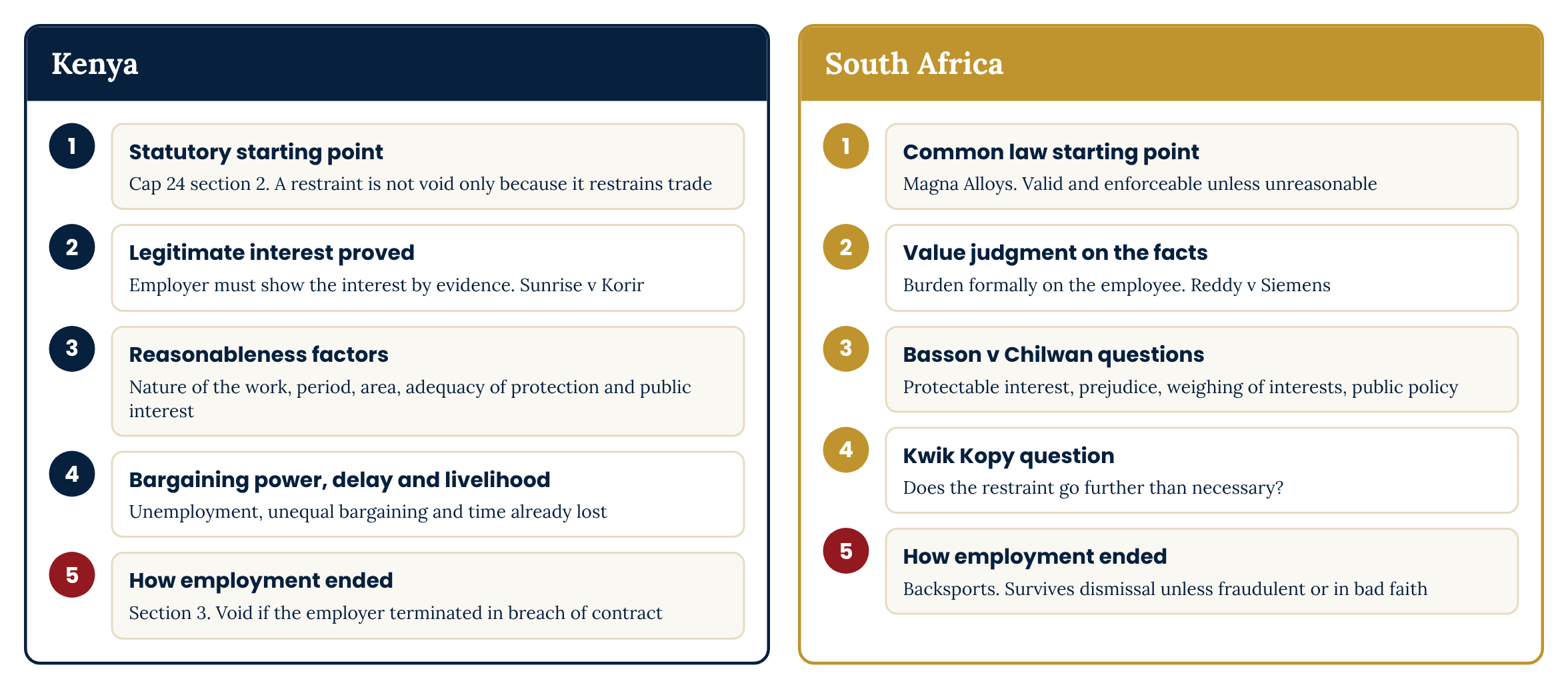
Figure 1. How courts in Kenya and South Africa decide whether to enforce a restraint
II. Foundational concepts
2.1 What a restraint of trade is
A restraint of trade is a contractual provision that limits the freedom of a person to carry on a trade, profession or occupation. In employment it usually takes one or more of 4 forms.
- A non compete clause prevents the former employee from working for, or setting up, a competing business for a period and within an area.
- A non solicitation clause prevents the former employee from approaching the customers of the employer to take their business, or from enticing its employees to leave.
- A non dealing clause goes further and prevents the former employee from doing business with those customers even if they approach the employee first.
- A confidentiality clause prevents the use or disclosure of confidential information. It restrains trade only indirectly, and it usually survives the end of employment without a time limit.
A garden leave clause is different. It applies during the notice period, while the contract still exists. The employer keeps paying the employee but tells the employee not to work, so that the employee is kept away from customers and current information before joining a competitor. Garden leave is examined in Part VI.
2.2 Why the law intervenes
Two public policies pull in opposite directions. The first is that agreements freely made should be honoured. The second is that every person should be free to work and that the economy benefits from competition. The Supreme Court of Appeal of South Africa has described the enquiry into reasonableness as a value judgment that weighs these 2 considerations.1 The common law resolved the tension by allowing restraints that protect a legitimate interest and go no further than is reasonably necessary to protect it, while refusing to enforce restraints that merely suppress competition.
2.3 The English foundations
Both Kenya and South Africa absorbed the English law of restraint, although South Africa later departed from it. In Nordenfelt the House of Lords held that restraints are contrary to public policy and void unless they are reasonable in the interests of the parties and of the public.2 In Mason the House distinguished restraints imposed on employees from those accepted by the seller of a business, and held that the former are scrutinised more strictly because the employee usually has less bargaining power.3 In Herbert Morris v Saxelby it held that an employer may protect its trade secrets and its connection with customers, but not its interest in avoiding competition, and that an employee may freely use the general skill and knowledge acquired in employment.4
These 3 decisions still frame the debate. The question is always what interest the employer is entitled to protect, and whether the restraint goes further than that interest requires.
III. The Kenyan framework
3.1 The Contracts in Restraint of Trade Act
Kenya received the common law and equity through the Judicature Act, which directs the courts to apply them so far as the written law does not extend to the matter.5 In restraint of trade, the written law does extend. The Contracts in Restraint of Trade Act, enacted as Act No 40 of 1932 and in force since 31 December 1932, is now Chapter 24 of the Laws of Kenya.6 It has 3 sections.
Section 2 provides that an agreement which restrains a party from exercising any lawful profession, trade, business or occupation "shall not be void only on the ground that the provision or covenant is therein contained". A proviso then gives the court power to declare the restraint void where it is satisfied that, having regard to the nature of the profession, trade, business or occupation, the period and area within which the restraint applies, and all the circumstances of the case, the restraint is not reasonable. It is not reasonable in the interest of the parties if it "affords more than adequate protection to the party in whose favour it is imposed", and not reasonable in the interest of the public if it is "injurious to the public interest".7
Section 3 contains a rule that has no general equivalent in South African law. Notwithstanding section 2, a restraint "shall be void in any case where an employer terminates the services of an employee in contravention of the terms of the contract of service".8 An employer that dismisses an employee without the notice the contract requires, or otherwise in breach of it, therefore loses the benefit of the restraint. Where the employee resigns, section 3 is not engaged.9
3.2 What the statute changes and what it does not
The Act does not make restraints enforceable as a matter of course. It removes the old rule that a restraint is prima facie void, and leaves the court to judge reasonableness. In Credit Reference Bureau v Kunyiha, Abuodha J observed that, "unlike other ordinary contracts where the sanctity of the contract is to be observed", the Act empowers the court "to second guess what the parties have agreed on to restrain".10 The statutory factors, which are the nature of the occupation, the period, the area, the adequacy of the protection and the public interest, track the common law enquiry closely.
3.3 The constitutional setting
The Constitution of Kenya bears on restraints in 2 ways. Article 41 guarantees every person the right to fair labour practices, and employees invoke it against restraints that would keep them out of work.11 In LG Electronics v Kimari the High Court held that a restraint would be unconstitutional only if it failed to meet the limits imposed by section 2 of the Act.12
Article 40 protects the right to property. In Jovet v Bavaria the Supreme Court held in May 2025 that goodwill is a form of property capable of protection under Article 40.13 That case concerned a distributor, not an employer, and the appellant obtained no relief. But the holding gives employers a constitutional footing for the argument that customer goodwill is an interest the law should protect, and it is likely to be cited in future restraint disputes.
3.4 Which court decides
The Act gives the power to declare a restraint void to the High Court. Since 2010, however, Article 162(2)(a) of the Constitution has required Parliament to establish a court with the status of the High Court to hear disputes relating to employment and labour relations, and Article 165(5)(b) denies the High Court jurisdiction over those matters.14 The Employment and Labour Relations Court is that court. It is a superior court of record with the status of the High Court, and it has jurisdiction over disputes relating to or arising out of employment between an employer and an employee.15
The Employment and Labour Relations Court has held that the reference to the High Court in the Act includes it, by virtue of Article 162(2)(a).16 Applications are now brought expressly under section 2 of the Act and section 12 of the Employment and Labour Relations Court Act.17 Older decisions such as LG Electronics v Kimari in 2012 and Bridge International Academies v Ombati in 2015 were decided in the High Court.18 The High Court remains the forum for restraints in commercial agreements, such as the sale of a business or a distribution agreement, where no employment relationship is in issue.
3.5 The burden of proof and interim relief
The wording of section 2 suggests that the party who asks the court to declare a restraint void must satisfy the court that it is unreasonable. In practice the question usually arises on an application by the employer for an injunction. The employer must then show a prima facie case with a probability of success, that damages would not adequately compensate it, and, if the court is in doubt, that the balance of convenience favours relief.19 In Sunrise Virtual Schools v Korir the court went further and stated that the burden of proving the reasonableness of a restraint lies on the employer, and that a restraint will not be upheld where the employer fails to show a particular legitimate proprietary interest.20 Whatever the formal position, an employer seeking to enforce a restraint in Kenya must come with evidence.
IV. Kenyan decisions
4.1 Time already lost and unemployment
2 early decisions show a pattern. In LG Electronics v Kimari a marketing manager resigned and, after a short spell elsewhere, joined Samsung, a direct competitor, in breach of a 12 month restraint covering Kenya.21 The court found that his duties did not prima facie involve confidential information, and that the fears of the employer were speculative.22 7 months had passed since he left. The court reasoned that any damage had largely been suffered, and that enforcement would remove him from work for 5 months with no guarantee that he would find work again, adding that "in a country like Kenya where unemployment is soaring every single day, subjecting the Defendant to loss of employment on the basis of the restrictive clause would be unreasonable and not in the interest of either party".23 The injunction was refused.24
In Credit Reference Bureau v Kunyiha the chief executive of a credit reference bureau resigned and joined a competitor within days. His contract barred him for 12 months from working for competitors and from sharing confidential information with them.25 The court found that the employer had not shown the nature of the secrets to which he had access or how he was likely to use them, that about 7 months had passed, and that experience and skill gained at work cannot be restrained.26 It declined the injunction.27
The lesson is practical. An employer that waits, or that cannot identify the information it wants protected, will struggle in Kenya.
4.2 Mwaura v Taxify
Mwaura v Taxify is the leading recent judgment. The claimant was employed from 1 November 2016 under a 2 year fixed term contract. A separate agreement dated 6 November 2017 barred him from competing with the respondent for 12 months after his employment ended. On 31 January 2019 the parties signed a deed of mutual separation, and he later joined a competitor within the 12 months.28
Manani J held the clause unenforceable as unreasonable, against the public interest and unconscionable.29 The court was reluctant to enforce a clause presented to an employee together with the contract of employment, when the employee had little real choice.30 The clause was not limited to protecting specific interests of the employer such as its trade secrets, and so went beyond legitimate protection.31 The employer produced no evidence that the claimant had passed on any trade secret, and the court refused to let it raise the point for the first time in closing submissions.32 Its counterclaim for compensation under the clause failed.33
2 features of the judgment deserve emphasis. First, the clause failed on its scope and purpose, not on its length alone. A 12 month clause tied to identified trade secrets or customers might have survived. Second, the court noted that a restraint becomes inoperative under section 3 where the termination of employment by the employer is irregular, but that rule did not decide the case, because the employment ended by mutual agreement.34
4.3 Restraints that have been enforced
Kenyan courts do enforce restraints that are tied to a real interest. In Bridge International Academies v Ombati a former manager was bound not to operate a school within a set radius of the schools of his former employer for 2 years after termination. The ruling refers to the radius as 5 kilometres in one place and 2 kilometres in another.35 The court found that a partial restraint "would be reasonable in order to forestall any further loss".36 It declined to stop the manager from operating his school, which was already running, and instead restrained him until the hearing of the suit from soliciting the staff, parents and pupils of one academy of his former employer within the 2 year period.37 The court protected the customer connection, not the market.
In Excel Global v Kithinji a lecturer at a college resigned on 1 month of notice, which took effect on 2 January 2025, and joined another college in the same industry, within walking distance, 4 days later. His contract barred him from working in education at an institution offering the same courses for at least 6 months after leaving.38 Manani J noted that courts are often reluctant to enforce non compete agreements unless the parties enjoyed equality of bargaining power and the agreement is not inimical to the public interest.39 Because the lecturer had resigned, section 3 did not apply. He did not respond to the application, so there was no material to suggest that he had bargained from a position of disadvantage or that the clause was unreasonable, and the court upheld it.40 It granted temporary injunctions against his employment with the competitor, against soliciting the clients of the employer and against using its confidential information, to lapse at the end of the 6 months on 2 July 2025.41
4.4 Restraints that have failed
In Sunrise Virtual Schools v Korir the operations manager of a virtual school registered a competing school while still employed, and was later dismissed for gross misconduct. His contract, although called a consultancy agreement, was found to be a contract of employment, and it barred him for 2 years from competing or working for a competitor.42 Nzei J described the clause as bare. It stated no territory, identified no proprietary interest, and the employer had not shown that its business model was its own.43 The court held that a restraint, even where reasonable, cannot be said to cover the entire Republic of Kenya without proof of where the businesses operate, and that a restriction of 2 years after employment was unreasonable "even where a legitimate proprietary interest is found to exist".44 It also noted an arbitral award, considered by the High Court, that treated the right to work as a constitutional right.45 The injunction was refused, and the court added that the employer had not shown that damages would be inadequate.46
Table 1. Selected Kenyan restraint decisions
| Decision | Restraint | Outcome |
|---|---|---|
| LG Electronics v Kimari (2012) | 12 months, competitors in Kenya | Injunction refused. No confidential information shown and 7 months already passed |
| Bridge International Academies v Ombati (2015) | 2 years, radius around the schools of the employer | Restrained only from soliciting staff, parents and pupils |
| Credit Reference Bureau v Kunyiha (2017) | 12 months, competitors and confidential information | Injunction refused. Secrets not identified and 7 months already passed |
| Mwaura v Taxify (2023) | 12 months, competing business | Unenforceable as unreasonable and unconscionable |
| Excel Global v Kithinji (2025) | 6 months, education sector | Enforced by temporary injunction after resignation |
| Sunrise Virtual Schools v Korir (2026) | 2 years, no territory | Injunction refused. No proprietary interest shown and 2 years unreasonable |
4.5 Lessons from the Kenyan cases
The Kenyan decisions yield 5 working rules. A restraint must protect a specific interest, such as identified confidential information or customer connections, and the employer must prove that interest with evidence. A restraint that keeps the employee out of the industry altogether, or that has no territorial limit, is unlikely to survive. Short periods are more likely to be enforced than long ones, and a period of 2 years has been held unreasonable. The employer must act quickly, because time lost before the hearing counts against it. And the employer must have ended the employment in accordance with the contract, or section 3 will void the restraint.
V. The South African framework
5.1 Magna Alloys and the reversal of the English rule
South Africa has no statute on restraints. Until 1984 its courts followed the English rule that a restraint is prima facie void. In Magna Alloys the Appellate Division rejected that approach and held that a restraint is valid and enforceable unless it is unreasonable and therefore contrary to public policy.47 Courts applying Magna Alloys place on the party resisting the restraint the burden of showing that it is unreasonable. In Atlas 360 in 2025, for example, the Labour Court enforced a restraint because the former employee "has not discharged the onus of proving that the restraint is unreasonable, and contrary to public policy".48 The court may also enforce a restraint in part, limiting it to what is reasonable, rather than refusing it altogether.49
5.2 The Basson v Chilwan questions
Reasonableness is assessed through 4 questions formulated by Nienaber JA in Basson v Chilwan, in a judgment written in Afrikaans.50 In the English form in which the Labour Appeal Court has restated them, they ask the following.51
- Is there an interest of the one party which is deserving of protection at the termination of the agreement?
- Is such interest being prejudiced by the other party?
- If so, does such interest so weigh up qualitatively and quantitatively against the interest of the latter party that the latter should not be economically inactive and unproductive?
- Is there another facet of public policy having nothing to do with the relationship between the parties, but which requires that the restraint should either be maintained or rejected?
Basson itself shows the questions at work. The restraint barred the appellant for 5 years from working for or assisting any business in southern Africa that manufactured, refurbished or distributed buses or coaches. The majority, led by Nienaber JA, allowed the appeal and refused to enforce it. Eksteen JA, in the minority, would have kept part of the order.52 In Kwik Kopy the court added a fifth question, which is whether the restraint goes further than necessary to protect the interest.53
5.3 The Constitution, the burden and Reddy v Siemens
The South African Constitution gives every citizen the right to choose a trade, occupation or profession freely, and allows the practice of a trade, occupation or profession to be regulated by law.54 After 1994 employees argued that this right required the burden of proof to shift to the employer.
In Reddy the Supreme Court of Appeal was asked to decide that question and declined. It recorded that the challenge was restricted to where the onus lies, and said "we are not called upon to decide that issue".55 It held that on application papers, where disputed facts are resolved in favour of the employee, the reasonableness of the restraint calls for "a value judgment, rather than a determination of what facts have been proved", so that "the incidence of the onus accordingly plays no role".56 The Labour Appeal Court has since applied Reddy in the same way. If the facts, with disputes resolved in favour of the employee, show that the restraint is reasonable, the employer succeeds, and if they show that it is unreasonable, the employee succeeds.57 In Labournet the Labour Appeal Court noted that the constitutional right to choose a trade may have affected the common law onus, and that Reddy had avoided the question.58
The position, therefore, is that the burden formally rests on the party resisting the restraint, but in most urgent applications the outcome turns on a value judgment on the facts.
5.4 Protectable interests
South African courts recognise 2 categories of protectable interest. The first is confidential information that would give a competitor a relative competitive advantage. The second is the trade connection of the business, meaning its relationships with customers, suppliers and others, which forms part of its goodwill.59 In Labournet the Labour Appeal Court said that "a restraint is only reasonable and enforceable if it serves to protect an interest", and that "the employee cannot be interdicted or restrained from taking away his or her experience, skills or knowledge".60 It dismissed the appeal of the employer, because genuine disputes of fact about the access of a junior employee to confidential information and his influence over clients had to be resolved in his favour, and the employer had conceded that its 3 year restraint was unreasonable.61
The interest must belong to the employer. In Automotive Tooling the Supreme Court of Appeal held that it must be one that might properly be described as belonging to the employer rather than to the employee, and that a restraint which "merely seeks to exclude or eliminate competition" is unenforceable.62 The know how of the skilled toolmakers in that case formed part of their general stock of skill and knowledge, so the employer had no protectable interest and the restraint was contrary to public policy.63
The employer need not prove that confidential information has been used. In Reddy the court held that the restraint was enforceable because the employee possessed confidential information and, at the competitor, "the opportunity to disclose confidential information at his disposal, whether deliberately or not, will exist". It added that "it is not that the mere possession of knowledge is sufficient".64
5.5 Forum and urgency
The Labour Court has concurrent jurisdiction with the civil courts over any matter concerning a contract of employment, so employers may bring restraint applications in either the Labour Court or the High Court.65 Once it has jurisdiction over the restraint, the Labour Court may also grant related relief, such as an interdict against threats to staff and property.66 Restraint disputes are accepted as inherently urgent, but an employer must account for any delay between learning of the breach and approaching the court.67
VI. Recent South African decisions
6.1 Garden leave in Vodacom v Motsa
Vodacom v Motsa was the first South African judgment to consider the relationship between garden leave and a restraint.68 Mr Motsa, a senior executive, resigned on 23 December 2015 to join the MTN Group. His contract required 6 months of notice, during which Vodacom could place him on garden leave, followed by a 6 month restraint. He argued that Vodacom had elected to pay him in lieu of notice, so that his employment had ended at once.
Van Niekerk J held that Vodacom had not waived the notice period, so that the employment would end on 30 June 2016 and the restraint would run from 1 July to 31 December 2016. The court declined to follow the view in Credit Suisse v Armstrong that garden leave and restraints are ordinarily unrelated, and adopted the approach of the New Zealand Employment Court in Air New Zealand v Kerr, that garden leave must be considered in assessing a restraint.69 It held that "any period of enforced commercial inactivity prior to the termination of employment is relevant", and that the combined period of about 12 months was not unreasonable for an executive with access to confidential and strategic information.70 An employer cannot stack a long garden leave on a long restraint without justifying the total.
6.2 Dismissal and the restraint in Backsports v Motlhanke
Backsports v Motlhanke concerned a senior stream lead in a broadcasting and streaming business, employed from 1 January 2024. His contract restrained him for 12 months after termination, in every province of South Africa, from competing and from enticing employees of the group to leave.71 He was found guilty of misconduct after a disciplinary hearing and dismissed on 16 October 2024. He referred an unfair dismissal dispute to the Commission for Conciliation, Mediation and Arbitration, but abandoned it.72 The employer then learnt that he had approached its employees and customers, and that he had provided streaming services at an event of one of its customers.73
On 18 February 2025 Makhura J refused relief in the Labour Court. The judge found that the employer had not shown that the employee had access to confidential information or used trade connections to its prejudice. The judge also held that it would be an unjustified limitation to enforce the restraint against an employee the employer had dismissed, and that by dismissing him the employer had "waived its right to enforce the restraint".74
The Labour Appeal Court heard an urgent appeal on 30 July 2025, upheld it on the same day, and gave its reasons on 27 October 2025.75 Djaje AJA, for the court, held that the Labour Court had departed from the binding decision of the Appellate Division in Reeves. In Reeves the court held that the circumstances in which employment ends are irrelevant to the operation of a restraint expressed to apply when employment ceases for any reason, subject to an exception where the dismissal is fraudulent or otherwise wilful and in bad faith, such as where an employee is hired and fired with the sole object of imposing a restraint.76 The restraint in Backsports referred only to the termination date. The employee did not suggest that his dismissal was fraudulent, he had pleaded guilty to the charges, and he had abandoned his unfair dismissal dispute. The dismissal was therefore "irrelevant to the enforcement of the restraint of trade agreement", and the finding of waiver was "a clear misdirection".77
The court also held that the employer had proved the contract and its breach, because the employee had approached its customers about business and urged its employees to work with him.78 The relief it granted is important. The court did not stop the employee from working in his field. It restrained him, for the remainder of the restraint period, from soliciting work from named customers of the employer and from soliciting its employees, and it interdicted threats against staff and damage to equipment.79 The judgment is marked not reportable, but it applies binding authority, and its reasons on dismissal reflect Reeves.
6.3 Other decisions of 2024 and 2025
In SMD Technologies v Tavares a key account manager resigned on 6 September 2024 after almost 5 years and joined a direct competitor. Her restraint applied for 12 months throughout South Africa.80 She had daily access to pricing, costing, margins and client data, and she was the point of contact for major retail customers.81 Baloyi AJ accepted that 12 months was justified, because the information needed time to lose its value, the employer planned pricing at least 6 months ahead, and most trading terms were negotiated annually.82 The court restrained her from employment with the competitor and from competitive activity for 12 months from the end of her employment.83
In HR and Skills Market v Strydom an HR consultant set up a competing business while still employed. Lagrange J held that the employer had a protectable interest in its client information, and that his disloyalty while employed made the risk of its use "not just hypothetical, but palpable".84 But the court cut down the geographical scope of the relief. Instead of the whole country, it confined the restraint to an area within 100 kilometres of the business of the employer and of the specific clients the consultant had served.85
In Atlas 360 a sales assistant who had signed a 24 month restraint emailed herself customer lists, contact details, fleet sizes and service level information shortly before leaving to join a competitor.86 Daniels J held that the information was proprietary, and noted with approval that the employer sought to enforce the restraint for only 12 months rather than 24.87 The court weighed her income and family responsibilities against the harm she could cause, observed that she could work in other industries, and enforced the restraint.88

Figure 2. Key restraint of trade decisions in Kenya and South Africa, 1932 to 2026
VII. Comparative analysis
7.1 The starting point and the burden
Both systems have abandoned the English rule that a restraint is prima facie void, Kenya by statute in 1932 and South Africa by judicial decision in 1984. The difference lies in the burden and the climate. In South Africa the burden formally rests on the employee, and courts enforce restraints that protect a real interest as a matter of routine, as SMD Technologies and Atlas 360 show. In Kenya the court has stated that the burden of proving reasonableness lies on the employer, and courts weigh heavily the unemployment rate, the bargaining position of employees and any time already lost.89
7.2 The way the employment ended
The sharpest contrast concerns termination. In Kenya, section 3 of the Act voids a restraint where the employer terminates the employment in breach of the contract of service.90 In South Africa, a restraint expressed to apply on termination operates whatever the reason, unless the dismissal was fraudulent or in bad faith.91 The Kenyan rule protects an employee who is wrongfully dismissed from also being kept out of work. The South African rule protects the employer from losing its protection because it had to dismiss an employee who misbehaved.
The 2 rules are not as far apart as they appear. Section 3 applies only to termination by the employer in contravention of the contract. A lawful dismissal for misconduct, with the notice or process the contract requires, does not engage it, and neither does a resignation.92 And the South African exception for fraudulent or bad faith dismissals would catch an employer that engineers a dismissal to trigger a restraint. The practical difference lies in the middle ground, the dismissal that is lawful under the contract but procedurally unfair, or that is in breach of contract but made in good faith.
7.3 Partial enforcement
Courts in both countries can enforce part of a restraint. In Bridge International Academies v Ombati the Kenyan court restrained solicitation rather than the operation of a competing school.93 In South Africa a restraint can be partially enforced so as to enforce it in a reasonable manner.94 The Backsports order confined the employee to non solicitation, and the Strydom order cut down the area.95 Employers should not rely on this. In Sunrise Virtual Schools the Kenyan court refused to rescue a bare clause, and a party that drafts widely in the hope of being cut down may lose everything.96
Table 2. Restraint of trade in Kenya and South Africa compared
| Issue | Kenya | South Africa |
|---|---|---|
| Source of the rule | Contracts in Restraint of Trade Act (Cap 24) | Common law, Magna Alloys (1984) |
| Starting point | Not void only because it restrains trade | Valid and enforceable unless unreasonable |
| Test | Nature of occupation, period, area, all the circumstances, adequacy of protection and public interest | 4 Basson questions and whether the restraint goes further than necessary |
| Burden | Stated in Sunrise to lie on the employer. Employer must show a prima facie case for an injunction | On the party resisting the restraint, but usually decided as a value judgment on the facts |
| Termination by employer | Restraint void where the employer terminates in breach of contract | Restraint operates unless the dismissal was fraudulent or in bad faith |
| Constitutional anchor | Articles 40 and 41 | Section 22 |
| Forum | Employment and Labour Relations Court | Labour Court or High Court |
| Recent periods | 6 months enforced. 12 months and 2 years refused on the facts | 12 months enforced in several cases |
7.4 The wider context
The debate is not confined to Africa. In April 2024 the Federal Trade Commission of the United States adopted a rule banning most non compete clauses for workers. A federal court set the rule aside in August 2024, and on 5 September 2025 the Commission abandoned its appeals and acceded to the vacatur, while stating that it would pursue harmful non compete clauses case by case.97 The episode shows that the balance between protection and mobility remains contested in every major economy.
VIII. Open questions
8.1 The meaning of section 3
The first question is how far section 3 reaches. Its words cover termination "in contravention of the terms of the contract of service". It is unclear whether a dismissal that complies with the contract but is unfair under the Employment Act, for want of a valid reason or a fair procedure, engages section 3.98 In Mwaura v Taxify the court spoke of termination that is declared irregular, and in Excel Global of a contract that is unlawfully terminated, both of which are wider than the words of the statute.99 The question is live where an employer dismisses for misconduct, as in Sunrise Virtual Schools, and later seeks to enforce a restraint. A ruling from the Court of Appeal would assist.
8.2 The burden of proof in Kenya
The second question is where the burden lies. The structure of section 2 points to the party seeking a declaration that the restraint is void. Sunrise Virtual Schools places the burden of proving reasonableness on the employer.100 Excel Global enforced a clause because there was no material to show that it was unreasonable.101 The 2 rulings can be reconciled, because in Excel Global the employer produced evidence of the competition and the employee did not respond, but appellate guidance would be valuable.
8.3 Goodwill after Jovet
The third question is how Jovet v Bavaria will be used. If goodwill is property under Article 40, an employer may argue that a restraint protecting customer goodwill protects a constitutional right, to be balanced against the Article 41 rights of the employee.102 It remains to be seen whether the Employment and Labour Relations Court will accept that framing.
8.4 Garden leave in Kenya
The fourth question is whether Kenyan courts will adopt the approach of Vodacom v Motsa. The writer has found no reported Kenyan decision on garden leave. Given the emphasis of Kenyan courts on time out of work, it is likely that they would count garden leave in assessing the total period of a restraint, as the South African and New Zealand courts have done.103
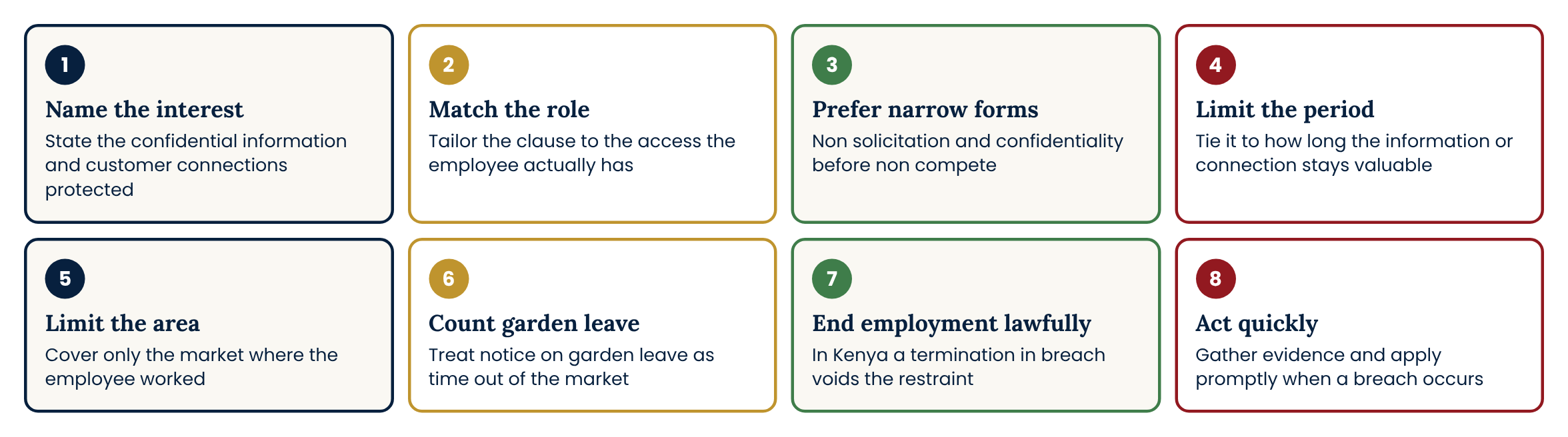
Figure 3. A checklist for drafting an enforceable restraint
IX. Questions every employer and employee should answer
What does the employer genuinely need to protect? The employer should identify the confidential information and customer connections to which the employee has access, and record them. A restraint that protects nothing but the absence of competition will fail in both countries.104
Does the restraint go no further than that interest requires? The period should match the time it takes for the information to lose value or for a replacement to build relationships with customers, as the evidence in SMD Technologies did. The area should match the market in which the employee actually worked. The activities restrained should match the role.105
How did the employment end? In Kenya, an employer that terminates in breach of contract loses the restraint. In South Africa, the restraint operates unless the dismissal was fraudulent or in bad faith.106
9.1 Practical guidance for employers
Employers should tailor restraints to roles rather than using one clause for every employee. A receptionist and a key account manager do not have the same access to customers or information. They should prefer non solicitation and confidentiality clauses, which courts enforce more readily, and use non compete clauses only for employees whose knowledge could not be protected in any other way. They should state the protected interest and the territory in the agreement, keep evidence of the access the employee has, and act quickly when a breach occurs, because delay counted against the employers in LG Electronics and Kunyiha. In Kenya they should ensure that every termination complies with the contract of service. In South Africa they should consider garden leave for senior employees, counting it in the total period.
9.2 Practical guidance for employees
Employees should read a restraint before signing and negotiate its scope where possible. On leaving, they should return all documents and devices, avoid taking customer lists or files, and avoid approaching former customers during the restraint period. Emailing confidential material to a private address shortly before leaving, as in Atlas 360, will weigh heavily against them.107 They should take advice before accepting a role with a competitor. In Kenya, an employee who was dismissed in breach of contract should consider whether section 3 applies, and an employee who is sued should respond, because in Excel Global the absence of a response left the court with no material on unreasonableness.108
9.3 Practical guidance for new employers
A business that hires a person bound by a restraint may be joined to the proceedings, as the new employers were in Excel Global, SMD Technologies and Atlas 360, and may face orders and costs.109 It should ask about restraints before making an offer, consider whether the role can be structured to avoid the restricted activities, and keep the new employee away from the confidential information of the former employer.
X. Frequently asked questions
Are non compete clauses enforceable in Kenya? Yes, but only if they are reasonable. The Contracts in Restraint of Trade Act provides that a restraint is not void only because it restrains trade, but allows the court to declare it void if it is not reasonable in the interest of the parties or of the public. Kenyan courts have refused to enforce broad clauses that keep an employee out of an industry, and have enforced a narrow clause against an employee who resigned and joined a nearby competitor.110
How long can a non compete clause last in Kenya? There is no fixed limit in the Act. The court looks at the period together with the area, the nature of the work and the interest protected. A 6 month clause was enforced in 2025, a 12 month clause failed in 2023, and in 2026 the court held that 2 years was unreasonable even where a legitimate interest exists.111
Can my employer stop me from joining a competitor in South Africa? It can if the restraint protects a genuine interest, such as confidential information or customer connections, and goes no further than necessary. Restraints of 12 months have been enforced against employees with access to pricing, customer data and key client relationships.112
Does a restraint still apply if I am dismissed? In Kenya, a restraint is void if the employer terminates the employment in breach of the contract of service. In South Africa, a restraint generally operates whatever the reason for termination, unless the dismissal was fraudulent or in bad faith.113
Which court hears restraint of trade disputes? In Kenya, disputes between employers and employees go to the Employment and Labour Relations Court, which exercises the power the Act gives to the High Court. In South Africa, either the Labour Court or the High Court may hear them.114
Is garden leave lawful? Yes, where the contract allows it. In South Africa, the period of garden leave is counted when the court decides whether the total time out of the market is reasonable.115
Can a court cut down an unreasonable restraint? Courts in both countries can enforce a restraint in part, for example by restraining solicitation but not employment with a competitor, or by reducing the area. They are not obliged to do so.116
XI. Conclusion
Kenya and South Africa share a common law inheritance and a common question. Both allow employers to protect confidential information and customer connections, and both refuse to protect employers from competition as such. They differ in emphasis. South Africa holds employees to their bargains, decides most cases as a value judgment on the facts, and applies restraints whatever the reason for termination unless the dismissal was fraudulent or in bad faith. Kenya scrutinises restraints closely in the light of unemployment and unequal bargaining power, expects the employer to prove the interest it protects, and by statute denies the protection of a restraint to an employer that ends the employment in breach of contract. In both countries, an employer that identifies a real interest, drafts a restraint that protects that interest and no more, acts quickly and ends the employment lawfully will usually be protected. An employer that does not will usually fail. Employees who understand these rules can leave with their skills and their careers intact, and employers who respect them can protect what is genuinely theirs.
About the author
Benson Odiwuor is an Advocate of the High Court of Kenya based in Nairobi, whose practice focuses on dispute resolution in the regulated industries, including mining, oil and gas, banking and project finance. He is the editor of The BOLD, Benson Odiwuor’s Legal Digests, a legal newsletter on dispute strategies and legal developments in the regulated industries of Kenya. Subscribe to The BOLD here.
For inquiries, contact the author at info@bensonodiwuor.com.
You can download the PDF here .
References
- Backsports (Pty) Ltd v Motlhanke and Another (JA2025-091548) [2025] ZALAC 50 (reasons delivered 27 October 2025); (2026) 47 ILJ 529 (LAC) para 27 <https://www.saflii.org/za/cases/ZALAC/2025/50.html>; Reddy v Siemens Telecommunications (Pty) Ltd (251/06) [2006] ZASCA 135; 2007 (2) SA 486 (SCA); (2007) 28 ILJ 317 (SCA) <https://www.saflii.org/za/cases/ZASCA/2006/135.html>. ↩
- Nordenfelt v Maxim Nordenfelt Guns and Ammunition Co Ltd [1894] AC 535 (HL). ↩
- Mason v Provident Clothing and Supply Co Ltd [1913] AC 724 (HL). ↩
- Herbert Morris Ltd v Saxelby [1916] 1 AC 688 (HL). ↩
- Judicature Act (Cap 8) s 3(1) <https://new.kenyalaw.org/akn/ke/act/1967/16>. ↩
- Contracts in Restraint of Trade Act (Cap 24), originally Act No 40 of 1932 <https://www.judy.legal/legislation/akn/ke/act/1932/40>. ↩
- Contracts in Restraint of Trade Act s 2; Sunrise Virtual Schools Ltd t/a Sunrise Virtual School v Korir t/a Weston Virtual School and 2 others (Cause E1057 of 2025) [2026] KEELRC 2057 (KLR) (10 July 2026) para 11 <https://new.kenyalaw.org/akn/ke/judgment/keelrc/2026/2057/eng@2026-07-10>. ↩
- Contracts in Restraint of Trade Act s 3; Sunrise Virtual Schools v Korir (n 7) para 12. ↩
- Excel Global Ltd v Kithinji and another (Cause E137 of 2025) [2025] KEELRC 1687 (KLR) (10 June 2025) para 23 <https://new.kenyalaw.org/akn/ke/judgment/keelrc/2025/1687/eng@2025-06-10>. ↩
- Credit Reference Bureau Holdings Ltd v Steven Kunyiha (Cause 260 of 2017) [2017] KEELRC 1418 (KLR) (28 April 2017) para 13 <https://new.kenyalaw.org/akn/ke/judgment/keelrc/2017/1418>. ↩
- Constitution of Kenya 2010 art 41 <https://new.kenyalaw.org/akn/ke/act/2010/constitution>. ↩
- LG Electronics Africa Logistics FZE v Charles Kimari (Civil Suit 346 of 2012) [2012] KEHC 5548 (KLR) (11 October 2012) para 15 <https://new.kenyalaw.org/akn/ke/judgment/kehc/2012/5548>. ↩
- Jovet (Kenya) Ltd v Bavaria NV (Petition E039 of 2024) [2025] KESC 27 (KLR) (16 May 2025) <https://new.kenyalaw.org/akn/ke/judgment/kesc/2025/27/eng@2025-05-16>; Supreme Court of Kenya, ‘Jovet (Kenya) Limited vs Bavaria NV, SC Petition No E039 of 2024. Media Summary’ (16 May 2025) <https://supremecourt.judiciary.go.ke/wp-content/plugins/download-attachments/includes/download.php?id=5603>. ↩
- Constitution of Kenya arts 162(2)(a) and 165(5)(b). ↩
- Employment and Labour Relations Court Act 2011 (No 20 of 2011), now Cap 8E of the Laws of Kenya ss 4 and 12(1)(a) <https://new.kenyalaw.org/akn/ke/act/2011/20>. ↩
- Sunrise Virtual Schools v Korir (n 7) para 13; Mwaura v Taxify Kenya Ltd (Employment and Labour Relations Cause 173 of 2019) [2023] KEELRC 1849 (KLR) (27 July 2023) para 30 <https://new.kenyalaw.org/akn/ke/judgment/keelrc/2023/1849>. ↩
- HF Fire International Incorporated and another v Sayed Hossam Mohamed Elshebrawi Mohamed Khalifa and another [2017] KEELRC 1084 (KLR) para 1 <https://new.kenyalaw.org/akn/ke/judgment/keelrc/2017/1084/eng@2017-06-20>. ↩
- LG Electronics v Kimari (n 12); Bridge International Academies v Bonface Nyanumba Ombati (Civil Case 13 of 2015) [2015] KEHC 36 (KLR) (30 November 2015) <https://new.kenyalaw.org/akn/ke/judgment/kehc/2015/36/eng@2015-11-30>. ↩
- Giella v Cassman Brown and Co Ltd [1973] EA 358. ↩
- Sunrise Virtual Schools v Korir (n 7) para 20. ↩
- LG Electronics v Kimari (n 12) paras 4 and 9. ↩
- LG Electronics v Kimari (n 12) paras 12 and 13. ↩
- LG Electronics v Kimari (n 12) para 16. ↩
- LG Electronics v Kimari (n 12) para 17. ↩
- Credit Reference Bureau v Kunyiha (n 10) paras 3 to 5. ↩
- Credit Reference Bureau v Kunyiha (n 10) paras 14 to 16. ↩
- Credit Reference Bureau v Kunyiha (n 10) para 17. ↩
- Mwaura v Taxify (n 16) paras 5 to 13. ↩
- Mwaura v Taxify (n 16) para 38. ↩
- Mwaura v Taxify (n 16) paras 33 to 36. ↩
- Mwaura v Taxify (n 16) para 38. ↩
- Mwaura v Taxify (n 16) paras 39 and 40. ↩
- Mwaura v Taxify (n 16) para 42. ↩
- Mwaura v Taxify (n 16) paras 24, 31 and 41. ↩
- Bridge International Academies v Ombati (n 18) paras 3 and 4. ↩
- Bridge International Academies v Ombati (n 18) para 15. ↩
- Bridge International Academies v Ombati (n 18) para 16. ↩
- Excel Global v Kithinji (n 9) paras 1 to 4, 10, 17 and 19. ↩
- Excel Global v Kithinji (n 9) para 20. ↩
- Excel Global v Kithinji (n 9) paras 23 and 24. ↩
- Excel Global v Kithinji (n 9) para 32. ↩
- Sunrise Virtual Schools v Korir (n 7) paras 4 and 7 to 9. ↩
- Sunrise Virtual Schools v Korir (n 7) paras 16 to 18. ↩
- Sunrise Virtual Schools v Korir (n 7) paras 17 and 21. ↩
- Sunrise Virtual Schools v Korir (n 7) para 22; Direct Pay Ltd v Sharon Tum [2024] KEHC 2114 (KLR). ↩
- Sunrise Virtual Schools v Korir (n 7) paras 23 and 24. ↩
- Magna Alloys and Research (SA) (Pty) Ltd v Ellis [1984] ZASCA 116; 1984 (4) SA 874 (A) <https://www.saflii.org/za/cases/ZASCA/1984/116.html>. ↩
- Atlas 360 Commercial Vehicle Services (Pty) Ltd v De Witt and Another (2025-117803) (2026) 47 ILJ 561 (LC) (3 November 2025) para 60. ↩
- Hudaco Trading (Pty) Ltd v Green and Another [2008] ZAGPHC 487 para 9 <https://www.saflii.org/za/cases/ZAGPHC/2008/487.html>. ↩
- Basson v Chilwan and Others [1993] ZASCA 61; 1993 (3) SA 742 (A) 767 <https://lawlibrary.org.za/akn/za/judgment/zasca/1993/61>. ↩
- Backsports (n 1) para 24. ↩
- Basson v Chilwan (n 50). ↩
- Kwik Kopy (SA) (Pty) Ltd v Van Haarlem and Another 1999 (1) SA 472 (W) 484. ↩
- Constitution of the Republic of South Africa 1996 s 22 <https://www.gov.za/documents/constitution/constitution-republic-south-africa-1996-1>. ↩
- Reddy (n 1) paras 13 and 14. ↩
- Reddy (n 1) para 14. ↩
- Ball v Bambalela Bolts (Pty) Ltd and Another (2013) 34 ILJ 2821 (LAC) para 14; Backsports (n 1) para 26. ↩
- Labournet (Pty) Ltd v Jankielsohn and Another [2017] ZALAC 7; (2017) 38 ILJ 1302 (LAC) paras 39 and 40 <https://www.saflii.org/za/cases/ZALAC/2017/7.html>. ↩
- Backsports (n 1) para 25. ↩
- Labournet (n 58) paras 41 and 43. ↩
- Labournet (n 58) paras 49 to 59 and 65. ↩
- Automotive Tooling Systems (Pty) Ltd v Wilkens and Others [2006] ZASCA 167; 2007 (2) SA 271 (SCA) para 8 <https://lawlibrary.org.za/akn/za/judgment/zasca/2006/167>. ↩
- Automotive Tooling (n 62) para 20. ↩
- Reddy (n 1) para 20. ↩
- Basic Conditions of Employment Act 75 of 1997 (South Africa) s 77(3) <https://www.gov.za/documents/basic-conditions-employment-act>; Backsports (n 1) para 33. ↩
- Labour Relations Act 66 of 1995 (South Africa) ss 151 and 158(1)(j) <https://www.gov.za/documents/labour-relations-act>; Backsports (n 1) paras 35 and 36. ↩
- SMD Technologies (Pty) Ltd v Tavares and Another (118592/24) [2024] ZALCJHB 546 (13 December 2024) para 3 <https://www.saflii.org/za/cases/ZALCJHB/2024/546.html>. ↩
- Vodacom (Pty) Ltd v Motsa and Another [2016] ZALCJHB 53; 2016 (3) SA 116 (LC); (2016) 37 ILJ 1241 (LC) <https://www.saflii.org/za/cases/ZALCJHB/2016/53.html>. ↩
- Vodacom v Motsa (n 68) paras 25 and 26; Credit Suisse Asset Management Ltd v Armstrong [1996] ICR 882 (CA); Air New Zealand Ltd v Kerr [2013] NZEmpC 153. ↩
- Vodacom v Motsa (n 68) para 26. ↩
- Backsports (n 1) para 4. ↩
- Backsports (n 1) para 5. ↩
- Backsports (n 1) paras 6 to 10. ↩
- Backsports (Pty) Ltd v Motlhanke and Another (2025-009346) [2025] ZALCJHB 68 (18 February 2025) paras 26 and 27 <https://www.saflii.org/za/cases/ZALCJHB/2025/68.html>. ↩
- Backsports (n 1) para 1. ↩
- Backsports (n 1) paras 13 to 15; Reeves and Another v Marfield Insurance Brokers CC and Another 1996 (3) SA 766 (A). ↩
- Backsports (n 1) paras 16 and 17. ↩
- Backsports (n 1) paras 29 to 31. ↩
- Backsports (n 1) para 1. ↩
- SMD Technologies v Tavares (n 67) paras 7 and 8. ↩
- SMD Technologies v Tavares (n 67) paras 10 to 12. ↩
- SMD Technologies v Tavares (n 67) para 30. ↩
- SMD Technologies v Tavares (n 67) para 36. ↩
- HR and Skills Market v Strydom and Another (J143/2025) (2026) 47 ILJ 590 (LC) (11 September 2025) paras 29 to 31. ↩
- HR and Skills Market v Strydom (n 84) order, para 5. ↩
- Atlas 360 (n 48) paras 12, 13 and 38. ↩
- Atlas 360 (n 48) para 57. ↩
- Atlas 360 (n 48) paras 58 to 60 and 62. ↩
- Sunrise Virtual Schools v Korir (n 7) para 20; LG Electronics v Kimari (n 12) para 16; Excel Global v Kithinji (n 9) para 20. ↩
- Contracts in Restraint of Trade Act s 3. ↩
- Backsports (n 1) paras 14 to 17; Reeves (n 76). ↩
- Excel Global v Kithinji (n 9) para 23. ↩
- Bridge International Academies v Ombati (n 18) para 16. ↩
- Hudaco v Green (n 49) para 9. ↩
- Backsports (n 1) para 1; HR and Skills Market v Strydom (n 84) order, para 5. ↩
- Sunrise Virtual Schools v Korir (n 7) para 23. ↩
- Ryan LLC v Federal Trade Commission (ND Tex, 20 August 2024); Federal Trade Commission, ‘Federal Trade Commission Files to Accede to Vacatur of Non Compete Clause Rule’ (Press release, 5 September 2025) <https://www.ftc.gov/news-events/news/press-releases/2025/09/federal-trade-commission-files-accede-vacatur-non-compete-clause-rule>. ↩
- Employment Act 2007 (No 11 of 2007), now Cap 226 of the Laws of Kenya s 45 <https://new.kenyalaw.org/akn/ke/act/2007/11>; Contracts in Restraint of Trade Act s 3. ↩
- Mwaura v Taxify (n 16) para 31; Excel Global v Kithinji (n 9) para 20. ↩
- Sunrise Virtual Schools v Korir (n 7) para 20. ↩
- Excel Global v Kithinji (n 9) para 24. ↩
- Jovet v Bavaria (n 13); Constitution of Kenya arts 40 and 41. ↩
- Vodacom v Motsa (n 68) para 26; Air New Zealand v Kerr (n 69). ↩
- Automotive Tooling (n 62) para 8; Mwaura v Taxify (n 16) para 38; Sunrise Virtual Schools v Korir (n 7) paras 19 and 20. ↩
- SMD Technologies v Tavares (n 67) para 30; HR and Skills Market v Strydom (n 84) order, para 5; Contracts in Restraint of Trade Act s 2. ↩
- Contracts in Restraint of Trade Act s 3; Backsports (n 1) paras 14 to 17. ↩
- Atlas 360 (n 48) para 38. ↩
- Excel Global v Kithinji (n 9) para 24. ↩
- Excel Global v Kithinji (n 9) para 32; SMD Technologies v Tavares (n 67) para 1; Atlas 360 (n 48) para 62. ↩
- Contracts in Restraint of Trade Act s 2; Mwaura v Taxify (n 16) para 38; Excel Global v Kithinji (n 9) paras 23 and 24. ↩
- Excel Global v Kithinji (n 9); Mwaura v Taxify (n 16); Sunrise Virtual Schools v Korir (n 7) para 21. ↩
- Basson v Chilwan (n 50) 767; SMD Technologies v Tavares (n 67) paras 30 and 36; Atlas 360 (n 48) para 60. ↩
- Contracts in Restraint of Trade Act s 3; Backsports (n 1) paras 14 to 17. ↩
- Sunrise Virtual Schools v Korir (n 7) para 13; Employment and Labour Relations Court Act s 12; Basic Conditions of Employment Act s 77(3). ↩
- Vodacom v Motsa (n 68) para 26. ↩
- Bridge International Academies v Ombati (n 18) para 16; Hudaco v Green (n 49) para 9; HR and Skills Market v Strydom (n 84) order, para 5. ↩