

Mergers and Brand Exits in Kenyan Fuel Retail. Change of Control, Dealers and the Station Lease
3 November 2026
A change of owner at the top does not rewrite the documents at the station. The law answers 3 questions about every deal. Does the deal need approval and on what conditions? Which contracts and licences move with the business? What protection do dealers, landowners and employees have? This edition answers each of them from the law and the decided cases.
| KEY POINTS AT A GLANCE Kenyan fuel retail has been reshaped by a series of acquisitions and brand changes, including the acquisition of Engen by Vivo Energy in 2018, of KenolKobil by Rubis in 2019, of Gulf Energy Holdings by KenolKobil in 2020, and the rebranding of Lexo stations to Shell under a retail supply agreement in 2023. A transaction that gives an undertaking control of another, or of part of its business such as a network of stations, is a merger under the Competition Act. It may not be implemented without the approval of the Competition Authority of Kenya, and an unapproved merger has no legal effect. The Competition Authority assesses fuel retail mergers on local markets, using a radius of about 3 kilometres, and has imposed conditions to protect dealers, employees and small businesses. In 2020 it required that the dealer contracts of Gulf Energy be maintained for their full length. A sale does not automatically carry the station leases, dealer agreements and licences. Leases may prohibit assignment or change of control, dealer agreements may be personal, and petroleum licences may be transferred only with the consent of the regulator. Landowners have successfully argued that a change of control breached their leases, and have challenged rebranding of their stations after a sale. Dealers and employees have their own claims. Buyers and sellers have litigated over the value of what was sold. Every transaction turns on 3 questions. Does the deal need approval and on what conditions? Which contracts and licences move with the business? What protection do dealers, landowners and employees have? |
I. Introduction
The oil marketing companies whose names appear on Kenyan canopies have changed often. Shell sold its African retail business to Vivo Energy, which kept the Shell brand. Rubis bought KenolKobil and then Gulf Energy Holdings, and rebranded the stations. Vivo Energy acquired Engen, and later agreed with Lexo Energy that Lexo stations would carry the Shell brand. Each transaction changed the supplier, the brand and sometimes the counterparty for hundreds of dealers, landowners and employees.
A change of ownership at the top does not rewrite the documents at the station. The lease, the dealer agreement, the retail licence and the employment contracts each have their own rules about assignment and change of control. Some move automatically with the company that holds them. Others need consent. A buyer that overlooks them may find itself in breach the day the deal closes.
This edition of The BOLD, the last in the Downstream Petroleum Series, explains how mergers and brand changes affect the downstream sector. It sets out the merger control regime, examines the conditions the Competition Authority has imposed, and works through the effect of a transaction on leases, dealer agreements, licences and employees. It closes with practical guidance. It takes no position on any matter pending before a court or regulator.

Figure 1. Recent transactions in Kenyan fuel retail
II. Foundational concepts
2.1 Share sale and asset sale
In a share sale the buyer acquires the company that owns the business. The company remains the party to its leases, dealer agreements and licences, so they continue without assignment, unless a clause is triggered by the change of control. In an asset sale the buyer acquires the stations, contracts and stock themselves, and each contract and licence must be transferred, usually with the consent of the counterparty or the regulator.
2.2 Change of control clauses
A change of control clause gives a counterparty rights when ownership of the other party changes, such as a right to consent, to terminate or to renegotiate. Landowners often include such clauses in station leases, because they chose the tenant for its identity and covenant strength.1 Dealer agreements may include them in favour of the oil company, so that it can end a relationship with a dealer whose ownership changes.
2.3 Rebranding without a merger
A brand change does not always involve a merger. In 2023 Vivo Energy began rebranding 15 stations owned by Lexo Energy under what it described as a retail supply agreement, and it played down talk of an acquisition. At the time Vivo had 286 stations in Kenya and Lexo had 42.2 Whether such an arrangement amounts to the acquisition of control of part of a business, and so requires merger approval, depends on its terms.3
III. Legal framework
3.1 Merger definition
A merger occurs when an undertaking or undertakings directly or indirectly acquire or establish direct or indirect control over the whole or part of the business of another undertaking.4 Control includes owning more than half of the share capital, being able to vote a majority of votes or being able to appoint a majority of directors, and it may also arise in other ways that give the ability to materially influence policy.5 A network of petrol stations is a part of a business, so the acquisition of a station network can be a merger even where no shares change hands.
3.2 Approval before implementation
No person may implement a proposed merger unless it has been approved by the Competition Authority and is implemented in accordance with any conditions. A merger implemented without approval has no legal effect.6 Paying the full purchase price counts as implementation, although a deposit of up to 20 per cent of the price does not.7 The Authority may also exclude a transaction from the provisions of the Act, as it did for the acquisition of the Valvoline lubricants group by an affiliate of Saudi Aramco.8
3.3 Criteria and conditions
The Authority may approve a merger, approve it with conditions or decline it. It considers whether the merger is likely to prevent or lessen competition and its effect on public interest factors, including employment, the ability of small undertakings to gain access to markets and the competitiveness of Kenyan industry.9 Its decisions are published in the Kenya Gazette, and it gives written reasons where it approves with conditions or declines.10
3.4 Petroleum licences
A licensee under the Petroleum Act may not transfer or give up its rights or obligations without the consent of the licensing authority, and consent may be withheld only if the transfer is likely to prejudice the public interest.11 A change of ownership of a retail licence cannot be dealt with by amending the licence, and requires the transfer procedure, while the licensee must notify the Authority of changes within 30 days.12
3.5 Exemptions
Agreements between competitors that fall short of a merger may still need an exemption under the Competition Act. In February 2026 the Competition Authority extended an exemption granted to a strategic partnership between the National Oil Corporation of Kenya and Rubis Energy Kenya from 5 to 8 years, beginning on 13 December 2024.13
IV. Merger decisions in fuel retail
4.1 Vivo Energy and Engen
In 2018 the Competition Authority approved the acquisition of Engen by Vivo Energy. It analysed the locations of the stations of each party and found that the stations of the parties were generally at least 3 kilometres apart. It nonetheless required Vivo to part with 2 stations.14
4.2 Rubis and KenolKobil
In 2019 the Authority authorised the acquisition of control of KenolKobil Plc by Rubis Energie SAS, stating that the transaction would not negatively affect competition.15 The transaction later gave rise to disputes with landlords and with a former managing director, examined below.16
4.3 KenolKobil and Gulf Energy
In February 2020 the Authority approved the acquisition of control of Gulf Energy Holdings Limited by KenolKobil Plc with conditions. It found that the merged entity would hold 21.2 per cent of the retail market and would be the market leader but not dominant, and that competitor stations within a radius of 3 kilometres would provide competitive restraint.17 It imposed 4 conditions. For 24 months the merged entity could not declare any of the 102 employees of the target redundant or reduce their pay. It had to keep the contractual benefits of small businesses operating at retail stations for the duration of their contracts. It had to maintain contracts between Gulf and its retail station dealers for their full length. And it had to report annually for 24 months or until the longest existing contract expired.18 The decision noted that the target prohibited its dealers from stocking competitor products and that the transaction was likely to affect dealer arrangements.19
4.4 Earlier decisions
When it approved the acquisition of Gulf African Petroleum by Total, the Authority required Total to retain the existing workforce and to continue sharing storage at the coast with other oil marketing companies, including contracts already entered into.20 It also approved the acquisition of the retail petroleum business of Hashi Energy by Lake Oil, at a time when Hashi held about 3.7 per cent of local volume sales.21
Table 1. Conditions imposed in fuel retail mergers
| Transaction | Year | Main condition |
|---|---|---|
| Vivo Energy and Engen | 2018 | Disposal of 2 stations |
| Rubis Energie and KenolKobil | 2019 | Authorised without reported conditions |
| KenolKobil and Gulf Energy Holdings | 2020 | Employees protected for 24 months. Dealer and small business contracts kept for their full term. Annual reporting |
| Total and Gulf African Petroleum | Earlier | Workforce retained. Storage shared with the industry |
| Lake Oil and Hashi Energy retail | 2017 | Authorised |
V. Effect on station contracts
5.1 Leases
A share sale leaves the tenant company in place, but a change of control clause may still be triggered. In the dispute between KenolKobil and Canarian Holdings, the Environment and Land Court declared that KenolKobil had breached a clause of the leases over its Changamwe, Mtwapa and Jomvu stations by transferring its shares to Rubis Energie, resulting in a change of control, and ordered payment of more than KSh 32,000,000 for restoration and mesne profits.22
An asset sale requires the lease to be assigned. In Mugwetwa a lease granted to Gulf Energy Limited in 2009 for 17 years was assigned to Gulf Energy Holdings Limited by a deed of assignment and variation of 13 January 2020, which the landowner signed. After the acquisition, the landowner contended that branding the station with the name Rubis, rather than that of the assignee, amounted to unlawful occupation and trespass.23 In Lexo v Nyanya a dispute arose over the rebranding of a leased station to Shell under the retail arrangement with Vivo Energy, and turned on a lease clause dealing with assignment to an authorised dealer.24
5.2 Dealer agreements
Dealer agreements continue in a share sale. In an asset sale they must be assigned or novated, and many contain clauses that prevent assignment without consent. The 2020 merger conditions required the merged entity to maintain the dealer contracts of Gulf for their full length, which protected dealers against early termination as a result of the transaction.25 Where no such condition applies, a dealer whose agreement is assigned to a new brand may find that the new owner applies different charges, standards and products. A dealer that did not consent to an assignment that its agreement required to be consented to may treat itself as released.
5.3 Retail licences
Where the licence is held by the company whose shares are sold, the licensee does not change, but the Authority must be notified of the change within 30 days.26 Where stations are sold as assets, each licence must be transferred with the consent of the Authority or a new licence obtained.27 Because the retail licence follows the title or registered lease, the buyer must also hold, or take an assignment of, the lease in its own name.28
5.4 Employees
Employees of a company whose shares are sold remain employed by the same employer. In an asset sale, the transfer of employees depends on agreement, and redundancy procedures apply to jobs that end.29 Merger conditions may add protection, as in the 2020 decision.30 Senior managers may have their own claims. After the acquisition of KenolKobil by Rubis, a former managing director obtained an order for payment of about KSh 34,600,000 in a claim for unfair termination.31
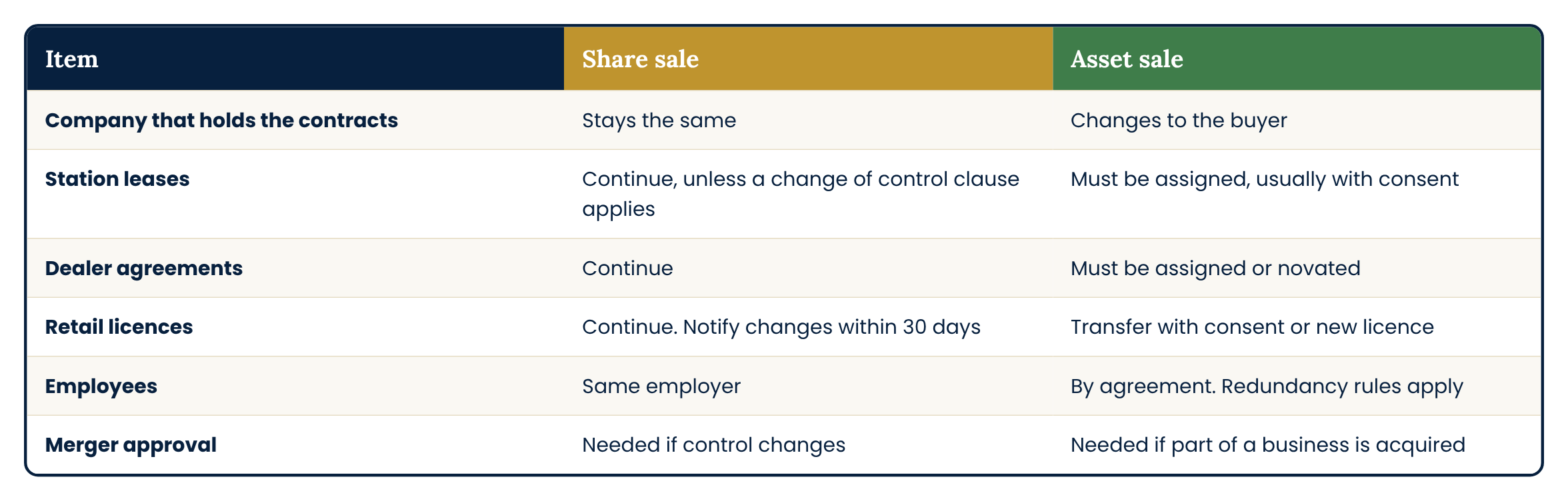
Figure 2. What moves with the business in a share sale and an asset sale
VI. Disputes between buyers and sellers
Transactions also produce disputes between the parties to them. Rubis acquired Gulf Energy Holdings Limited, a special purpose company holding part of the oil marketing business of Gulf Energy Limited, on 4 November 2019. In 2021 Gulf Energy filed a petition contending that Rubis had recovered data from the servers and laptops of former employees, and had then demanded at least US$41,000,000 for an alleged overstatement of the value of the business. Gulf asked the court to declare that its rights to privacy, information and property had been violated.32 Disputes of this kind are usually governed by the warranties, indemnities and dispute resolution clauses of the sale agreement.
VII. Brand exits
7.1 Debranding
When a brand leaves a station, its marks must come down and the new brand must not go up until the contracts and licences are in place. A landowner whose lease identifies the tenant and its brand, or restricts the permitted use, may object to a new brand, as the landowners did in Mugwetwa and Lexo v Nyanya.33
7.2 Dealers on exit of a brand
A dealer whose oil company leaves the market, sells its network or rebrands to a partner faces a change of supplier without having chosen it. Its rights depend on its agreement, on any merger conditions and on the general law of assignment. The sixth edition in this series examines termination and exit in detail.
7.3 LPG brands
Brand exits also affect liquefied petroleum gas. Cylinders belong to the brand owner, and a brand owner that fails to meet its licence requirements may become a distressed brand owner whose cylinders are operated by a brand caretaker appointed by the Authority.34 The eighth edition in this series examines LPG.
VIII. Open legal questions
8.1 Supply agreements as mergers
The first question is when a retail supply or rebranding agreement amounts to the acquisition of control of part of a business. An agreement under which a supplier takes over the branding, supply and operating standards of a network of stations, for a long term, may give it the ability to materially influence the policy of that network.35 No published decision has settled where the line lies.
8.2 Regulatory consent
The second question is how the requirement for consent to the transfer of a petroleum licence applies to a share sale, where the licensee does not change but its ownership does. The Act and the regulations require notice of changes, but the Authority has not published guidance on whether it treats a change of control as a transfer.36
8.3 Enforcement of merger conditions by dealers
The third question is whether a dealer can enforce a merger condition that protects it, for example in a claim against the merged entity, or whether only the Competition Authority can enforce it.37
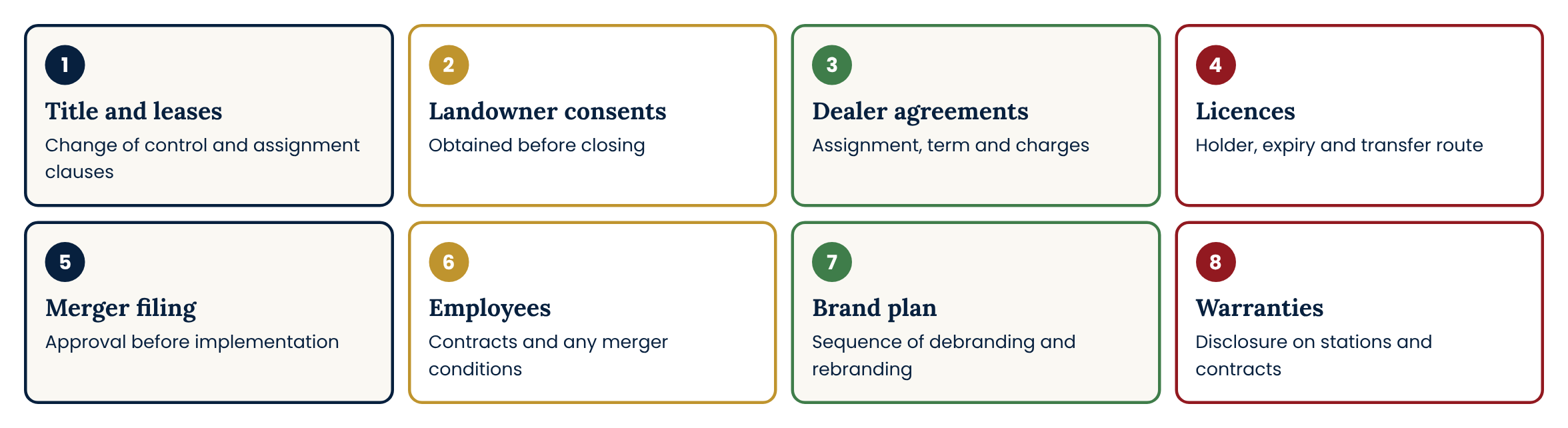
Figure 3. A due diligence checklist for a station network
IX. Questions every participant should answer
Does the deal need approval and on what conditions? The parties should test whether the transaction gives control of all or part of a business, and if so, obtain approval before paying more than a 20 per cent deposit or taking any other step of implementation.38
Which contracts and licences move with the business? The buyer should review every lease, dealer agreement, supply agreement and licence for assignment and change of control clauses, and plan for the consents it needs.39
What protection do dealers, landowners and employees have? Dealers and landowners have their contracts and any merger conditions. Employees have the Employment Act and any merger conditions.40
9.1 Practical guidance for buyers
Buyers should build a register of every station, showing the title or lease, the change of control and assignment clauses, the dealer agreement, the licences and the brand obligations. They should seek landowner consent before closing where a lease requires it, and plan the sequence of rebranding so that no station trades under a brand that its lease or licence does not permit.
9.2 Practical guidance for sellers
Sellers should disclose fully against warranties, especially on stations and contracts, to reduce the risk of later claims on the value of the business. They should consider their obligations to employees and dealers before agreeing to terms that require terminations.
9.3 Practical guidance for dealers and landowners
Dealers and landowners should read their agreements for assignment and change of control clauses as soon as a transaction is announced, and should engage early with the buyer. Where the Competition Authority invites comment on a proposed merger, they may make submissions on its effect on them.
X. Conclusion
Mergers and brand changes will continue to reshape Kenyan fuel retail. The Competition Authority has shown that it will look at local markets and protect dealers, employees and small businesses through conditions. The courts have shown that landowners can hold oil companies to their change of control and assignment clauses. Buyers, sellers, dealers and landowners who answer the 3 questions in this edition before a deal closes will avoid much of the litigation that has followed past transactions. This edition completes the Downstream Petroleum Series of The BOLD.
Benson Odiwuor is an Advocate of the High Court of Kenya based in Nairobi, whose practice focuses on dispute resolution in the regulated industries, including mining, oil and gas, banking and project finance. He is the editor of The BOLD, Benson Odiwuor’s Legal Digests, a legal newsletter on dispute strategies and legal developments in the regulated industries of Kenya. Subscribe to The BOLD here.
For inquiries, contact the author at info@bensonodiwuor.com.
References
- ‘KenolKobil Respite in Sh32m Row with Ex Landlord’ Business Daily (Nairobi, 8 July 2024) <https://www.businessdailyafrica.com/bd/corporate/companies/kenolkobil-respite-in-sh32m-row-with-ex-landlord-4683124>. ↩
- ‘Vivo Energy to Cement Dominance with Lexo Deal’ Business Daily (Nairobi, 2023) <https://www.businessdailyafrica.com/bd/corporate/companies/vivo-energy-to-cement-dominance-with-lexo-deal--4388922>. ↩
- Competition Act 2010 (No 12 of 2010), now Cap 504 of the Laws of Kenya s 41. ↩
- Competition Act s 41(1). ↩
- Competition Act s 41(3). ↩
- Competition Act s 42(2) and (3). ↩
- Competition Act s 42(4). ↩
- ‘Saudi Oil Firm Sets Foot in Kenya through Acquisition of US Valvoline’ Garowe Online<https://garoweonline.com/en/featured/business-n/saudi-oil-firm-sets-foot-in-kenya-through-acquisition-of-us-valvoline>. ↩
- Competition Act s 46(1) and (2). ↩
- Competition Act s 46(6). ↩
- Petroleum Act 2019 (No 2 of 2019), now Cap 308 of the Laws of Kenya s 83 <https://new.kenyalaw.org/akn/ke/act/2019/2>. ↩
- Petroleum (Retail Dispensing Site Construction and Licensing) (No 2) Regulations 2025 (LN 188 of 2025) regs 14(2), 15(1)(k) and 17 <https://epra.go.ke/extras/legal/web/uploads/6a5f3964c4b13_The%20Petroleum%20(Retail%20Dispensing%20Site%20Construction%20and%20Licensing)(No%202)%20Regulations.pdf>. ↩
- ‘CAK Extends National Oil, Rubis Exemption Deal to Eight Years’ Capital Business (Nairobi, 3 February 2026) <https://www.capitalfm.co.ke/business/2026/02/cak-extends-national-oil-rubis-exemption-deal-to-eight-years/>; Competition Act ss 25 and 26. ↩
- Nelly K, ‘CAK Approves Acquisition of Engen by Vivo, Latter Ordered to Part Away with Two Petrol Stations’ Kenyan Wall Street (5 July 2018) <https://kenyanwallstreet.com/cak-approves-acquisition-of-engen-by-vivo-latter-ordered-to-part-away-with-two-petrol-stations>. ↩
- ‘CAK Gives Nod to KenolKobil Takeover by French Firm’ Business Daily (Nairobi, 2019) <https://www.businessdailyafrica.com/bd/news/cak-gives-nod-to-kenolkobil-takeover-by-french-firm-2236282>. ↩
- ‘KenolKobil Respite in Sh32m Row’ (n 1); ‘Court Orders Rubis to Pay Fired Boss of Oil Firm Kobil Sh34.6m’ The Standard (Nairobi, 2024) <https://www.standardmedia.co.ke/counties/article/2001502632/court-orders-rubis-to-pay-fired-boss-of-oil-firm-kobil-sh346m>. ↩
- Competition Authority of Kenya, ‘Decision on the Proposed Acquisition of Control of Gulf Energy Holdings Limited by KenolKobil Plc’ (2020) paras 40 to 45 <https://cak.go.ke/sites/default/files/determinations/2024-07/CAK%20Decision%20on%20Acquisition%20of%20Control%20of%20Gulf%20Energy%20Holdings%20Limited%20by%20KenolKobil%20Plc%20(1).pdf>; Jackson Okoth, ‘Kenol Kobil Proposed Merger with Gulf Energy Gets Approval’ Kenyan Wall Street (25 February 2020) <https://kenyanwallstreet.com/kenol-kobil-has-received-approval-to-merge-with-gulf-energy-subject-to-set-conditions>. ↩
- CAK, KenolKobil and Gulf decision (n 17) para 53; ‘Rubis to Retain Gulf Energy Staff after Acquisition Gets Nod’ Business Daily (Nairobi, February 2020) <https://www.businessdailyafrica.com/bd/corporate/companies/rubis-to-retain-gulf-energy-staff-after-acquisition-gets-nod-2281576>. ↩
- CAK, KenolKobil and Gulf decision (n 17) paras 51 and 52. ↩
- ‘Competition Authority of Kenya Gives Total the Nod to Buy Gapco’ The Standard (Nairobi) <https://www.standardmedia.co.ke/business/business/article/2001228180/competition-authority-of-kenya-gives-total-the-nod-to-buy-gapco>. ↩
- ‘TZ Firm Cleared to Buy Kenya Oil Unit’ The Citizen (Dar es Salaam, 2017) <https://www.thecitizen.co.tz/tanzania/business/tz-firm-cleared-to-buy-kenya-oil-unit-2581386>; ‘TZ’s Lake Oil Cleared to Acquire Hashi Energy’s Retail Business’ Citizen Digital (Nairobi, 2017) <https://www.citizen.digital/business/tzs-lake-oil-cleared-to-acquire-hashi-energys-retail-business-158364>. ↩
- ‘KenolKobil Respite in Sh32m Row’ (n 1). ↩
- Mugwetwa v Rubis Energy Kenya PLC & another (Environment and Land Case E003 of 2023) [2024] KEELC 5710 (KLR) <https://new.kenyalaw.org/akn/ke/judgment/keelc/2024/5710/eng@2024-07-25>. ↩
- Lexo Energy Kenya Ltd v Nyanya [2025] KEELC 3413 (KLR) <https://new.kenyalaw.org/akn/ke/judgment/keelc/2025/3413/eng@2025-04-29>. ↩
- CAK, KenolKobil and Gulf decision (n 17) para 53. ↩
- Retail Regulations 2025 reg 15(1)(k). ↩
- Petroleum Act s 83; Retail Regulations 2025 reg 17. ↩
- Energy and Petroleum Regulatory Authority, ‘Requirements for Licence for Retail of Petroleum Products (Except LPG)’ (February 2025) <https://epra.go.ke/sites/default/files/2025-02/Licence%20for%20Retail%20of%20Petroleum%20Products%20%28Except%20LPG%29.pdf>. ↩
- Employment Act 2007 (No 11 of 2007) s 40. ↩
- CAK, KenolKobil and Gulf decision (n 17) para 53. ↩
- ‘Court Orders Rubis to Pay Fired Boss’ (n 16). ↩
- Frankline Sunday, ‘Gulf Energy Sues Rubis Contesting Sh4b Refund’ The Standard (Nairobi, 10 June 2021) <https://standardmedia.co.ke/business/amp/news/article/2001415282/gulf-energy-sues-rubis-contesting-sh4b-refund>. ↩
- Mugwetwa (n 23); Lexo v Nyanya (n 24). ↩
- Petroleum (Liquefied Petroleum Gas) (No 2) Regulations 2025 (LN 189 of 2025) reg 2 <https://www.epra.go.ke/extras/legal/web/uploads/6a5f39a2750c5_The%20Petroleum%20(Liquefied%20Petroleum%20Gas)(No%202)%20Regulations.pdf>. ↩
- Competition Act s 41(3); ‘Vivo Energy to Cement Dominance with Lexo Deal’ (n 2). ↩
- Petroleum Act s 83; Retail Regulations 2025 regs 15(1)(j) and (k). ↩
- Competition Act s 46; CAK, KenolKobil and Gulf decision (n 17) para 53. ↩
- Competition Act ss 41 and 42. ↩
- Petroleum Act s 83; ‘KenolKobil Respite in Sh32m Row’ (n 1). ↩
- CAK, KenolKobil and Gulf decision (n 17) para 53; Employment Act s 40. ↩