
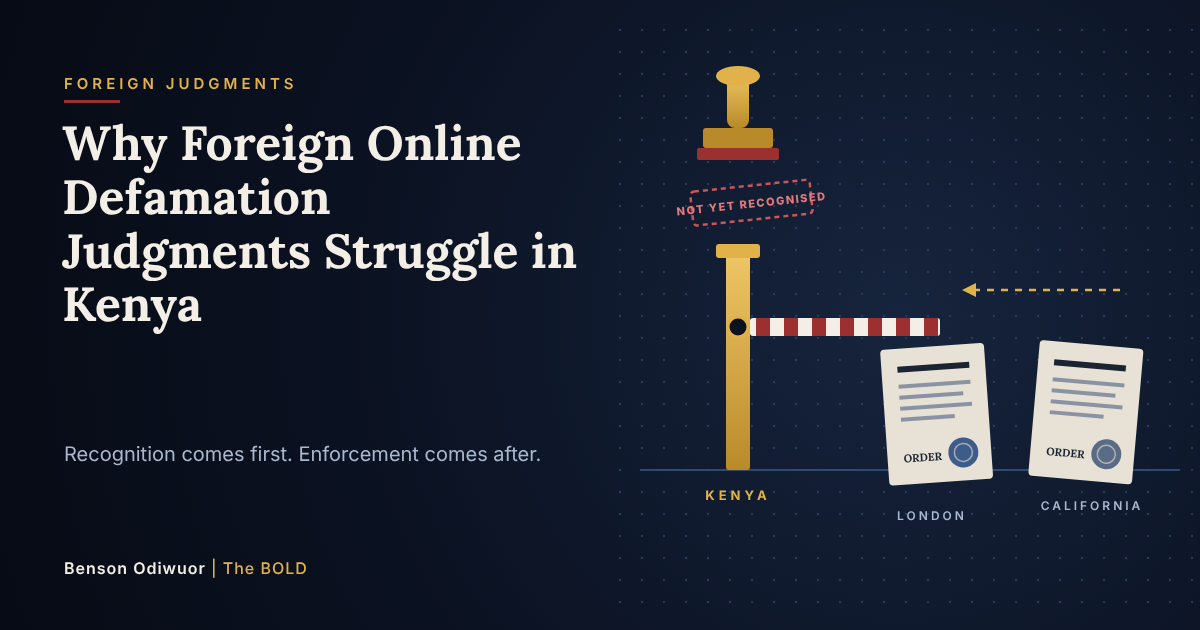
Why Foreign Online Defamation Judgments Struggle in Kenya
27 October 2026
A Nairobi media house receives an email from a law firm in London. Attached is a sealed order of the English High Court, made in proceedings the media house never defended, awarding damages for an article published on its website and ordering the article to be taken down. A Kenyan bank receives a similar letter enclosing an order from a court in California. Both recipients ask the same question. Does this order bind us in Kenya?
The short answer is no, at least not yet. A foreign judgment has no force in Kenya by its own authority. It acquires force only when a Kenyan court recognises it, and Kenyan courts will do so only on Kenyan terms. For businesses and individuals in Kenya who publish, trade or hold data online, those terms are an important shield. For foreign claimants who hope to turn a judgment obtained abroad into money or action in Kenya, they are a set of hurdles that must be planned for before the foreign case is even filed.
No foreign judgment enforces itself
The Supreme Court settled the basic principle in Ingang'a v James Finlay (Kenya) Ltd. Tea estate workers in Kericho had sued their employer, a company incorporated in Scotland, in the Scottish courts and obtained an order permitting experts to inspect the estates in Kenya. The dispute over whether that order could be carried out in Kenya reached the Supreme Court. The Supreme Court held that, because each state has sole authority over its own territory, no judgment of a court of one country can be executed of its own force in another.1 Decisions of foreign courts and tribunals are not automatically recognised or enforceable in Kenya. They must be examined by Kenyan courts before they can be recognised and enforced.2
The Court also explained why Kenya recognises foreign judgments at all. It is not a matter of obligation but of comity, a principle of convenience and utility that protects Kenyan citizens while taking account of the legitimate interests of foreign litigants.3 Recognition is therefore something a Kenyan court grants, on conditions, and not something a foreign court can demand.
The registration route
The Foreign Judgments (Reciprocal Enforcement) Act offers a streamlined route for judgments from countries that the Minister has declared to give substantially reciprocal treatment to Kenyan judgments.4 The countries currently designated are the United Kingdom, Australia, Rwanda, Tanzania, Uganda, Malawi, Zambia and Seychelles. The United States, the home of most global platforms, is not among them.
Even for designated countries, the Act is narrow. It applies to final and conclusive judgments by which a sum of money is made payable, to orders for the delivery of movable property, and to a few related categories. It expressly excludes, among other things, judgments for exemplary or punitive damages.5 An application for registration must be made to the High Court within six years of the judgment,6 and once registered the judgment has the same force for purposes of execution as a judgment of the High Court.7 The judgment debtor may then apply to set the registration aside on any of the grounds the Act lists, including that the original court had no jurisdiction, that the judgment was obtained by fraud, and that its enforcement would be manifestly contrary to public policy in Kenya.8
The Court of Appeal has made clear that the setting aside process is not an appeal. In Dari Ltd v East African Development Bank, borrowers sought to set aside the registration of an English Commercial Court judgment, arguing among other things that the English judge had been biased. The court rejected the description of the High Court's role as merely ceremonial, but held that the Act aims to avoid re-litigation in Kenya of matters finally determined by a foreign superior court, and that a registered judgment cannot be set aside merely because it is said to be wrong on the merits.9
Jurisdiction is judged by Kenyan rules
The most powerful ground for setting aside registration, in internet disputes, is the absence of jurisdiction. The question is not whether the foreign court considered that it had jurisdiction under its own law. The question is whether it had jurisdiction under the list of grounds in the Kenyan Act.
That list is short and traditional. A foreign court is treated as having jurisdiction if the defendant voluntarily appeared in the proceedings, was the claimant or counterclaimant, had agreed in writing to submit to that court, was habitually resident or incorporated in that country, or conducted the business out of which the claim arose through an office or agent there. There are further grounds for contracts to be performed in that country, for property located there, and for claims for physical injury, death or damage to tangible property occurring there.10 There is no ground for defamation, privacy, data protection or other wrongs committed online, and none based on the fact that material was published, downloaded or read in the foreign country.
The consequence is striking. An English court may well consider that it has jurisdiction over a Kenyan website whose articles are read in England. But if the Kenyan publisher did not appear, had no office or agent in England and never agreed to English jurisdiction, the resulting judgment would appear to fall outside every ground in the Kenyan Act, and its registration in Kenya would be liable to be set aside. A Kenyan defendant that does appear in England only to contest the English court's jurisdiction is not, for this purpose, treated as having submitted to it.11 The same strategic choice explored in the previous article, whether and how to appear in a foreign court, therefore operates in both directions.
Takedown orders and injunctions
Many orders in internet disputes are not for money at all. They require content to be removed, accounts to be suspended or data to be deleted. Such orders are not within the categories of judgment to which the Kenyan Act applies, which are confined to money and the delivery of movable property. The Supreme Court in Ingang'a held that the Scottish inspection orders fell outside the Act both because they were not among the listed categories and because they were not final and conclusive.12 A foreign interim injunction ordering a Kenyan publisher to take down an article is in the same position.
The common law has traditionally been equally restrictive, enforcing only foreign judgments for a fixed sum of money. The Supreme Court of Canada considered whether to relax that rule in Pro Swing Inc v Elta Golf Inc, a case arising from an American order restraining a Canadian company from selling infringing goods, including through its website. The majority accepted that the traditional rule should be adapted so that non-monetary foreign orders could in principle be enforced, but declined to enforce the American orders, emphasising that a court asked to enforce a foreign injunction must consider its clarity, its territorial scope and its effect on the enforcing state's own legal system.13 No Kenyan appellate court has yet decided whether to take that step. Until one does, a foreign takedown order addressed to a Kenyan publisher or platform has persuasive effect only.
Judgments from countries outside the Act
A judgment from a country that is not designated under the Act, such as the United States, cannot be registered at all. It can be enforced in Kenya only by bringing a fresh action on the judgment at common law, treating the foreign judgment as creating a debt. The Court of Appeal has accepted that this route exists. In Shah v Haria, a claimant who had obtained a judgment for USD 250,000 from the Ethiopian courts sued on it in Kenya and applied for summary judgment. The High Court refused summary judgment and the Court of Appeal upheld that refusal, leaving the defendants free to contest the claim at trial.14 The common law route is therefore slower and less certain than registration, and it gives the Kenyan defendant a full opportunity to challenge the foreign court's jurisdiction and the fairness of its process.
The Supreme Court has also signalled that Kenyan courts will not defer to foreign courts that disregard Kenyan law. In MAK v RMAA, a family dispute with no online dimension, the Court held that the Kenyan superior courts had erred in relying on findings of an English court that had disregarded an agreement adopted as an order of the Kenyan High Court. It held that judgments of foreign courts are not matters of which Kenyan courts take judicial notice, and that the English court's orders had disregarded the sovereignty of the Kenyan legal system over its own nationals.15 Foreign litigants seeking to enforce a judgment against Kenyans should expect the same protective scrutiny.
Public policy and the Constitution
A further ground for setting aside a registered judgment is that its enforcement would be manifestly contrary to public policy in Kenya. In Dari, the Court of Appeal adopted the test that public policy is engaged where enforcement would be inconsistent with the Constitution or other Kenyan law, inimical to the national interest of Kenya, or contrary to justice and morality.16 The ground is deliberately narrow, and the Court of Appeal treated the recognition of a reciprocating country's judgment as an exercise of Kenyan sovereignty, not a surrender of it.17
The Constitution may nonetheless give the ground real content in online disputes. A Kenyan publisher facing enforcement of a foreign judgment that penalised reporting on a matter of public interest may argue that enforcing it would be inconsistent with the freedom of expression and media freedom guaranteed by the Constitution.18 No Kenyan court has yet decided such a case. The argument is strongest where the foreign law gives speech markedly less protection than Kenyan law would, and weakest where the Kenyan defendant simply wishes to reopen the merits.
What this means in practice
For a business or individual in Kenya who receives a foreign court order, the first question is not whether the order is correct but whether it has been recognised by a Kenyan court. Until it has, it cannot be executed against Kenyan assets. That does not mean it can safely be ignored. A recipient with assets, operations or plans in the foreign country may face enforcement there, and a foreign judgment that cannot be registered today may become registrable if Kenya designates further reciprocating countries. The response should be considered, documented and, where the foreign court lacked jurisdiction on Kenyan standards, carefully confined so as not to amount to submission.
For a foreign claimant, the lesson mirrors that of the previous article. A judgment against a Kenyan defendant should be obtained with Kenyan recognition in mind: by establishing a ground of jurisdiction that the Kenyan Act accepts, by ensuring proper notice, and by seeking a remedy that a Kenyan court can enforce. Where the real objective is to stop publication in Kenya, it may be more effective to sue in Kenya from the start.
A foreign judgment arrives in Kenya as a request. Only a Kenyan court can turn it into a command.
Benson Odiwuor is a Nairobi-based dispute resolution lawyer and researcher in internet jurisdiction, who handles dispute resolution in cross-border digital, data protection and online reputation matters. He is also the editor of The BOLD, a legal newsletter focusing on dispute strategies and legal developments in the regulated industries of Kenya. Subscribe to The BOLD here
For inquiries, contact the author at info@bensonodiwuor.com
References
- Ingang'a & 6 others v James Finlay (Kenya) Ltd (Petition 7 (E009) of 2021) [2023] KESC 22 (KLR), paras 51–52. ↩
- ibid para 66. ↩
- ibid paras 59–60. ↩
- Foreign Judgments (Reciprocal Enforcement) Act (Cap 43), s 13(1); Foreign Judgments (Reciprocal Enforcement) (Extension of Act) Order, LN 135/1984. ↩
- Foreign Judgments (Reciprocal Enforcement) Act (n 4) s 3(1)–(3). ↩
- ibid s 5(1). ↩
- ibid s 8(1). ↩
- ibid s 10(2). ↩
- Dari Ltd & 5 others v East African Development Bank (Civil Appeal 70 of 2020) [2023] KECA 454 (KLR), paras 45, 49 and 52. ↩
- Foreign Judgments (Reciprocal Enforcement) Act (n 4) s 4(1). ↩
- ibid s 4(2)(b). ↩
- Ingang'a (n 1) paras 71 and 79. ↩
- Pro Swing Inc v Elta Golf Inc 2006 SCC 52, [2006] 2 SCR 612. ↩
- Shah v Haria & another (Civil Appeal 147 of 2009) [2016] KECA 762 (KLR). ↩
- MAK v RMAA & 4 others (Petition 2 (E003) of 2022) [2023] KESC 21 (KLR), paras 49–51 and 56–58. ↩
- Dari (n 9) para 48, citing Christ for All Nations v Apollo Insurance Co Ltd [2002] 2 EA 366. ↩
- Dari (n 9) para 56. ↩
- Constitution of Kenya 2010, arts 33 and 34. ↩