
Termination of Petrol Station Dealer Agreements in Kenya. Notice, Repossession and the Road Out
3 November 2026
Every dealer agreement ends, and many end in a dispute. The law answers 3 questions about the exit. Was the termination valid? What must each party hand back or pay? What may the dealer do afterwards? This edition answers each of them from the law and the decided cases.
| KEY POINTS AT A GLANCE Most dealer agreements in Kenya allow termination either on notice without cause or immediately for serious breach. The notice periods in decided cases range from 30 days to 6 months, and some agreements list breaches that justify termination without any notice. A dealer whose agreement is wrongly terminated will usually be confined to damages. The Court of Appeal has held that an injunction to keep a dealer in a company station is not available where damages are an adequate remedy, although interim orders have been granted to preserve the position pending arbitration. Damages must be proved. Special damages must be pleaded and strictly proved, and pro forma invoices are not proof of loss. A properly supported valuation of the lost business can, however, produce a large award, as the judgment of October 2025 against TotalEnergies shows. On exit the parties must deal with the station, the stock, the deposit, the equipment and the brand. Each step has its own legal rules, and each is a common source of a second dispute. Post termination restraints are not void merely because they restrain trade, but the High Court may declare them void if they are unreasonable in duration, area or scope. Kenyan law gives a dealer no statutory right to compensation for goodwill, so any claim must rest on the contract or on damages for breach. Every exit turns on 3 questions. Was the termination valid? What must each party hand back or pay? What may the dealer do afterwards? |
I. Introduction
Every dealer agreement ends. Some expire quietly. Many end in a letter that gives the dealer a few weeks to hand over the keys, or none at all, and in a dispute about whether the letter was lawful. The stakes are high on both sides. A dealer may have invested years of effort and much of its capital in a station it does not own. An oil marketing company may need to remove a dealer who is selling contaminated fuel, missing payments or damaging the brand.
The decided cases show the same issues arising again and again. Was the notice right? Is the dealer a licensee who must leave, or a tenant who can stay? Who owns the fuel in the tanks on the day of handover? Must the deposit be repaid, and with interest? Can the dealer rebrand to a rival or open a new station across the road?
This edition of The BOLD answers those questions from the ground up. It explains the termination clauses in common use, sets out the remedies for wrongful termination, works through the steps of exit, and examines restraints of trade and goodwill. It closes with practical guidance. It takes no position on any matter pending before a court or tribunal.

Figure 1. The stages of exit from a dealer agreement
II. Foundational concepts
2.1 Termination for convenience
Many agreements allow either party to end the relationship by notice without giving a reason. In Agip v Appollos either party could terminate on 30 days written notice.1 In Esso v Okiya the agreement could be ended by either party on 6 months notice.2 In Kileleshwa the company served a 3 month notice of termination in July 2004.3 Where the contract allows termination on notice, the party who gives the notice does not need a reason, but it must give the full period and comply with any formal requirements.
2.2 Termination for breach
Agreements also allow immediate termination for specified breaches, and the common law allows termination for a repudiatory breach. In Esso v Okiya the company terminated with immediate effect after fuel at the station was found contaminated with kerosene, and disabled the pumps.4 In Janevams the company terminated on the ground that sales targets had not been met.5 In Matu the company relied on a schedule to the dealership licence agreement that, it said, allowed termination without notice for the breach in question.6 The common grounds are adulteration, non payment, failure to meet targets, sale of competing products and breach of safety rules.
2.3 Expiry
An agreement for a fixed term ends when the term expires, unless it is renewed. A dealer who stays on after expiry without a new agreement risks being treated as a trespasser. In a dispute between KenolKobil and its former landlord, the Environment and Land Court held that continued occupation of a station after the lease expired, without the consent of the landlord, amounted to trespass, and ordered payment of mesne profits at the monthly rent and the cost of restoring the station, which together exceeded KSh 32,000,000.7 The same reasoning applies with greater force to a dealer who stays on in a company station after its licence has ended.
2.4 Licensee or tenant
The legal character of the dealer affects every step of exit. A licensee has a personal permission to be on the land, which ends with the agreement. A tenant has an interest in the land and may have statutory protection. The second edition in this series examines the distinction in detail. For present purposes it is enough to note that most dealer agreements describe the dealer as a licensee, and that Kenyan courts have generally accepted that description where the substance supports it.8
III. Legal framework
3.1 Contract
The starting point is the agreement. The court will give effect to the termination clause according to its terms. Where the agreement is silent on notice, the law may imply a term that the relationship can be ended on reasonable notice, judged by the circumstances, including the investment the dealer was required to make. Where the formal agreement was never signed, the court will look at the offer letter and the conduct of the parties to find the terms, as the High Court did in Njane.9
3.2 Remedies for wrongful termination
The ordinary remedy for wrongful termination is damages. In Esso v Okiya the Court of Appeal set aside an injunction that had kept a dealer in a company station. It held that even if the termination breached the 6 month notice clause, damages were an adequate remedy, and that the judge should have given weight to the evidence of the company on the risk to public safety from contaminated fuel.10 Interim relief remains possible where a dispute is to be arbitrated. In a dispute between Bill Investments and Total Kenya over the New Mombasa Road station, the High Court referred the dispute to arbitration and granted interim orders stopping Total from terminating the dealership agreement in the meantime.11
The measure of damages is the loss that puts the dealer in the position it would have been in if the contract had been performed. In Janevams the Court of Appeal held that special damages must be specifically pleaded and strictly proved, that pro forma invoices are not receipts and do not prove loss, and that interest is awarded at the discretion of the court under the Civil Procedure Act.12 It upheld general damages of KSh 50,000 but set aside the award for equipment losses and an interest rate of 35 per cent that had no evidential basis.13 In Njane, by contrast, the dealer proved its loss with expert accounting evidence and recovered KSh 61,460,012 for the value of the lost business among total damages of KSh 139,279,574.97.14 The difference lay in the evidence.
3.3 Licence and land
A licence to occupy company land ends when the agreement ends, and the company may recover possession. It must still act lawfully. A company that uses force, or cuts off supply in a way that breaches the contract before termination takes effect, exposes itself to a claim. In Kileleshwa the company stopped supplying products and sought a mandatory injunction to compel the operator to move out, while the operator sought orders restraining repossession and compelling supply.15
3.4 Petroleum licensing
A change of operator affects the retail licence. A licensee may not transfer its rights or obligations without the consent of the Authority, a change of ownership cannot be dealt with by amending the licence, and the licensee must notify the Authority of changes within 30 days.16 Where the dealer held the licence, the incoming operator will need a licence in its own name. Where the company held it, the company remains answerable for the site throughout the handover.
3.5 Restraint of trade
The Contracts in Restraint of Trade Act provides that an agreement that restrains a party from exercising a lawful profession, trade, business or occupation is not void merely because it contains that restraint. The High Court may, however, declare it void if, having regard to the nature of the trade and the period and area of the restraint, it is not reasonably necessary to protect the interests of the person in whose favour it was given.17 Courts have described the inquiry as an exercise in reasonableness, in which the restraint must be justified both between the parties and in the public interest.18
3.6 Competition law
A restraint that is reasonable in contract law may still breach the Competition Act if it has the object or effect of lessening competition.19 The Competition Authority ordered the removal of a clause in the dealership agreements of Total Kenya that barred dealers from operating a competitor outlet within 20 kilometres.20 The fourth edition in this series examines restrictions during the term.
IV. Exit step by step
4.1 Notice and its validity
The first question is whether the termination was valid. A notice that is too short, given by the wrong person or served in the wrong way may be ineffective. A notice for breach must identify a breach that the agreement treats as a ground for termination, and must follow any procedure for warning or cure. A company that terminates for breach should be able to prove the breach. In Esso v Okiya the dealer denied the contamination, and the Court of Appeal left that factual dispute for trial while refusing interim relief.21
4.2 Station handover
Most agreements set out how the station is to be handed back. In Agip v Appollos a separate clause dealt with the mechanics of handing over the station on termination.22 A careful handover includes a joint inspection, a reading of the meters, a dip of each tank, an inventory of equipment and a record of the condition of the site. Without that record, every later claim about missing stock or damaged pumps becomes a contest of oral evidence.
4.3 Stock
The fuel in the tanks on the day of handover belongs to whoever owns it under the supply contract.23 If the dealer has paid for it, the company must buy it back or allow the dealer to sell it out, unless the contract provides otherwise. In Matu the value of the stock at termination was among the issues the Energy and Petroleum Tribunal had to determine.24 If the stock belongs to the company under an agency model, the dealer must account for it and for the takings.
4.4 Deposits and guarantees
Dealers usually provide a cash deposit or a bank guarantee. On termination the company may apply the security to sums properly due and must return the balance. In Janevams a deposit of KSh 491,450 was not refunded until June 1994, more than 3 years after the dealer was evicted, and the Court of Appeal held that it should have been returned at handover.25 In Njane the company recalled and collected the bank guarantee but then failed to prove its counterclaim.26 In Matu the value of the security deposit was in issue alongside the stock.27
4.5 Equipment and improvements
Equipment owned by the company stays with the station. Equipment owned by the dealer may be removed if it can be removed without damage, unless the agreement provides otherwise. Improvements fixed to company land usually become part of the land. In Kileleshwa the operator claimed KSh 13,088,000 for improvements to the station, and the High Court set aside an earlier order that the company pay that sum, a decision the operator sought to appeal.28 A dealer who intends to invest in a company station should agree in writing how the investment will be treated on exit.
4.6 Debranding and rebranding
When the agreement ends, the licence to use the trade marks of the company ends with it. A dealer who owns its station must remove the canopy, signs and colours of the company and stop selling under its name, or it risks a claim for infringement or passing off.29 Rebranding to a rival is a common source of dispute where land is leased. In Mugwetwa a landowner contended that branding a station with the name of Rubis, instead of the name of the company to which the lease had been assigned, amounted to unlawful occupation and trespass.30 In Lexo v Nyanya the dispute arose from the rebranding of a leased station to Shell under a retail supply arrangement.31 The tenth edition in this series examines rebranding after a change of control.
4.7 Employees
The forecourt staff of a dealer are usually employees of the dealer, not of the company. When the dealer leaves, it must deal with its staff under the Employment Act, including the procedure for redundancy where the jobs end.32 An incoming operator has no general obligation to take them on, although merger conditions sometimes protect employees and dealers for a period after a sale of the business.33
Table 1. Exit checklist and the governing rule
| Item | Usual position | Governing rule |
|---|---|---|
| Notice | As the agreement provides. Reasonable notice if silent | Contract and implied terms |
| Station | Returned to the owner of the land | Licence or lease terms, and law of trespass |
| Stock | Belongs to whoever owns it under the supply contract | Sale of Goods Act ss 19 to 22 |
| Deposit or guarantee | Applied to sums due. Balance returned at handover | Contract. Janevams |
| Equipment | Company equipment stays. Removable dealer equipment may go | Contract and law of fixtures |
| Brand | Licence ends. Marks removed | Contract, Trade Marks Act and passing off |
| Retail licence | Transfer needs consent. New operator may need a new licence | Petroleum Act s 83 and Retail Regulations 2025 |
| Restraint | Enforceable only if reasonable | Contracts in Restraint of Trade Act s 2 and Competition Act s 21 |

Figure 2. Remedies open to a dealer after termination
V. Restraint of trade after exit
5.1 Common restraints
Post termination restraints in dealer agreements usually take 3 forms. A non compete clause prevents the dealer from operating a station within a stated distance for a stated period. A non solicitation clause prevents the dealer from approaching fleet and account customers of the station. A confidentiality clause protects pricing, volume and customer data.
5.2 Reasonableness
Under the Act the question is whether the restraint is reasonably necessary to protect a legitimate interest of the company, having regard to the nature of the trade and the period and area of the restraint.34 A company has a legitimate interest in the customer connection of its station and in its confidential information. It has no legitimate interest in preventing competition as such. A restraint that covers only the immediate catchment of the station, for a short period, is more likely to be upheld than a restraint that covers a large area for years. The leading English authority on petrol ties upheld a tie of about 4 years and 5 months but struck down a tie of 21 years.35 A clause of 20 kilometres was removed at the instance of the Competition Authority.36
5.3 Dealer owned stations
Restraints in DODO agreements raise a further issue. The dealer owns the land and the business. A clause that prevents it from selling fuel of another brand at its own station after the agreement ends would sterilise its property. Courts are likely to scrutinise such a clause closely, and a long tie of a dealer owned site was the very kind of arrangement the English courts found unreasonable.37
VI. Goodwill
6.1 No statutory right to compensation
Kenyan law contains no statute that gives a petrol station dealer a right to compensation for goodwill when its agreement ends. The dealer must therefore rely on the contract or on a claim for damages for wrongful termination.
6.2 Whose goodwill?
The goodwill of a branded station has 2 sources. Some motorists come because of the brand, and that goodwill belongs to the company. Others come because of the location, the service and the relationships the dealer has built, and in a dealer owned station that goodwill belongs largely to the dealer. In Njane the agreement granted the dealer the right to use the goodwill of the company, which confirms that the company regarded the goodwill of the brand as its own.38
6.3 Goodwill as damages
Loss of goodwill can be recovered as damages for breach of contract where it is proved. In an arbitration between Kenya Pipeline Company and KenolKobil, the arbitrator awarded damages for loss of consumer goodwill and loss of financial goodwill, among other heads, arising from a breach of a transportation and storage agreement.39 In Njane the High Court accepted a valuation of the business of the dealer as the measure of its loss.40 A dealer that is wrongly terminated may therefore recover the value of the business it has lost, but only with credible valuation evidence.
VII. Open legal questions
7.1 Good faith in termination
The High Court in Njane described conduct by the company that was not a breach of contract as inconsistent with good faith and fair trading.41 Whether Kenyan law implies a general duty of good faith into the exercise of a right to terminate a long term dealer agreement remains open. The third edition in this series examines the question.
7.2 Termination as abuse of buyer power
Section 24A of the Competition Act lists unilateral termination of a commercial relationship without notice, or on short notice, as an example of abuse of buyer power.42 If a dealer that operates a company station is treated as a supplier of operating services, the section could apply to its termination. No court has decided the point.
7.3 Forum
Dealer agreements usually contain arbitration clauses, and the Energy and Petroleum Tribunal has heard dealership disputes, including Matu.43 In Times Touch the High Court referred a dispute about termination of a dealership licence agreement without 30 days notice to the Tribunal.44 The ninth edition in this series examines the choice of forum.
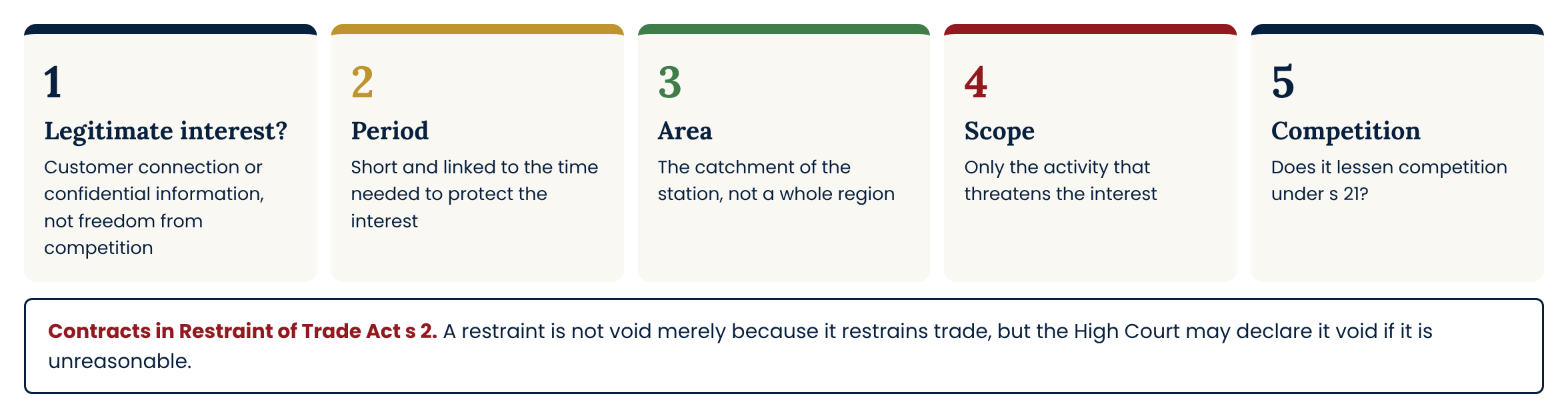
Figure 3. Testing a post termination restraint
VIII. Questions every participant should answer
Was the termination valid? The parties should check the ground relied on, the notice given, the method of service and any procedure for warning or cure, against the signed agreement or, if none was signed, against the offer letter and the conduct of the parties.45
What must each party hand back or pay? The station, the stock, the deposit, the equipment, the takings and the brand must each be dealt with under its own rule.46
What may the dealer do afterwards? Any restraint must be reasonable in duration, area and scope, and must not lessen competition.47
8.1 Practical guidance for dealers
A dealer that receives a termination notice should take advice at once, record the state of the station and the stock, and preserve its records. It should consider whether interim relief is available in the forum named in its agreement, while recognising that damages are the usual remedy. It should prepare for a claim with documents and valuation evidence rather than estimates.
8.2 Practical guidance for oil marketing companies
A company that intends to terminate should check the ground and the notice, gather the evidence of any breach, and plan the handover, including the treatment of stock and deposits. It should avoid self help that pre empts the notice period. It should review its restraints so that they protect the station and nothing more.
IX. Conclusion
The end of a dealer agreement is where the drafting of the agreement is truly tested. The cases show that courts will usually let a company recover its station and confine a dealer to damages, but that they will also hold a company to its notice periods, its obligations to repay deposits and its duty to prove what it alleges. A dealer that has prepared its evidence can recover the real value of what it has lost. Parties who plan for exit at the start, and who can answer the 3 questions in this edition when the end comes, will spend less on the dispute that follows.
Benson Odiwuor is an Advocate of the High Court of Kenya based in Nairobi, whose practice focuses on dispute resolution in the regulated industries, including mining, oil and gas, banking and project finance. He is the editor of The BOLD, Benson Odiwuor’s Legal Digests, a legal newsletter on dispute strategies and legal developments in the regulated industries of Kenya. Subscribe to The BOLD here.
For inquiries, contact the author at info@bensonodiwuor.com.
References
- Agip (Kenya) Ltd v Appollos Kennedy Mwangi t/a Appollos Service Station (Civil Appeal 166 of 1995) [1996] eKLR <https://www.judy.legal/case/agip-kenya-limited-v-appollos-kennedy-mwangi-ta-appollos-service-station>. ↩
- Esso Kenya Ltd v Okiya (Civil Appeal 69 of 1991) [1992] KECA 53 (KLR) <https://new.kenyalaw.org/akn/ke/judgment/keca/1992/53/eng@1992-07-10>. ↩
- Kileleshwa Service Station Ltd v Kenya Shell Ltd (Civil Application Nai 84 of 2008) [2008] eKLR <https://www.judy.legal/case/kileleshwa-service-station-limited-v-kenya-shell-limited>. ↩
- Esso v Okiya (n 2). ↩
- Total (Kenya) Ltd (formerly Caltex Oil (Kenya) Ltd) v Janevams Ltd (Civil Appeal 178 of 2005) [2015] KECA 822 (KLR) <https://new.kenyalaw.org/akn/ke/judgment/keca/2015/822>. ↩
- Matu v Rubis Energy Kenya Plc (Tribunal Appeal E003 of 2025) [2025] KEET 29 (KLR) <https://new.kenyalaw.org/akn/ke/judgment/keet/2025/29/eng@2025-06-26>. ↩
- ‘KenolKobil Respite in Sh32m Row with Ex Landlord’ Business Daily (Nairobi, 8 July 2024) <https://www.businessdailyafrica.com/bd/corporate/companies/kenolkobil-respite-in-sh32m-row-with-ex-landlord-4683124>. ↩
- Kileleshwa (2008) (n 3); Shell-Mex and BP Ltd v Manchester Garages Ltd [1971] 1 WLR 612 (CA). ↩
- Njane t/a Argwings Twin Service Station & another v Total Kenya Limited & another (Civil Case 433 of 2010) [2025] KEHC 14898 (KLR) paras 79 to 86 <https://new.kenyalaw.org/akn/ke/judgment/kehc/2025/14898/eng@2025-10-24>. ↩
- Esso v Okiya (n 2). ↩
- ‘Petrol Station Dealer Gets Reprieve in Row with Total Kenya’ Daily Nation (Nairobi) <https://nation.africa/kenya/news/petrol-station-dealer-gets-reprieve-in-row-with-total-kenya-45472>; Arbitration Act 1995 (No 4 of 1995) s 7. ↩
- Janevams (n 5). ↩
- Janevams (n 5). ↩
- Njane (n 9) paras 127 to 137. ↩
- Kileleshwa Service Station Ltd v Kenya Shell Ltd (Civil Appeals 205 and 239 of 2008) [2012] KECA 13 (KLR) <https://new.kenyalaw.org/akn/ke/judgment/keca/2012/13/eng@2012-04-20>. ↩
- Petroleum Act 2019 (No 2 of 2019), now Cap 308 of the Laws of Kenya s 83 <https://new.kenyalaw.org/akn/ke/act/2019/2>; Petroleum (Retail Dispensing Site Construction and Licensing) (No 2) Regulations 2025 (LN 188 of 2025) regs 14(2), 15(1) and 17 <https://epra.go.ke/extras/legal/web/uploads/6a5f3964c4b13_The%20Petroleum%20(Retail%20Dispensing%20Site%20Construction%20and%20Licensing)(No%202)%20Regulations.pdf>. ↩
- Contracts in Restraint of Trade Act (Cap 24) s 2 <https://www.judy.legal/legislation/akn/ke/act/1932/40>. ↩
- CM Advocates, ‘The Courts’ Decisions on Covenants in Restraint of Trade in Employment Contracts’ (2 August 2022) <https://cmadvocates.com/blog/the-courts-decisions-on-covenants-in-restraint-of-trade-in-employment-contracts/>. ↩
- Competition Act 2010 (No 12 of 2010), now Cap 504 of the Laws of Kenya s 21. ↩
- ‘CAK Orders Total’s Anti-Competition Clauses Expunged’ Daily Nation (Nairobi) <https://nation.africa/kenya/business/cak-orders-total-s-anti-competition-clauses-expunged-138340>. ↩
- Esso v Okiya (n 2). ↩
- Agip v Appollos (n 1). ↩
- Sale of Goods Act (Cap 31) ss 19 to 22 <https://new.kenyalaw.org/akn/ke/act/1930/33/eng@1964-11-03>. ↩
- Matu (n 6). ↩
- Janevams (n 5). ↩
- Njane (n 9) para 166. ↩
- Matu (n 6). ↩
- Kileleshwa (2008) (n 3). ↩
- Trade Marks Act (Cap 506). ↩
- Mugwetwa v Rubis Energy Kenya PLC & another (Environment and Land Case E003 of 2023) [2024] KEELC 5710 (KLR) <https://new.kenyalaw.org/akn/ke/judgment/keelc/2024/5710/eng@2024-07-25>. ↩
- Lexo Energy Kenya Ltd v Nyanya [2025] KEELC 3413 (KLR) <https://new.kenyalaw.org/akn/ke/judgment/keelc/2025/3413/eng@2025-04-29>; ‘Vivo Energy to Cement Dominance with Lexo Deal’ Business Daily (Nairobi, 2023) <https://www.businessdailyafrica.com/bd/corporate/companies/vivo-energy-to-cement-dominance-with-lexo-deal--4388922>. ↩
- Employment Act 2007 (No 11 of 2007) s 40. ↩
- Competition Authority of Kenya, ‘Decision on the Proposed Acquisition of Control of Gulf Energy Holdings Limited by KenolKobil Plc’ (2020) para 53 <https://cak.go.ke/sites/default/files/determinations/2024-07/CAK%20Decision%20on%20Acquisition%20of%20Control%20of%20Gulf%20Energy%20Holdings%20Limited%20by%20KenolKobil%20Plc%20(1).pdf>. ↩
- Contracts in Restraint of Trade Act s 2. ↩
- Esso Petroleum Co Ltd v Harper’s Garage (Stourport) Ltd [1968] AC 269 (HL). ↩
- ‘CAK Orders Total’s Anti-Competition Clauses Expunged’ (n 20). ↩
- Harper’s Garage (n 35). ↩
- Njane (n 9) para 3. ↩
- ‘KPC Ordered to Pay KenolKobil Sh4.6 Billion’ Business Daily (Nairobi) <https://www.businessdailyafrica.com/Corporate-News/-/539550/845712/-/14x6tmyz/-/index.html>. ↩
- Njane (n 9) paras 127 to 137. ↩
- Njane (n 9) para 100. ↩
- Competition Act s 24A. ↩
- Matu (n 6); Energy Act 2019 (No 1 of 2019), now Cap 314 of the Laws of Kenya s 36. ↩
- Times Touch Enterprises Ltd v Rubis Energy Kenya PLC [2024] KEHC 13956 (KLR) <https://new.kenyalaw.org/akn/ke/judgment/kehc/2024/13956/eng@2024-11-12>. ↩
- Njane (n 9) paras 79 to 86; Esso v Okiya (n 2). ↩
- Sale of Goods Act ss 19 to 22; Janevams (n 5). ↩
- Contracts in Restraint of Trade Act s 2; Competition Act s 21. ↩