
Fuel Pricing Disputes and the Regulator in Kenya. The Price at the Pump
2 November 2026
Every month the regulator sets the maximum price of fuel, and every month the price is contested. The law answers 3 questions. Did the Authority apply the formula lawfully? Were the choices on taxes, levies and subsidies made by the right body? Is the dispute in the right forum? This edition answers each of them from the law and the decided cases.
| KEY POINTS AT A GLANCE The Energy and Petroleum Regulatory Authority sets maximum wholesale and retail prices for super petrol, diesel and kerosene on the 14th day of each month. The prices apply from the 15th to the 14th of the following month. The prices are computed under the Petroleum (Pricing) Regulations 2022, made under section 101(y) of the Petroleum Act 2019. They start from the weighted average landed cost of cargoes discharged at Mombasa between the 10th of the previous month and the 9th of the pricing month, and add taxes, levies, costs and regulated margins. Prices may be stabilised using the Petroleum Development Levy Fund, and the Authority has at times cross subsidised one product with another. In Ithagi (2024) the High Court held that cross subsidy was lawful and not discriminatory. In 2026 prices rose sharply. VAT on fuel was cut from 16 per cent to 13 per cent and then to 8 per cent in 2 days in April, and Parliament amended the VAT Act to regularise the cut. Courts have so far declined to set prices. In September 2025 the High Court dismissed a petition by Kituo cha Sheria. Consolidated petitions by the Law Society of Kenya and an activist on transparency in pricing remain pending. Every pricing dispute turns on 3 questions. Did the Authority apply the formula lawfully? Were the policy choices on taxes, levies and subsidies made by the right body in the right way? Is the dispute in the right forum? |
I. Introduction
Few regulatory decisions touch as many Kenyans as the monthly review of fuel prices. The price of diesel moves the cost of transport, food and manufacturing, and the price of kerosene matters to households that cook and light with it. It is no surprise that pricing decisions are regularly challenged in court, debated in Parliament and contested in public.
The year 2026 tested the system as rarely before. Conflict in the Middle East raised landed costs sharply. In April the Authority recorded rises of more than 40 per cent in the landed cost of super petrol and more than 68 per cent in that of diesel over a single month.1 The government responded with stabilisation from the Petroleum Development Levy Fund, a cut in VAT that went through 2 legal notices in 2 days, and an amendment to the VAT Act.2 Petitions followed in the High Court, and consumer and professional bodies called for audits of the pricing system.3
This edition of The BOLD explains, from the ground up, how fuel prices are set, who may change them and how decisions may be challenged. It sets out the legal framework, examines the decided and pending cases, and closes with an analysis and practical guidance. It takes no position on matters pending before the courts.
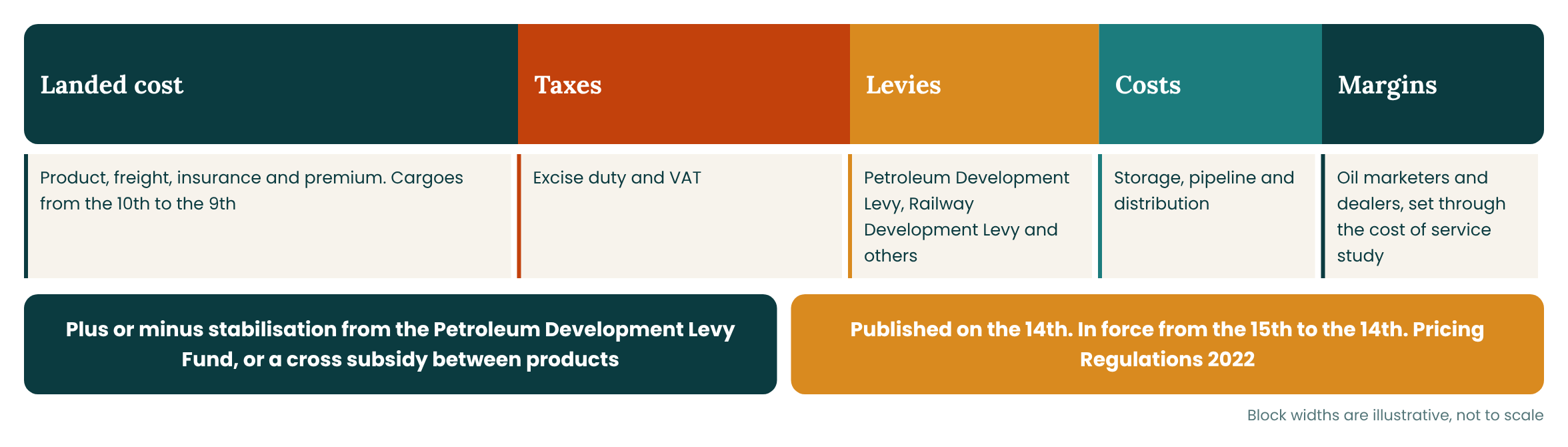
Figure 1. How the maximum pump price is built up under the Petroleum (Pricing) Regulations 2022
II. Foundational concepts
2.1 Landed cost
The landed cost is the cost of a product delivered to Mombasa, including the product itself, freight, insurance and the supplier premium. Under the regulations, it is the weighted average cost of cargoes discharged between the 10th day of the previous month and the 9th day of the pricing month.4 It changes with world prices, the exchange rate and the terms of supply.
2.2 Taxes, levies, costs and margins
To the landed cost are added taxes such as excise duty and VAT, levies such as the Petroleum Development Levy and the Railway Development Levy, the costs of storage and distribution, and the margins allowed to oil marketers and dealers.5 The Authority has explained that storage costs, margins and distribution charges are set through a cost of service study carried out with stakeholders, most recently reviewed in October 2024.6
2.3 Maximum price, stabilisation and cross subsidy
The Authority sets maximum prices. Marketers may sell below them but not above. Stabilisation means using money from the Petroleum Development Levy Fund to compensate marketers for selling below the computed price. Cross subsidy means setting the price of one product above its computed level to keep another product below its own. Both have been used, and both have been challenged.7
III. Legal framework
3.1 Constitution
Article 46 gives consumers the right to goods of reasonable quality, to the information necessary to gain full benefit from goods and services, and to protection of their economic interests.8 Article 43 guarantees economic and social rights. Article 47 requires administrative action to be lawful, reasonable and procedurally fair. Article 10 includes transparency, accountability and public participation among the national values, and Articles 201 and 206 govern the use of public money.9
3.2 Petroleum Act and Pricing Regulations
Section 101(y) of the Petroleum Act empowers the Cabinet Secretary, on the recommendation of the Authority, to make regulations on the pricing of petroleum products.10 The Petroleum (Pricing) Regulations 2022 were made under that power, published on 28 October 2022, and replaced the regulations of 2010.11 Their main rules are set out in Table 1.
Table 1. Main rules of the Petroleum (Pricing) Regulations 2022
| Subject | Rule |
|---|---|
| Publication | The Authority determines and publishes maximum wholesale and retail prices on the 14th day of each month |
| Period | Published prices apply from the 15th day of the month to the 14th day of the following month |
| Landed cost | Weighted average cost of cargoes discharged at Mombasa from the 10th of the previous month to the 9th of the pricing month |
| Wholesale price | The sum of landed cost and the specified cost components, in Kenya shillings per litre |
| Retail price | Wholesale price plus distribution costs and the retail margin |
| Penalty | Breach of the regulations, where no other penalty applies, attracts the fine under section 124 of the Act |
The sources for the table are the regulations and contemporary explanations of them.12
3.3 Petroleum Development Levy and taxes
The Petroleum Development Levy is charged under the Petroleum Development Fund Act and the Levy Order of 2020, and the Fund is used, among other things, to stabilise prices.13 VAT is charged under the VAT Act. The Cabinet Secretary for the National Treasury may vary the rate by order, but section 6(1) limits the variation to 25 per cent of the rate in force.14 Larger changes require an amendment by Parliament.
3.4 Disputes
The Energy Act provides a layered system. The Authority must decide a complaint within 60 days. A person aggrieved by a decision of the Authority may appeal to the Energy and Petroleum Tribunal, which also acquires jurisdiction if the Authority fails to decide in time.15 The High Court retains jurisdiction over constitutional questions, and the Fair Administrative Action Act requires internal remedies to be exhausted before judicial review unless the court exempts the applicant.16
IV. Decided and pending cases
4.1 Ithagi and cross subsidy
From October 2022, after the government ended subsidies on super petrol, the Authority priced super petrol above its computed level in order to keep diesel lower. An advocate who uses super petrol challenged the practice in the High Court at Mombasa. He argued that it imposed a levy without legislation, was inconsistent with the Levy Order and the Fund Act, discriminated against users of super petrol and had been adopted without public participation.17
On 23 January 2024 the High Court dismissed the petition. It held that it had jurisdiction, because the dispute provisions of the Energy Act did not completely oust the jurisdiction of the court. On the merits, it held that the cross subsidy scheme was lawful, justified and supported by statute, and that it was neither unlawful nor discriminatory.18 The judgment gives the Authority room to manage prices across products. It does not remove the need for each decision to be reasoned and within the regulations.
4.2 Finance Act 2023 and VAT
On 30 June 2023 the High Court suspended the Finance Act 2023, which doubled VAT on fuel from 8 per cent to 16 per cent. The Authority nonetheless recalculated prices with VAT at 16 per cent from 1 July 2023, and marketers applied them.19 The episode shows how quickly a tax decision passes into the pump price, and how difficult it is for a court order to keep pace with the monthly cycle.
4.3 Kituo cha Sheria
In December 2023 Kituo cha Sheria petitioned the High Court, arguing that the Authority had failed to pass falling world prices through to Kenyan consumers.20 On 23 September 2025 the court dismissed the petition. It held that the petitioner had not shown how the Authority or the Ministry had violated the rights in Articles 43 and 46, that the measures already taken were reasonable, and that further steps would be policy choices rather than constitutional obligations.21
4.4 Petitions of 2026
On 14 May 2026 the Authority raised super petrol by KSh 16.65 and diesel by KSh 46.29 a litre for the cycle from 15 May to 14 June 2026, using about KSh 5,000,000,000 from the Fund to subsidise diesel and kerosene.22 An activist petitioned the High Court for conservatory orders suspending the prices, disclosure of the full computation, and restraint on the use of the Fund without disclosure. He also challenged a temporary waiver of sulphur standards announced on 30 April 2026.23 The Law Society of Kenya filed a similar petition in Nyamira, relying on Articles 35, 201 and 206.24
The court declined to certify the first petition as urgent.25 In July 2026 the 2 petitions were consolidated, with the petition of the Law Society as the lead matter. The Authority responded that the formula is public, that its components are set through the cost of service study, and that the law does not require fresh public participation each time it applies the regulations.26 The petitions are pending, and nothing in this edition comments on their merits.
The courts will review how a price was set. They have been slow to say what the price should be.

Figure 2. Fuel pricing disputes and interventions, 2022 to 2026
V. Prices and policy in 2026
5.1 VAT in April
On 14 April 2026 the Authority raised super petrol by KSh 28.69 and diesel by KSh 40.30 a litre, after a cut in VAT from 16 per cent to 13 per cent by Legal Notice 69 of 2026 and stabilisation of about KSh 6,200,000,000 from the Fund.27 The next day a second notice, Legal Notice 70, cut VAT further to 8 per cent, and the Authority recalculated prices that took effect on 16 April.28 Because section 6(1) of the VAT Act limits the power of the Cabinet Secretary to a variation of 25 per cent, the second cut exceeded the delegated power. Parliament passed the Value Added Tax (Amendment) Act 2026 within 2 days, with retrospective effect from 15 April 2026.29
5.2 Stabilisation from July to October
In July 2026 the Authority kept prices unchanged. The reduced VAT rate was extended to 14 October 2026, and about KSh 945,000,000 from the Fund was used to hold prices.30 On 14 October 2026 prices rose again, by KSh 12.93 for super petrol, KSh 9.90 for diesel and KSh 28.49 for kerosene, and the government chose not to apply stabilisation in that cycle.31 The Motorists Association of Kenya questioned why kerosene, which had the smallest percentage rise in landed cost, had the largest percentage rise at the pump. It called for the Authority to publish full worksheets for each product.32
Table 2. Interventions in fuel prices in 2026
| Cycle | Intervention | Legal instrument |
|---|---|---|
| 15 April to 14 May | VAT cut to 13 per cent, then 8 per cent. Stabilisation of about KSh 6,200,000,000 | Legal Notices 69 and 70 of 2026. VAT (Amendment) Act 2026 |
| 15 May to 14 June | Stabilisation of about KSh 5,000,000,000 on diesel and kerosene. Temporary waiver of sulphur standards | Levy Order and Fund Act. Standards notice |
| 15 July to 14 August | Prices unchanged. Reduced VAT extended. KSh 945,000,000 from the Fund | Legal notice under the power to extend in the VAT (Amendment) Act 2026 |
| 15 October to 14 November | Prices increased. No stabilisation in the cycle | Pricing Regulations 2022 |
The sources for the table are the reports cited in this Part.33
VI. Analysis
6.1 Role of the Authority
The Authority applies a formula set by regulation. It does not set taxes, which are for Parliament and, within limits, the Treasury. It does not decide to spend the Fund on its own, because stabilisation is a government decision implemented through the Fund. Distinguishing these roles is essential in any challenge. A complaint about the level of VAT is a complaint about the Treasury and Parliament. A complaint about the arithmetic or the inputs is a complaint about the Authority.
6.2 Transparency
The Authority publishes the formula and a monthly summary of prices. Critics argue that the public cannot check the result without the cargo by cargo landed costs, the exchange rates and the stabilisation amounts for each product.34 Article 35 and Article 46(1)(b) support disclosure of the information a consumer needs to understand the price. The question whether those provisions require publication of full worksheets each month is before the High Court in the consolidated petitions.
6.3 Public participation
The Authority contends that public participation took place when the regulations were made and when margins were set in the cost of service study, and that it is not required again for each monthly computation.35 That position is consistent with the view that applying a formula is not making a new rule. A different question arises when the government changes taxes, waives standards or decides how to use the Fund. Those are policy choices, and the duty to involve the public applies to them with more force.
6.4 Limits of judicial relief
The Kituo cha Sheria judgment shows that courts will not order lower prices merely because prices are high, and that measures to cushion consumers are matters of policy.36 Ithagi shows that the Authority has room to manage prices across products. The 2023 experience with VAT shows that interim orders are hard to apply within a monthly cycle.37 The more promising challenges are those that target the process. Examples are a computation that departs from the regulations, a use of public money without the required authority, or a decision taken without the information or consultation that the law requires.
6.5 Forum
A licensee or consumer aggrieved by a decision of the Authority should consider the Energy and Petroleum Tribunal first. The High Court has referred pricing disputes to the Tribunal where the claimant had not exhausted that route, and objections to jurisdiction on this ground are raised regularly.38 Constitutional challenges to regulations, taxes or the use of the Fund belong in the High Court, as Ithagi and the consolidated petitions show.
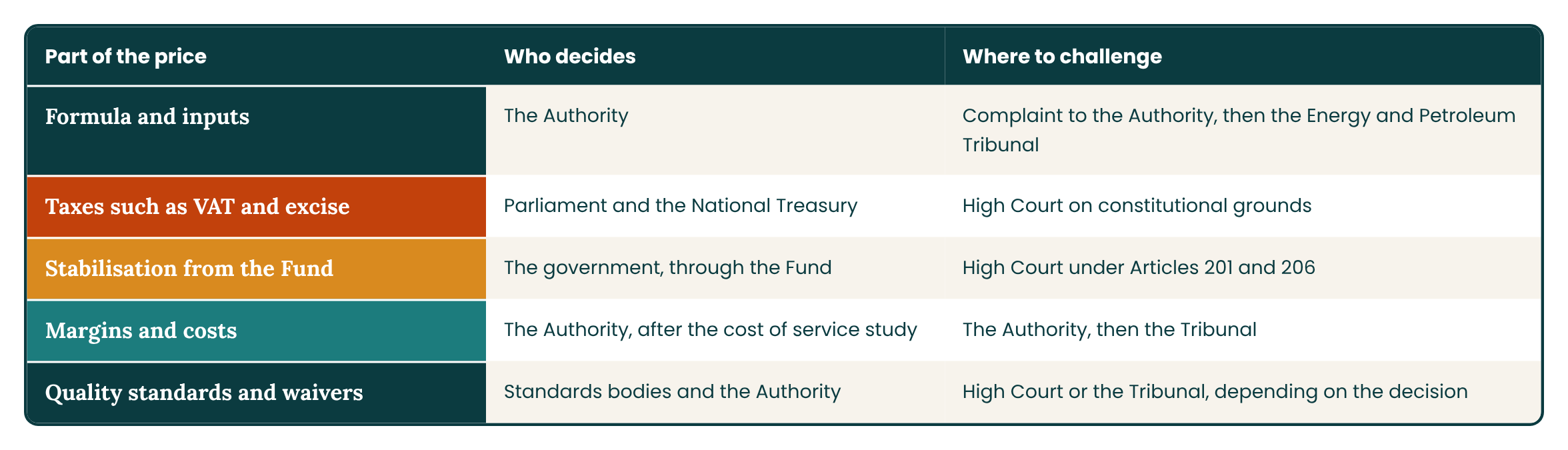
Figure 3. Who decides each part of the pump price, and where each decision may be challenged
Table 3. Open legal questions on fuel pricing
| Question | Present position |
|---|---|
| Must the Authority publish full pricing worksheets each month? | Before the High Court in the consolidated petitions |
| Is fresh public participation required for each monthly review? | The Authority says no. Not yet decided |
| Can the Fund be used to stabilise prices without detailed disclosure? | Challenged in the consolidated petitions |
| Is cross subsidy between products lawful? | Yes, according to Ithagi (2024) |
| Can a court order lower prices? | The Kituo cha Sheria judgment says further relief is a matter of policy |
VII. Next round
7.1 Questions every party should answer
Table 4. Questions every party to a pricing dispute should be able to answer
| Question | Why it matters |
|---|---|
| Is the complaint about the formula, the inputs, a tax or the use of the Fund? | Each is decided by a different body and challenged in a different way |
| Was the decision made within the time and procedure set by law? | Procedural defects are the most promising grounds of review |
| Has the complaint first been taken to the Authority or the Tribunal? | The Energy Act and the doctrine of exhaustion may require it |
| What information is needed, and has it been requested under Article 35? | Disclosure is often the first remedy that matters |
| What relief is realistic within a monthly cycle? | Interim orders against prices are rarely granted |
7.2 What each party should do
Table 5. Practical guidance drawn from the law and the cases
| Party | What the law and the cases counsel |
|---|---|
| Oil marketing companies and dealers | Comply with maximum prices, keep records of costs and claims on the Fund, and raise disputes over margins or compensation with the Authority first |
| Consumers and their associations | Request information under Article 35, identify the body responsible for the decision, and frame challenges around process and disclosure |
| The Authority | Publish the inputs for each product with each review, and give reasons for any cross subsidy or stabilisation |
| The National Treasury and Parliament | Make tax changes within the limits of the VAT Act, and report the use of the Fund |
VIII. Conclusion
The monthly review is a regulated calculation built on a formula, but the price at the pump also reflects taxes, levies, stabilisation and policy choices made by others. In 2026 every part of that structure was tested, from the formula to the VAT rate to the use of the Fund. The courts have so far upheld the authority of the regulator to manage prices and declined to set prices themselves.
The questions now before the High Court concern transparency and process rather than the level of prices. That is where the law is likely to develop. For the Authority, the lesson is that the more it discloses, the less it will need to defend. For those who challenge it, the lesson is to aim at the right decision maker, in the right forum, on the grounds the law recognises.
Benson Odiwuor is an Advocate of the High Court of Kenya based in Nairobi, whose practice focuses on dispute resolution in the regulated industries, including mining, oil and gas, banking and project finance. He is the editor of The BOLD, Benson Odiwuor’s Legal Digests, a legal newsletter on dispute strategies and legal developments in the regulated industries of Kenya. Subscribe to The BOLD here.
For inquiries, contact the author at info@bensonodiwuor.com.
References
- ‘Diesel Price Rises by Ksh40.30 per Litre, Petrol Shoots by Ksh28.69 in Latest EPRA Review’ People Daily (Nairobi, 14 April 2026) <https://peopledaily.digital/news/diesel-price-rises-by-ksh40-30-per-litre-petrol-shoots-by-ksh28-69-in-latest-epra-review/amp>. ↩
- ‘Kenya Cuts VAT to 8%: Petrol Now KSh 197.60, Diesel KSh 196.63’ Kenyan Wall Street (16 April 2026) <https://kenyanwallstreet.com/govt-cuts-fuel-vat-to-8-april-2026>; ALN Kenya, ‘Temporary Reduction of VAT on Selected Petroleum Products’ (April 2026) <https://aln.africa/insight/temporary-reduction-of-vat-on-selected-petroleum-products/>. ↩
- Nancy Gitonga, ‘Petition Filed to Halt Fuel Prices Hike as Activist Cites Illegality, Economic Harm’ The Standard (Nairobi, 18 May 2026) <https://www.standardmedia.co.ke/business/amp/national/article/2001548087/petition-filed-to-halt-fuel-prices-hike-as-activist-cites-illegality-economic-harm>; Dzuya Walter, ‘LSK Moves to Court to Challenge EPRA over Fuel Price Hike’ Citizen Digital (Nairobi, 19 May 2026) <https://citizen.digital/article/lsk-moves-to-court-to-challenge-epra-over-fuel-price-hike-n383035>; ‘Kenya: Motorists Association Demands Independent Audit of EPRA Fuel Prices, G-to-G Oil Deal’ allAfrica (15 October 2026) <https://allafrica.com/stories/202610150203.html>. ↩
- Petroleum (Pricing) Regulations 2022 (LN 192 of 2022) sch 2 <https://new.kenyalaw.org/akn/ke/act/ln/2022/192>; ‘Inside Kenya’s G-to-G Fuel Deal: Credit Terms, Pump-Price Formula and Audit Questions’ Pulse Kenya (15 October 2026) <https://www.pulse.co.ke/story/inside-kenyas-g-to-g-fuel-deal-credit-terms-pump-price-formula-and-audit-questions-2026101518281667154>. ↩
- ‘How Fuel Prices Are Calculated in Kenya’ Citizen Digital (Nairobi, 2025) <https://citizen.digital/article/how-fuel-prices-are-calculated-in-kenya-n366753>. ↩
- ‘Kenya: High Court Consolidates Petitions Challenging Kenya Fuel Prices’ allAfrica (Capital FM, 2 July 2026) <https://allafrica.com/stories/202607020386.html>. ↩
- Ithagi v Energy & Petroleum Regulatory Authority & another (Constitutional Petition E005 of 2023) [2024] KEHC 483 (KLR) <https://new.kenyalaw.org/akn/ke/judgment/kehc/2024/483/eng@2024-01-23>; ‘Cross-Subsidy on Super Petrol Denies Diesel Users Ksh1.77 per Litre Drop’ Kenyans.co.ke<https://www.kenyans.co.ke/news/101659-cross-subsidy-super-petrol-denies-diesel-users-ksh177-litre-drop>. ↩
- Constitution of Kenya 2010 art 46(1). ↩
- Constitution of Kenya 2010 arts 10, 43, 47, 201 and 206. ↩
- Petroleum Act 2019 (No 2 of 2019), now Cap 308 of the Laws of Kenya s 101(y) <https://new.kenyalaw.org/akn/ke/act/2019/2>. ↩
- Petroleum (Pricing) Regulations 2022. ↩
- Petroleum (Pricing) Regulations 2022 reg 3 and sch 2; ‘How Fuel Prices Are Calculated’ (n 5). ↩
- Petroleum Development Fund Act (Cap 426), and Petroleum Development Levy Order 2020; Ithagi (n 7). ↩
- Value Added Tax Act 2013 (No 35 of 2013) s 6(1); ALN, ‘Temporary Reduction of VAT’ (n 2). ↩
- Energy Act 2019 (No 1 of 2019), now Cap 314 of the Laws of Kenya ss 23, 25 and 36; Energy and Petroleum Tribunal, directions of 17 October 2024 [2024] KEET 417 (KLR) <https://new.kenyalaw.org/akn/ke/judgment/keet/2024/417/eng@2024-10-17>. ↩
- Fair Administrative Action Act 2015 (No 4 of 2015) s 9; Ithagi (n 7). ↩
- Ithagi (n 7). ↩
- Ithagi (n 7). ↩
- ‘Oil Marketers Implement Higher Epra Prices despite Court Order’ Daily Nation (Nairobi, July 2023) <https://nation.africa/kenya/news/oil-marketers-implement-higher-epra-prices-despite-court-order--4289622>; Yunus Kemp, ‘Kenya: EPRA Defies Court Ruling, Increases Price of Petroleum Products’ ESI Africa (July 2023) <https://www.esi-africa.com/east-africa/kenya-epra-defies-court-ruling-increases-price-of-petroleum-products/>. ↩
- Kamau Muthoni, ‘Kituo cha Sheria Sues EPRA for Retaining Fuel Cost above Sh200’ The Standard (Nairobi, 11 December 2023) <https://www.standardmedia.co.ke/business/article/2001487100/kituo-cha-sheria-sues-epra-for-retaining-fuel-cost-above-sh200>. ↩
- Judgment of the High Court (Chacha Mwita J) of 23 September 2025 on the petition by Kituo cha Sheria against the Energy and Petroleum Regulatory Authority and the Cabinet Secretary for Energy and Petroleum, filed in December 2023; James Gichigi, ‘High Court Dismisses Petition Challenging Fuel Prices’ The Star (Nairobi, 23 September 2025) <https://www.the-star.co.ke/news/2025-09-23-high-court-dismisses-petition-challenging-fuel-prices>. ↩
- ‘EPRA: Petrol and Diesel Prices Increase by Sh16.65, Sh46.29 per Litre Respectively’ The Standard (Nairobi, May 2026) <https://www.standardmedia.co.ke/national/article/2001547851/epra-petrol-and-diesel-prices-increase-by-sh1665-sh4629-per-litre-respectively>; ‘Fuel Shock at the Pump as EPRA Raises Petrol and Diesel Prices’ Dawan Africa (14 May 2026) <https://www.dawan.africa/news/fuel-shock-at-the-pump-as-epra-raises-petrol-and-diesel-prices>. ↩
- Gitonga, ‘Petition Filed to Halt Fuel Prices Hike’ (n 3). ↩
- Walter, ‘LSK Moves to Court’ (n 3). ↩
- Sheila Mutua, ‘Court Declines Urgent Hearing in Petition Challenging EPRA Fuel Price Hike’ Radio47 (22 May 2026) <https://www.radio47.fm/news/court-declines-urgent-hearing-in-petition-challenging-epra-fuel-price-hike-31382/>. ↩
- ‘High Court Consolidates Petitions’ (n 6). ↩
- ‘Kenya Cuts VAT to 8%’ (n 2). ↩
- ‘Kenya Cuts VAT to 8%’ (n 2); Legal Notice 69 of 2026 and Legal Notice 70 of 2026, issued under section 6(1) of the Value Added Tax Act 2013. ↩
- ALN, ‘Temporary Reduction of VAT’ (n 2). ↩
- Brian Kimani, ‘Petrol, Diesel, Kerosene Prices Remain Unchanged in Latest EPRA Review’ Citizen Digital (Nairobi, 14 July 2026) <https://citizen.digital/article/petrol-diesel-kerosene-prices-remain-unchanged-in-latest-epra-review-n386481>; ‘Fuel Prices Remain Unchanged as EPRA Retains Pump Rates for Another Month’ Eastleigh Voice (Nairobi, July 2026) <https://eastleighvoice.co.ke/news/379363/fuel-prices-remain-unchanged-as-epra-retains-pump-rates-for-another-month>. ↩
- ‘Motorists Association Demands Independent Audit’ (n 3); ‘Updated Prices for Petrol, Diesel and Kerosine for the Next 30 Days’ Ghanamma (October 2026) <https://www.ghanamma.com/?p=194021>. ↩
- ‘Motorists Association Demands Independent Audit’ (n 3). ↩
- ‘Kenya Cuts VAT to 8%’ (n 2); ‘Fuel Shock at the Pump’ (n 22); Kimani, ‘Prices Remain Unchanged’ (n 30); ‘Motorists Association Demands Independent Audit’ (n 3). ↩
- ‘Motorists Association Demands Independent Audit’ (n 3). ↩
- ‘High Court Consolidates Petitions’ (n 6). ↩
- Kituo cha Sheria judgment (n 21). ↩
- ‘Oil Marketers Implement Higher Epra Prices’ (n 19). ↩
- ‘Court Throws Out Suit on Petroleum Pricing’ Business Daily (Nairobi) <https://www.businessdailyafrica.com/bd/economy/court-throws-out-suit-on-petroleum-pricing-2725990>; High Court judgment of 19 June 2025 [2025] KEHC 8541 (KLR), in which the appellate jurisdiction of the Energy and Petroleum Tribunal was raised as an objection <https://new.kenyalaw.org/akn/ke/judgment/kehc/2025/8541/eng@2025-06-19>. ↩