
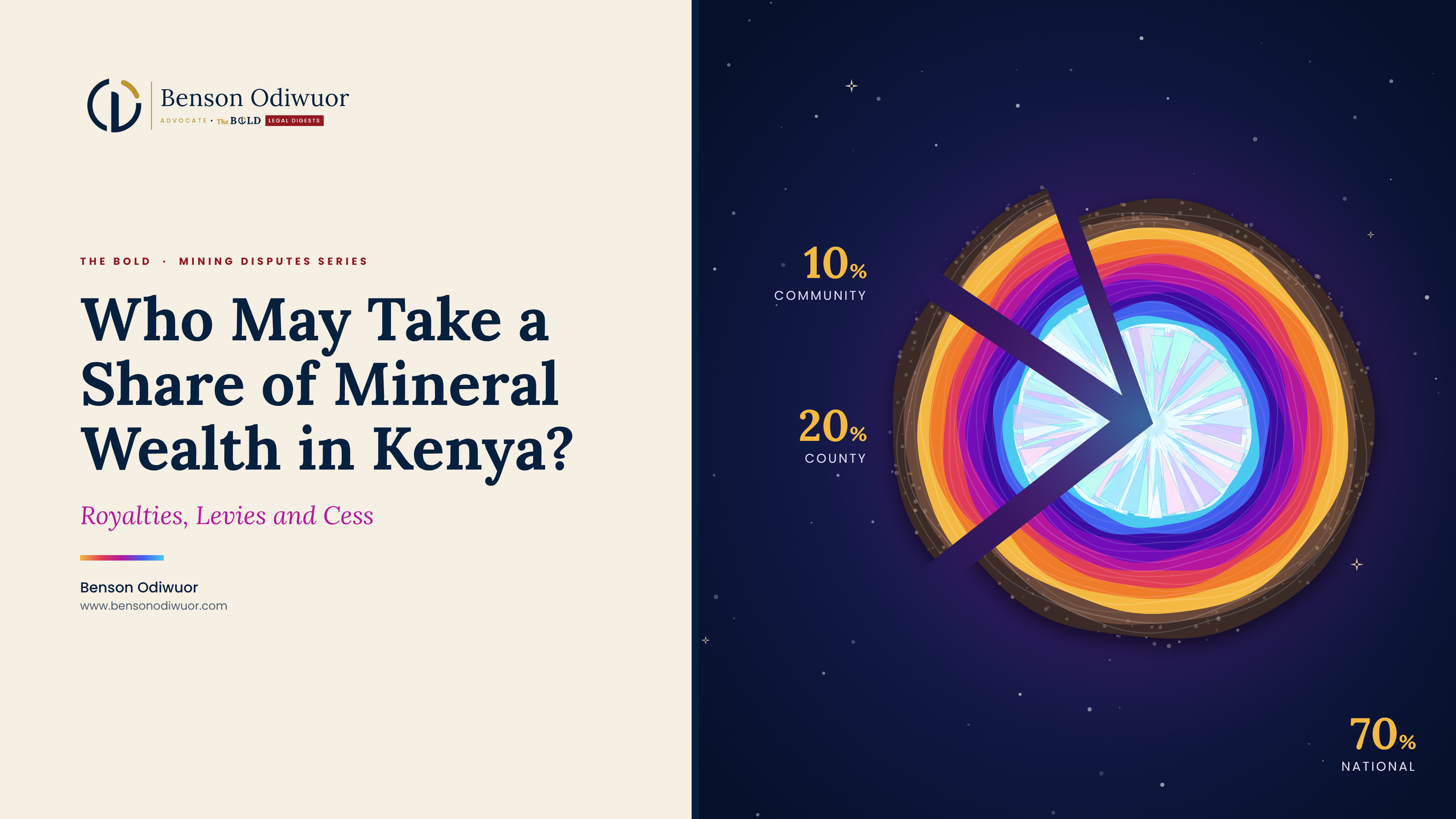
Who May Take a Share of Mineral Wealth in Kenya? Royalties, Levies and Cess
31 October 2026
Every operator, lender, county government treasury, regulator and host community must eventually answer 3 questions. Who has the constitutional power to charge for minerals? How must that charge be lawfully made? What happens to money collected under a charge the courts strike down? This edition answers each of them from the decided cases.
| KEY POINTS AT A GLANCE Minerals in Kenya belong to the people of Kenya. The Constitution classifies them as public land and vests them in the national government, which holds them in trust. The holder of a mineral right pays a royalty to the State on the minerals it wins. The Mining Act divides that royalty, with 70 per cent going to the national government, 20 per cent to the county government and 10 per cent to the community where the mining takes place. A county government may not tax minerals. It may charge only for a service that it actually provides, or impose a tax that an Act of Parliament authorises. The Supreme Court applied that rule in 2021 to strike down a cess on trucks carrying titanium, and the High Court applied it in October 2026 to strike down a county government cess on salt. The national government may prescribe royalties, fees and charges, but only through regulations made after genuine public consultation. The High Court struck down the royalty rates of 2013 on that ground in 2023, and quashed the 5 Mining Regulations of 2024, including the Mineral Development Levy, in 2025. When a charge is declared unlawful, a refund is not automatic. The Supreme Court ordered one against a county government in 2021. The High Court declined to order one against the Ministry in 2025 because of the disruption it would cause. Every new fiscal measure in the sector, including any restriction on the export of raw minerals, will be measured against the same 4 questions of power, process, substance and remedy. |
I. Introduction
A mineral leaves the ground in Kenya and, almost immediately, several hands reach for a share of its value. The national government expects a royalty on every tonne that is won. The Ministry responsible for mining charges application fees, annual rent and, for a period, charged a mineral development levy. The county government of the area through which the ore is carried may demand a cess on each truck that crosses its boundary. The community that lives above the deposit waits for the share of royalties that Parliament promised it in 2016. Each of these claims is made in the name of the public, and each of them has, in the last decade, been tested in a Kenyan court.
The decisions that resulted are rarely read together, yet together they form a coherent body of law. They answer 3 questions that every operator, lender, county treasury, regulator and host community must eventually ask. The first is who has the constitutional power to charge for minerals. The second is the process by which that charge must be made. The third is what happens to money that was collected under a charge that the courts later strike down.
This edition of The BOLD answers those questions from the ground up. It begins with the basic ideas, namely who owns minerals in Kenya, what a mineral right is, and how a royalty differs from a tax, a fee, a levy and a cess. It then sets out the constitutional and statutory rules that govern every public charge. With that foundation in place, it examines the leading decisions on county government charges, on ministerial regulations and on the community share of royalties, before turning to the difficult question of refunds. It closes with the questions that any court will ask about the next round of fiscal measures in the sector, and with practical guidance for each of the parties involved.
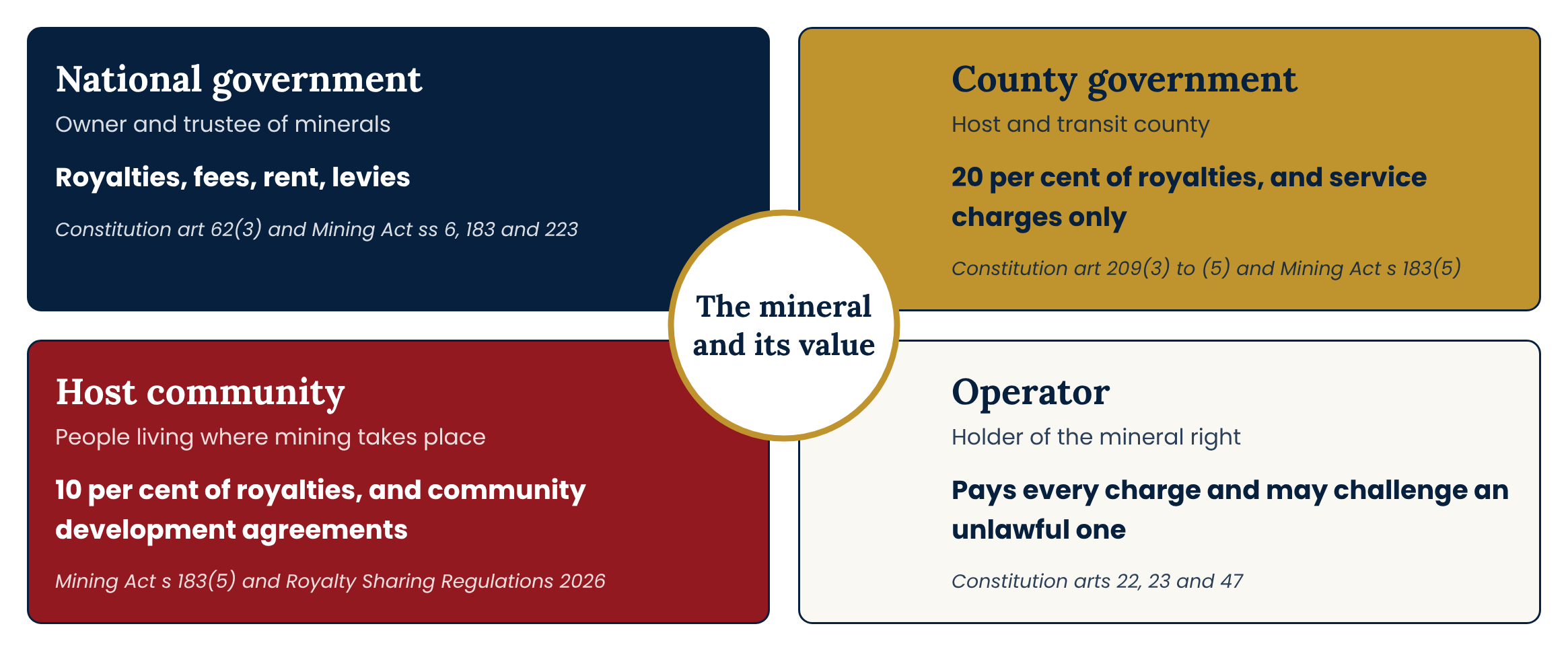
Figure 1. Claimants to revenue from a Kenyan mine and legal basis of each claim
II. Foundational concepts
2.1 Who owns minerals
The starting point is ownership. The Constitution divides land in Kenya into public, community and private land, and it places minerals and mineral oils in the category of public land.1 It then vests that category of public land in the national government, to be held in trust for the people of Kenya.2 The Mining Act repeats the point by vesting every mineral in its natural state in the Government, whoever owns the land above it.3
This has a consequence that surprises many landowners. A person who owns a farm in Kenya owns the surface and the soil, but does not own the gold, the gemstones or the titanium beneath it. Those belong to the nation. The landowner has rights to be consulted and to be compensated for loss caused by mining operations, but the mineral itself is not part of the title.4
2.2 What a mineral right is
Because the State owns the minerals, no one may prospect for them or mine them without permission. The Mining Act provides that permission in the form of mineral rights, which include prospecting licences, retention licences, mining licences for large scale operations, mining permits for small scale operations, and licences for those who deal in minerals.5 A mining licence gives its holder the exclusive right to mine in the licensed area and to dispose of the minerals recovered, subject to paying the prescribed fees and royalties.6
A mineral right is therefore a grant by the owner of the resource. It allows a private party to take something that belongs to the public, and it is in return for that privilege that the public charges a royalty.
2.3 Royalty, tax, fee, levy and cess
Much of the confusion in this area comes from the fact that several different kinds of public charge fall on the same mineral. They have different legal foundations, and the difference is often decisive in litigation. Table 1 sets out the distinctions in plain terms.
Table 1. Main public charges in the mining sector and how they differ
| Charge | What it is | Who may impose it | Legal foundation |
|---|---|---|---|
| Royalty | A payment to the owner of the mineral for the right to take it, calculated on the value of the minerals won | The national government, through rates prescribed by the Cabinet Secretary | Mining Act s 183 and regulations under s 223 |
| Fee | A payment for a specific act of the State, such as processing an application or issuing a licence | The authority that performs the act, within the power given by statute | Mining Act s 223 and fee regulations |
| Rent | An annual payment for holding a mineral right over an area | The national government | Mining Act and licence regulations |
| Tax | A compulsory payment to raise general revenue, with no specific service given in return | The national government, or a county government where an Act of Parliament authorises it | Constitution art 209(1) to (3) and art 210 |
| Levy | A charge imposed for a defined purpose, often to fund a policy objective. Where it raises general revenue it behaves like a tax | Depends on its character. A levy that is in substance a tax needs clear legislative authority | Constitution art 210 and the parent statute |
| Cess | A charge usually imposed by a county government on goods moving through or produced in it | A county government, but only as a charge for a service it provides or as a tax authorised by an Act of Parliament | Constitution art 209(3) to (5) |
The decisions discussed in this edition turn largely on these distinctions. A county government may call a charge a cess, but if it provides no service in return, the courts treat it as a tax. The Ministry may call a charge a levy, but if it raises general revenue, it may need clearer authority than a power to prescribe fees.
III. Legal framework
3.1 Royalty and how it is shared
The Mining Act requires every holder of a mineral right to pay a royalty to the State in respect of the minerals won by virtue of that right, and it empowers the Cabinet Secretary to prescribe the rates.7 The current rates and the method of calculating the royalty base are contained in the Mining (Royalty Collection and Management) Regulations 2024, which calculate the royalty on the gross value of the minerals extracted.8 In broad terms, gross value is the value of the minerals at the point of sale, before deductions for the costs of the operator.9
Section 183(5) of the Act then divides the royalty collected among 3 recipients. Figure 2 shows the division.10
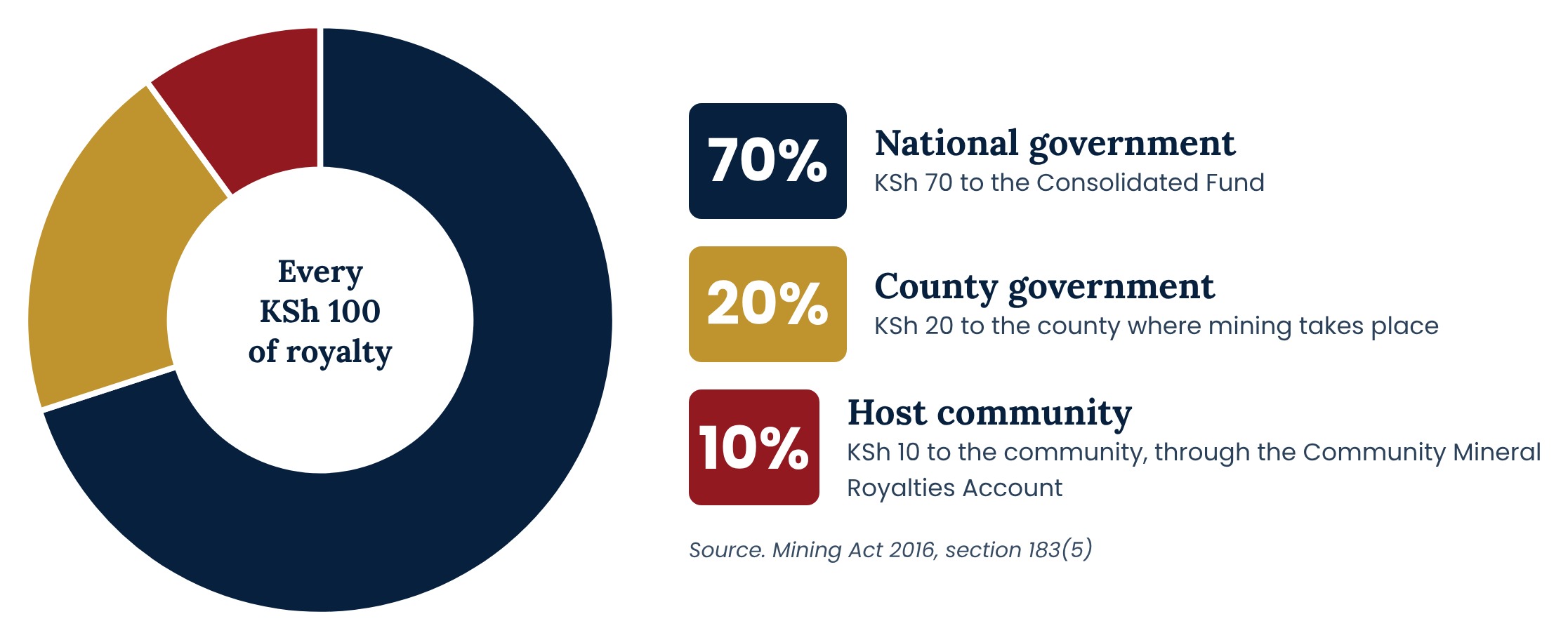
Figure 2. How every shilling of mineral royalty is shared under section 183(5) of the Mining Act
This arrangement has 2 features that are important for what follows. The first is that the county government share is fixed by Parliament. County governments are given 20 per cent of royalties precisely because they are not permitted to tax minerals themselves. The second is that the community share is a statutory entitlement. It does not depend on the goodwill of the operator or the discretion of the Ministry.
3.2 Who may tax and charge
The Constitution allocates the power to tax between the national government and the county governments, and it adds a general rule of legality that binds both. Table 2 sets out the allocation.
Table 2. Allocation of taxing and charging powers under Articles 209 and 210 of the Constitution
| Provision | What it says | What it means for minerals |
|---|---|---|
| Art 209(1) and (2) | Only the national government may impose income tax, value added tax, customs duties and excise, together with any other tax authorised by an Act of Parliament | The main revenue taxes on mining companies are national |
| Art 209(3) | A county government may impose property rates, entertainment taxes and any other tax that an Act of Parliament authorises it to impose | A county Finance Act alone cannot authorise a county government tax on minerals |
| Art 209(4) | The national government and the county governments may impose charges for the services they provide | A county government charge must be tied to a real service the county government itself provides |
| Art 209(5) | County revenue powers must not prejudice national economic policies, economic activity across county boundaries or the national mobility of goods, services, capital or labour | Charges that obstruct the movement of minerals to market are suspect |
| Art 210(1) | No tax or licensing fee may be imposed, waived or varied except as provided by legislation | Every charge, national or county government, needs a lawful legislative source |
3.3 How a lawful charge must be made
The power to charge is only half of the inquiry. The other half concerns the process by which a charge is made. Public participation is a national value that binds every state organ, and Parliament must facilitate it in its legislative business.11 Where Parliament delegates the power to make law, the delegate may exercise it only within the authority conferred, and the Act that confers the power must define its purpose, limits and principles.12
The Statutory Instruments Act gives those principles practical content for regulations made by a Cabinet Secretary. Figure 3 sets out the path that a lawful mining regulation must follow, and marks the points at which the 2 leading cases found the Ministry wanting.13
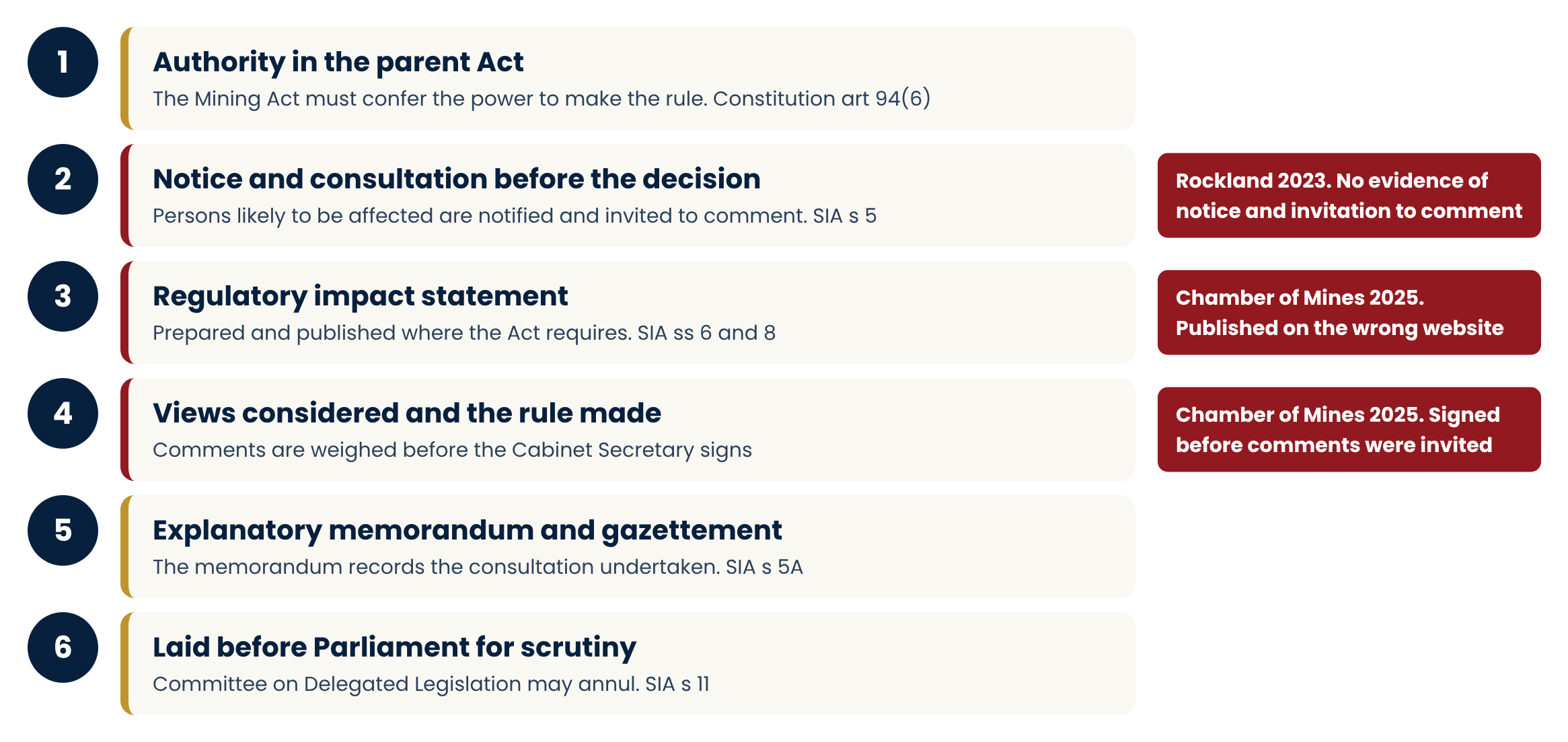
Figure 3. Lawful path of a mining regulation under the Statutory Instruments Act, and where the courts found it was not followed
Every case discussed below turns on one or more of these provisions. The county governments lost because they could not bring their charges within Article 209. The Ministry lost, twice, because it did not make its rules in the manner that the Constitution and the Statutory Instruments Act require. The power to charge for minerals was never in doubt. What the courts insisted upon was that the right body exercise it, and that it be exercised in the right way.
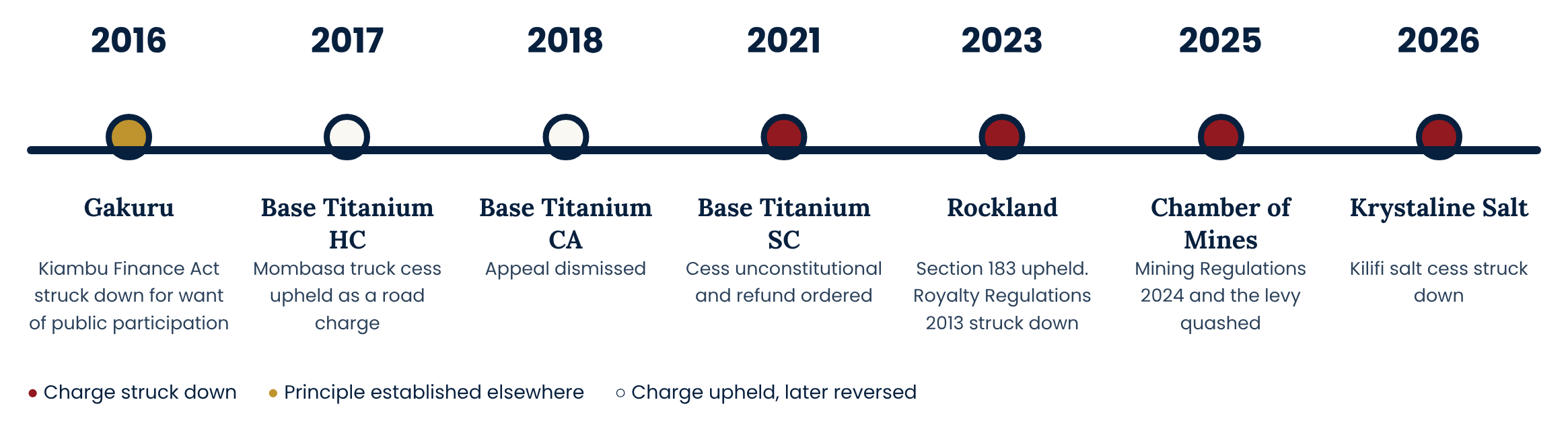
Figure 4. Leading decisions on mineral revenue, 2016 to 2026
IV. County governments and limits of cess
4.1 Base Titanium litigation
The leading decision on county government charges in the mining sector arose from the Kwale mineral sands operation of Base Titanium. In 2014 the County Government of Mombasa began to charge the company a cess on the trucks that carried its mineral products through the county to the port of Mombasa. The county government relied on section 90 of its Finance Act of 2014, which imposed a charge of KSh 3,000 on goods vehicles exceeding 7 tonnes.14 The company challenged the charge as unconstitutional, and the dispute went through all 3 levels of the superior courts.
The High Court. The High Court began with a proposition that no party disputed. Because Article 62 vests minerals in the national government, there is no power in a county government to levy a tax or other charge on the mineral itself.15 The court nevertheless dismissed the petition. It held that the Mombasa cess was not a charge on the mineral but a charge on vehicles for the use of roads, that road transport was a service for which a county government could charge under Article 209(4), and that Article 209(5) did not bar the charge because the company had not proved actual prejudice to trade across county boundaries.16
The Court of Appeal. The Court of Appeal agreed. It accepted that a charge in respect of the minerals themselves would have been unconstitutional, but it treated the cess as a lawful charge for a service.17
The Supreme Court. The Supreme Court reversed both courts.18 It held that a county government may impose a charge under Article 209(4) only in exchange for a service that the county government itself provides. The trucks travelled to the port on a national trunk road managed by the Kenya National Highways Authority, not on a county road, and the county government had not shown what service it rendered in return for the cess. The charge was therefore not a charge for services within the meaning of Article 209(4), and the superior courts had erred in finding otherwise.19 The court declared that the action of the county government in charging the cess, or any sum at all, as a condition for moving the goods of the company across its boundaries was unconstitutional, null and void. It ordered the county government to refund the sum of KSh 1,542,000 paid up to the end of 2014, and left later payments to be pursued in the High Court.20
A county government that cannot tax the mineral at the mine cannot achieve the same result at its boundary.
4.2 What Supreme Court settled
The decision yields 3 principles, and each has consequences well beyond titanium.
The first is that the label a county government attaches to a charge does not determine its character. A cess on trucks that carry minerals may be presented as a road charge, but the court will ask what the county government actually provides in return. If the answer is nothing, the charge is a tax in substance, and a county government may impose a tax only if an Act of Parliament authorises it to do so.
The second is that the burden of justification falls on the county government. The High Court had required the operator to prove economic prejudice under Article 209(5) with concrete evidence. The Supreme Court resolved the appeal on Article 209(4) instead, by asking whether the county government had demonstrated a service. That shift matters in practice. An operator challenging a county government charge need not prove that the charge has damaged the national economy. It is enough to show that the county government cannot point to a service it renders in exchange.
The third is that the constitutional bar on county government taxation of minerals cannot be avoided by indirection. The lower courts accepted that a county government may not charge for the mineral itself. The Supreme Court went further and refused to allow a charge on the movement of the mineral to stand where there was no genuine service behind it.
4.3 Principle applied to salt in 2026
The reach of those principles was confirmed on 2 October 2026, when the High Court at Malindi struck down the salt cess imposed by the County Government of Kilifi.21 The petitioners, 4 salt producers, had challenged a cess on salt extraction that the county government raised under its Finance Act of 2018.22 The court held that the county government had not identified any Act of Parliament authorising the cess, so that it could not be sustained as a tax under Article 209(3). It held that the county government had not identified any service rendered in exchange, so that it could not be sustained under Article 209(4) either. It found that the cess was capable of prejudicing economic activity across county boundaries and the movement of goods, and that the county government had not facilitated meaningful public participation before enacting it.23
Krystaline Salt is instructive for a further reason. A Finance Act passed by a county assembly is legislation, but it is county legislation, and Article 209(3) requires the authority for a county government tax to come from an Act of Parliament. Nor does enactment by a county assembly cure a defective consultative process. The High Court reached the same conclusion about a county Finance Act from Kiambu a decade earlier, when it struck the statute down for want of adequate public participation.24
4.4 Tests for a county government charge on mineral activity
The decisions can be reduced to 3 questions, each of which a county government charge must pass. Figure 5 sets them out in the order in which a court is likely to ask them.
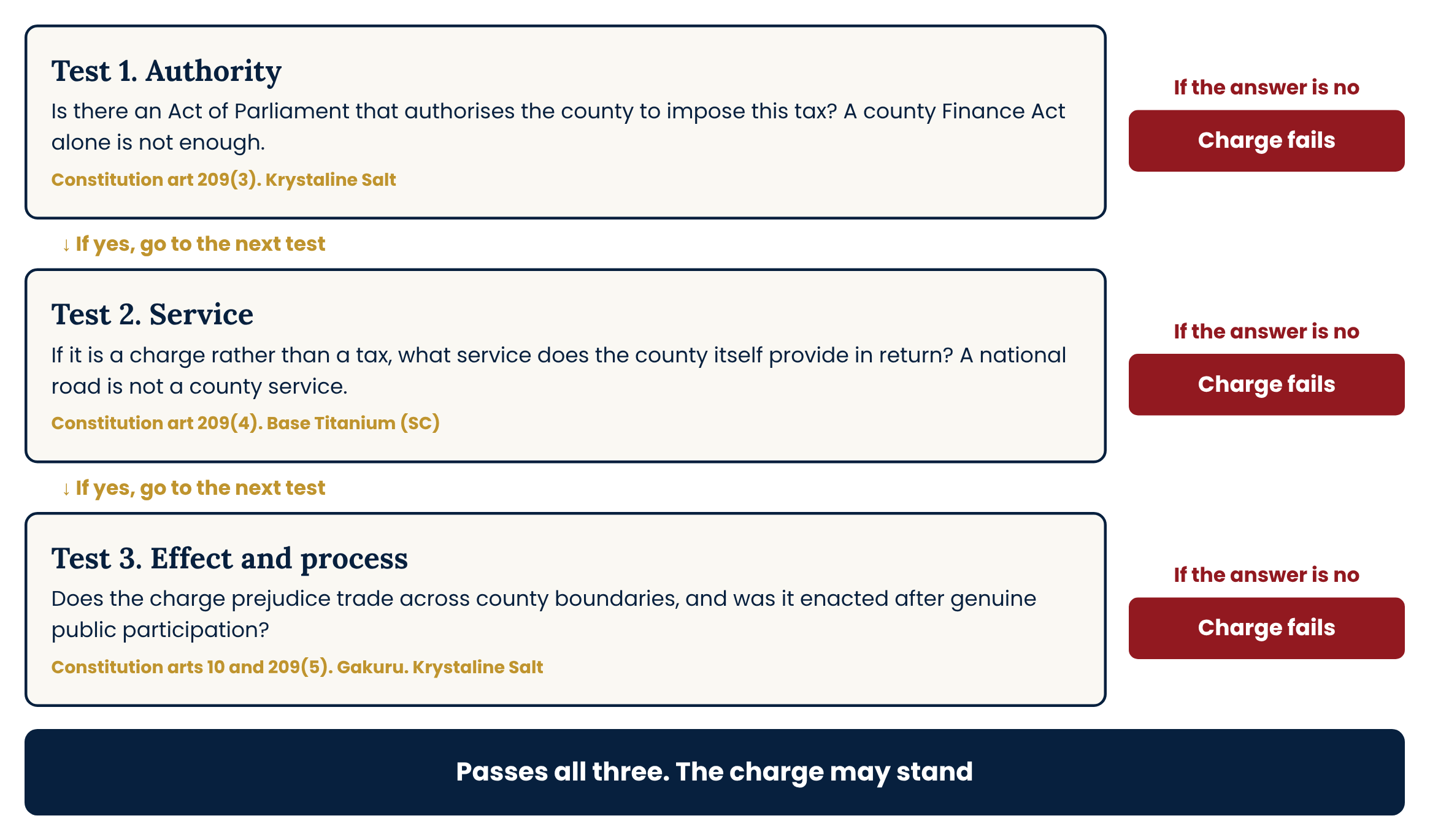
Figure 5. Constitutional tests that a county government charge on mineral activity must pass
For operators, the practical lesson is that a county government demand note is not self validating. It may appear in a Finance Act, carry an official receipt and be enforced at a roadblock, yet still fail every one of the 3 tests. For county governments, the lesson is equally clear. The share of mineral revenue that the Constitution and the Mining Act allocate to them is the 20 per cent of royalties provided for in section 183. A county government that wants more must obtain it from Parliament, or it must provide a real service and charge for that service openly.
V. National government and power to prescribe charges
5.1 Rockland and validity of royalty regime
If county governments may not charge for minerals, the national government plainly may. The question in Rockland Kenya Limited v Cabinet Secretary was not whether royalties are lawful but whether the instruments that impose them were lawfully made.25 The petitioner, a mining company, challenged section 183 of the Mining Act, the Royalty Regulations of 2013 and the Community Development Agreement Regulations of 2017.26
Justice Ong'udi upheld section 183. She characterised a royalty as a levy that shares some features of a tax while remaining distinct from an ordinary tax, held that the Constitution empowers the State to impose such charges, and held that the setting of rates is a matter for the political branches rather than for the court.27 The distribution formula in section 183(5) therefore stood.28 The court also upheld the Community Development Agreement Regulations, because the Ministry demonstrated a series of stakeholder meetings held in 2016 that amounted to genuine consultation.29 A further claim of discrimination failed.30
The Royalty Regulations of 2013 did not survive. They had been made after the Statutory Instruments Act came into force, and the Ministry did not show that it had notified the persons likely to be affected or invited their comments as section 5 of that Act requires. Relying on the principle that public participation must be real and not illusory, the court declared the regulations unconstitutional.31
The judgment repays careful reading because it separates 2 questions that operators often run together. The obligation to pay a royalty, and the sharing of royalty revenue, rest on the statute and were upheld. The rate schedule rested on a regulation and fell because the process was defective. An operator who reads Rockland as a holiday from royalties misreads it. An operator who reads it as authority that every royalty rate must be set through a demonstrable consultative process reads it correctly.
5.2 Kenya Chamber of Mines case and Mining Regulations 2024
The same principle was applied, with greater force, in the challenge brought by the Kenya Chamber of Mines against the Mining Regulations 2024.32 These were 5 amending instruments which, among other things, revised licence and permit fees, the regime for dealing in minerals, mine support services and gemstone value addition fees, and introduced a Mineral Development Levy payable by holders of mineral rights and mineral dealers.33 The Chamber told the court that the Cabinet Secretary had signed the regulations on 23 January 2024, a week before the public was invited to comment on them, and that a detailed memorandum from the industry was disregarded.34 It also complained that the regulatory impact assessment had been published on a website other than the one the Statutory Instruments Act requires, which deprived the public of an opportunity to comment on it.35
Justice Mwamuye held that meaningful public participation had not been undertaken. He declared the Mining Regulations 2024 unconstitutional, null and void in their entirety and quashed them by an order of certiorari. Because the instruments that created the Mineral Development Levy fell, the levy fell with them.36
The issues framed in the judgment included whether a levy of that kind could be introduced by regulation at all, given that the Mining Act empowers the Cabinet Secretary to prescribe fees, royalties, rent and charges, and that a levy with both revenue raising and policy objectives bears the characteristics of a tax.37 The court did not need to rest its decision on that ground because the failure of public participation disposed of the petition. The question nonetheless remains open and important. Article 210 permits a tax or licensing fee only as provided by legislation, and Article 94(6) requires an Act that delegates law making power to define its limits. A fee charged for a licence, priced by reference to the cost of administering it, sits comfortably within a power to prescribe fees. A general levy on the value of minerals traded, imposed for the purpose of developing the sector, is closer to a tax, and a court asked to decide the point squarely may well require clearer authority in the parent Act than the general words of section 223.
Table 3. Challenges to ministerial regulations compared
| Rockland (2023) | Kenya Chamber of Mines (2025) | |
|---|---|---|
| Instruments challenged | Mining Act s 183, Royalty Regulations 2013 and Community Development Agreement Regulations 2017 | The 5 Mining Regulations 2024, including the Mineral Development Levy |
| What survived | Section 183 and the 70, 20 and 10 sharing formula. The Community Development Agreement Regulations | Nothing. The regulations were quashed in their entirety |
| What fell | The Royalty Regulations 2013 | All 5 instruments, including the levy |
| Reason | No evidence of the notice and invitation to comment required by s 5 of the Statutory Instruments Act | No meaningful public participation. Regulations signed before comments were invited |
| Remedy | Declaration of unconstitutionality | Declaration, certiorari, and refusal of refunds in the public interest |
5.3 What the regulatory cases establish
Rockland and Kenya Chamber of Mines establish a working rule that the Ministry has now learned at considerable cost. The power to prescribe royalties, fees and charges is real, and the courts will not interfere with the policy choices it embodies. But every exercise of that power is a law making act, and it must comply with the Constitution and the Statutory Instruments Act at every stage. Consultation must precede the decision, not follow it. The regulatory impact statement must be published where the public can find it. The views received must be considered, and the explanatory memorandum must show that they were. The Supreme Court has set out the principles of public participation in comparable terms, emphasising that it must be meaningful and must afford those affected a reasonable opportunity to be heard.38
These are not technical objections. They reflect the constitutional judgment that a charge on the use of a public resource is a matter of public concern, and that those who will pay it, together with the public on whose behalf it is collected, are entitled to be heard before it is fixed.
VI. Host communities and promise of section 183
6.1 From statutory promise to money in the account
The 10 per cent community share in section 183(5) was enacted in 2016, but for almost a decade little or no money reached communities, because there was no legal framework for identifying them or for paying them. That gap was closed by the Mining (Mineral Royalty Sharing) Regulations 2026, published on 29 January 2026 and later endorsed by the Committee on Delegated Legislation of the National Assembly.39 The regulations identify the community for each mining licence by reference to the report that an applicant for a mining licence must submit. They require 10 per cent of all mineral royalties to be paid into a Community Mineral Royalties Account held in trust for communities, and they establish community committees to identify and oversee the projects on which the money is spent.40 Figure 6 traces the flow.
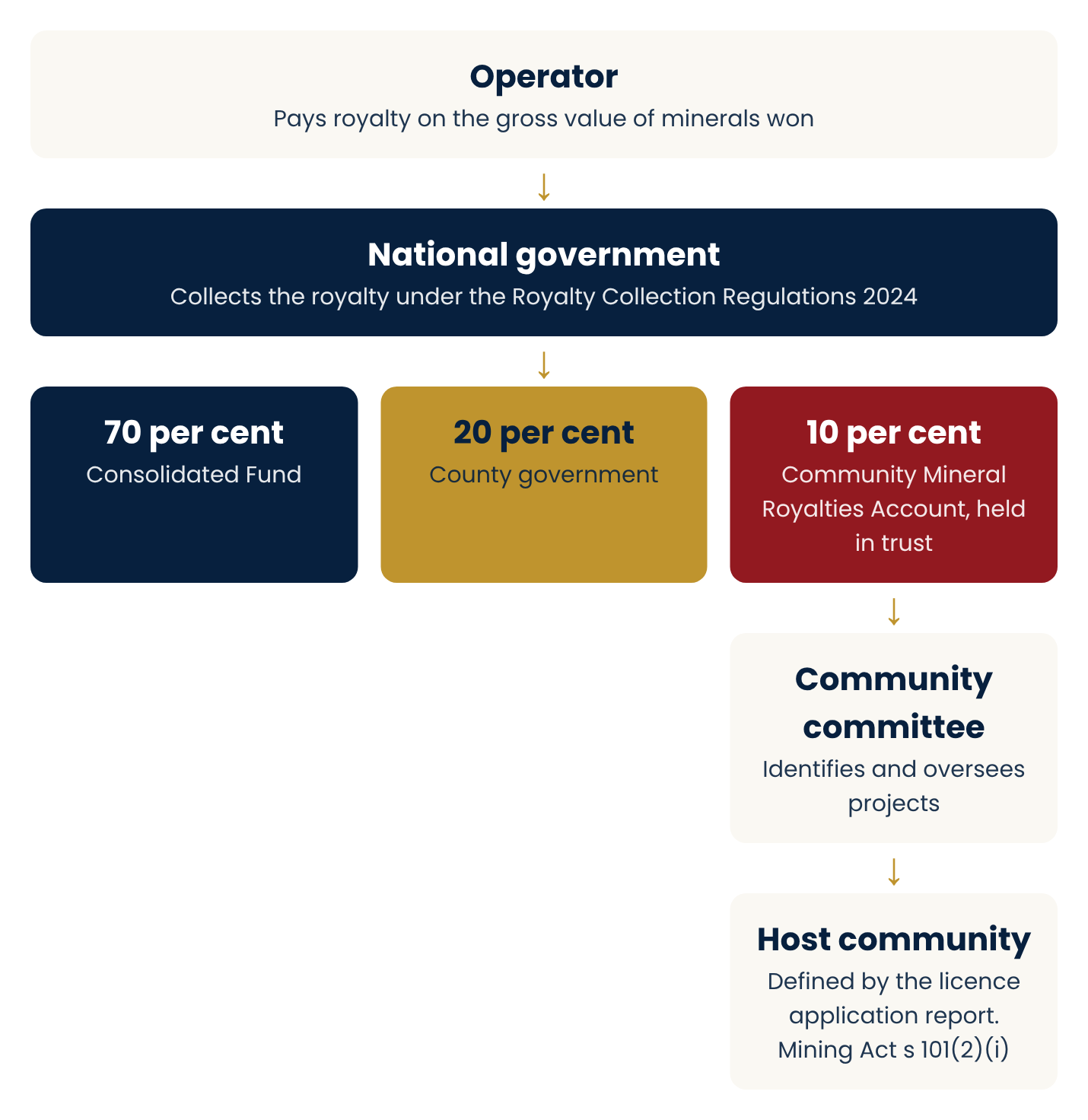
Figure 6. How royalty money is meant to reach the county governments and the host community
Rockland is the foundation on which this structure rests, because it upheld the distribution formula in section 183(5) against a direct constitutional challenge.41 The community share is therefore a statutory entitlement, not a matter of ministerial discretion, and the regulations are the mechanism by which it is delivered.
6.2 Where the next disputes will arise
The regulations have not ended the contest. Communities and members of Parliament have argued that the 10 per cent share is too small, and that routing it through structures in which county governments play a role prevents it from reaching the people it is meant for.42 The more immediate legal questions, however, concern identification and process. Because the community is defined by reference to a report prepared by the applicant for a licence, the boundaries of the beneficiary community are shaped at the application stage, and a community left out of that report may find itself outside the scheme. Deposits that straddle county boundaries raise similar questions about which county and which community share in the 20 and 10 per cent allocations.
The cases discussed above suggest how the courts are likely to approach these disputes. A community that challenges its exclusion will rely on Articles 10 and 69, and on the principle in Rockland and Kenya Chamber of Mines that decisions affecting the distribution of public revenue must be taken through a transparent and participatory process. A regulator that identifies beneficiary communities on the basis of a document prepared by the operator, without independent verification or consultation, will be exposed. Operators, for their part, have a direct interest in the accuracy of the community identification in their applications, because that report now determines who will receive a share of the royalties they pay, and errors in it will be litigated.
VII. Money already paid
7.1 Approaches to refunds
The most difficult question in fiscal litigation is often not whether a charge is unlawful but what follows once it is declared so. The cases discussed here reveal 2 approaches, which Table 4 compares.
Table 4. Refunds after a charge is declared unlawful
| Base Titanium (Supreme Court, 2021) | Kenya Chamber of Mines (High Court, 2025) | |
|---|---|---|
| Who collected the charge | A single county government | The national Ministry |
| Who paid it | A single identifiable operator | Many operators and dealers across the sector |
| Outcome on refund | Refund ordered of sums paid to the end of 2014, with later sums to be pursued in the High Court | Refunds declined in the public interest |
| Reason given | The county government had no constitutional authority to collect the charge | A refund would paralyse the operations of the Ministry and impose a substantial burden on the Government |
In Base Titanium the logic was simple. A county government that collects money without constitutional authority has no right to keep it, and the person who paid is entitled to restitution.43 In Kenya Chamber of Mines the High Court observed that the quashing of regulations would ordinarily open the way to refunds of the fees and levies collected under them, but it declined to order refunds on the ground that doing so would paralyse the operations of the Ministry and impose a substantial financial burden on the Government.44 It was reported after the judgment that the Chamber and the Ministry agreed that the quashed rates would continue to apply for a transitional period, with any excess paid to be offset once new regulations were made.45
7.2 Reconciling both approaches
The 2 decisions can be reconciled, but the reconciliation carries a warning. Constitutional remedies are discretionary, because Article 23(3) empowers the court to grant appropriate relief, and a court that declares a general instrument invalid may shape the remedy to avoid disproportionate disruption to public administration.46 A targeted charge collected from an identifiable operator, as in Base Titanium, presents a strong case for restitution. A sector wide regime of fees and levies, collected from many payers over a long period and already spent on public functions, presents a weaker one.
The practical consequences for operators deserve to be stated plainly. A payer who wishes to preserve a claim to restitution should pay under written protest, keep a complete record of every payment and its legal basis, and bring a challenge promptly, because delay strengthens the argument that refunds would be disruptive. A payer who waits for an industry body to litigate and then claims a refund may find that the remedy has been tailored to the public interest rather than to its own position.
VIII. Next round
8.1 Measures now in contemplation
The mining sector is entering a new period of fiscal and regulatory activity. The Cabinet has approved a policy that minerals should not be exported in raw form, and the draft Minerals, Mining and Beneficiation Policy 2026 contemplates legislation to give effect to it.47 New fee regulations will be needed to replace those quashed in 2025. Royalty assessments continue to be issued under the Royalty Collection Regulations of 2024.48 County government treasuries, under pressure to raise their own revenue, continue to look at mineral traffic as a source of income.
The decided cases do not tell us how each of these measures will fare, and nothing in this edition is a comment on any pending matter. They do, however, supply the questions that any court will ask.
8.2 Questions courts will ask
Table 5. Questions that any new charge in the mining sector must answer
| Question | What the court will look for | Authority |
|---|---|---|
| Power | Does the body imposing the charge have constitutional and statutory authority to impose a charge of this kind? A county government needs an Act of Parliament or a real service. A measure resembling a tax may need more specific authority than a power to prescribe fees | Constitution arts 94, 209 and 210. Base Titanium (SC). Krystaline Salt |
| Process | Was the instrument preceded by genuine consultation, a properly published regulatory impact statement, an explanatory memorandum, and timely laying before Parliament? | Statutory Instruments Act ss 5 to 11. Rockland. Kenya Chamber of Mines |
| Substance | Does the charge relate to what the payer actually received or extracted? A royalty is a charge on minerals won, calculated on their value | Mining Act s 183. Royalty Collection Regulations 2024 |
| Remedy | If the charge falls, who bears the loss of money already paid? | Base Titanium (SC). Kenya Chamber of Mines |
A restriction on the export of minerals that is introduced by directive rather than by a properly made instrument would face the process question in its sharpest form. The Mining Act requires export permits to be applied for and granted under its own framework, and the courts have already been asked to examine ministerial directives on the processing of export permits against the requirements of the Statutory Instruments Act.49
8.3 What each party should do
Table 6. Practical guidance drawn from the decided cases
| Party | What the cases counsel |
|---|---|
| Operators and lenders | Trace every charge on a project to its legal source and confirm that source rather than assume it. Pay doubtful charges under written protest and keep a full record. Submit detailed written comments whenever the Ministry or a county government invites them, because the record of consultation is the evidence on which any later challenge will turn. Check the community identification in every licence application |
| The Ministry | Consult before signing, not after. Publish the regulatory impact statement where the Statutory Instruments Act requires. Record how each comment was treated. Seek express statutory authority for any charge that behaves like a tax |
| County governments | Rely on the 20 per cent royalty share that Parliament has allocated. Impose any additional charge only where an Act of Parliament authorises it or a real county government service is provided, and only after genuine public participation |
| Host communities | Engage at the licence application stage, when the beneficiary community is identified. Insist on transparent records of royalties paid into the community account and of the projects funded from it |
IX. Conclusion
The contest over the revenue from minerals is, at its root, a contest over who speaks for the public that owns them. The national government speaks for the nation as owner and trustee. The county governments speak for the places through which minerals are carried and in which mining takes place. The communities speak for those whose land and livelihoods bear its cost. The courts have not chosen between them. They have done something more useful, which is to insist that each claimant act within the power the Constitution gives it, and that each charge be made through a process the public can see and influence.
The result is a body of law that rewards preparation. Operators who know the source and validity of every charge they pay are able to resist the unlawful ones and to recover what they should never have paid. Regulators who make their instruments properly collect revenue that will withstand challenge. County governments that stay within their constitutional share avoid the litigation that their neighbours have lost. As Kenya seeks to increase the contribution of mining to its economy, that clarity is an asset in its own right, because capital follows rules that are certain, and the courts have now shown with some precision what those rules are.
Benson Odiwuor is an Advocate of the High Court of Kenya based in Nairobi, whose practice focuses on dispute resolution in the regulated industries, including mining, oil and gas, banking and project finance. He is the editor of The BOLD, Benson Odiwuor’s Legal Digests, a legal newsletter on dispute strategies and legal developments in the regulated industries of Kenya. Subscribe to The BOLD here.
For inquiries, contact the author at info@bensonodiwuor.com.
References
- Constitution of Kenya 2010 art 62(1)(f). ↩
- Constitution of Kenya 2010 art 62(3). ↩
- Mining Act 2016 (No 12 of 2016), now Cap 306 of the Laws of Kenya s 6 <https://new.kenyalaw.org/akn/ke/act/2016/12/eng@2022-12-31>. ↩
- Mining Act 2016. ↩
- Mining Act 2016. ↩
- Mining Act 2016. ↩
- Mining Act 2016 s 183(1) and (2). ↩
- Mining (Royalty Collection and Management) Regulations 2024 (LN 106 of 2024) regs 5 and 6 and sch <https://new.kenyalaw.org/akn/ke/act/ln/2024/106/eng@2024-07-05>. ↩
- Royalty Collection Regulations 2024. ↩
- Mining Act 2016 s 183(5). ↩
- Constitution of Kenya 2010 arts 10(2)(a) and 118(1)(b). ↩
- Constitution of Kenya 2010 art 94(5) and (6). ↩
- Statutory Instruments Act 2013 (Cap 2A) ss 5, 5A, 6, 8 and 11 <https://new.kenyalaw.org/akn/ke/act/2013/23/eng@2023-07-01>. ↩
- Base Titanium Limited v County Government of Mombasa & another (Petition 9 of 2015) [2017] KEHC 7040 (KLR) paras 1 to 2 and 28 <https://new.kenyalaw.org/akn/ke/judgment/kehc/2017/7040/eng@2017-02-21>; County Government of Mombasa Finance Act 2014. ↩
- Base Titanium (HC) (n 14) paras 11 to 12. ↩
- Base Titanium (HC) (n 14) paras 13, 17 to 18, 20, 22 and 31. ↩
- Base Titanium Limited v County Government of Mombasa & another (Civil Appeal 69 of 2017) [2018] eKLR <http://kenyalaw.org/caselaw/cases/view/157726/>. ↩
- Base Titanium Limited v County Government of Mombasa & another (Petition 22 of 2018) [2021] KESC 33 (KLR) <https://kenyalaw.org/caselaw/cases/view/216144/>. ↩
- Base Titanium (SC) (n 18) para 45. ↩
- Base Titanium (SC) (n 18). ↩
- Krystaline Salt Company Ltd & 3 others v County Government of Kilifi & 2 others (Constitutional Petition E011 of 2021) [2026] KEHC 14868 (KLR) <https://new.kenyalaw.org/akn/ke/judgment/kehc/2026/14868/eng@2026-10-02>. ↩
- Kilifi County Finance Act 2018; ‘Kilifi County Loses Salt Levy Battle as Court Declares Charge Illegal’ Business Daily (Nairobi, October 2026) <https://www.businessdailyafrica.com/bd/news/kilifi-county-loses-salt-levy-battle-as-court-declares-charge-illegal-5630054>. ↩
- Krystaline Salt (n 21); ‘Kilifi County Loses Salt Levy Battle’ (n 22). ↩
- Gakuru & others v County Government of Kiambu & another (Constitutional Petition 603 of 2014) [2016] KEHC 7680 (KLR) <https://new.kenyalaw.org/akn/ke/judgment/kehc/2016/7680>. ↩
- Rockland Kenya Limited v Cabinet Secretary, Ministry of Petroleum and Mining & another (Petition 200 of 2019) [2023] KEHC 17264 (KLR) <https://new.kenyalaw.org/akn/ke/judgment/kehc/2023/17264/eng@2023-05-12>. ↩
- Rockland (n 25); Mining (Prescription of Royalties on Minerals) Regulations 2013 (LN 187 of 2013); Mining (Community Development Agreement) Regulations 2017. ↩
- Rockland (n 25) paras 40 to 46. ↩
- Rockland (n 25) paras 39 and 46. ↩
- Rockland (n 25) paras 33 to 34. ↩
- Rockland (n 25) paras 53 to 54. ↩
- Rockland (n 25) paras 31, 35 and 55; Statutory Instruments Act 2013 s 5(2) and (3). ↩
- Kenya Chamber of Mines v Cabinet Secretary, Ministry of Mining, Blue Economy and Maritime Affairs (Constitutional Petition E549 of 2024) [2025] KEHC 12697 (KLR) <https://new.kenyalaw.org/akn/ke/judgment/kehc/2025/12697/eng@2025-09-10>. ↩
- Kenya Chamber of Mines (n 32); Mining (Licence and Permit) (Amendment) Regulations 2023 (LN 43 of 2024) reg 28A. ↩
- ‘Blow to Ruto’s Mining Reforms as New Regulations Declared Illegal’ The Standard (Nairobi, September 2025) <https://www.standardmedia.co.ke/courts/article/2001529716/blow-to-rutos-mining-reforms-as-new-regulations-declared-illegal>. ↩
- Kenya Chamber of Mines (n 32); Statutory Instruments Act 2013 s 8. ↩
- Kenya Chamber of Mines (n 32); James Gichigi, ‘High Court Declares 2024 Mining Regulations Unconstitutional’ The Star (Nairobi, 10 September 2025) <https://www.the-star.co.ke/news/2025-09-10-high-court-declares-2024-mining-regulations-unconstitutional>. ↩
- Kenya Chamber of Mines (n 32). ↩
- British American Tobacco Kenya PLC v Cabinet Secretary for the Ministry of Health & 2 others (Petition 5 of 2017) [2019] KESC 15 (KLR); Cabinet Secretary for the National Treasury and Planning & 4 others v Okoiti & 52 others; Bhatia (Amicus Curiae) [2024] KESC 63 (KLR). ↩
- Mining (Mineral Royalty Sharing) Regulations 2026 (LN 3 of 2026) <https://new.kenyalaw.org/akn/ke/act/ln/2026/3/eng@2026-01-29>; ‘MPs Endorse Mining Rules Boosting Community Royalties to 10 Per Cent’ The Eastleigh Voice (Nairobi, April 2026) <https://eastleighvoice.co.ke/business/332226/mps-endorse-mining-rules-boosting-community-royalties-to-10-per-cent>. ↩
- Royalty Sharing Regulations 2026; Mining Act 2016 s 101(2)(i). ↩
- Rockland (n 25) paras 39 to 46. ↩
- ‘MPs Endorse Mining Rules’ (n 39). ↩
- Base Titanium (SC) (n 18). ↩
- Kenya Chamber of Mines (n 32); Gichigi (n 36). ↩
- ‘Traders Protest to Joho over Denied Mineral Export Permits, Royalties’ Business Daily (Nairobi, 2025) <https://www.businessdailyafrica.com/bd/economy/traders-protest-to-joho-over-denied-mineral-permits-royalties-5204786>. ↩
- Constitution of Kenya 2010 art 23(3). ↩
- ‘MPs Endorse Mining Rules’ (n 39); ‘Kenya Moves to Outlaw Raw Mineral Exports’ Africa Briefing (2026) <https://africabriefing.com/kenya-moves-to-outlaw-raw-mineral-exports/>. ↩
- Royalty Collection Regulations 2024. ↩
- Mining Act 2016 s 171; Rockland Kenya Limited v Cabinet Secretary, Ministry of Petroleum and Mining & another [2021] KEHC 13595 (KLR) <https://new.kenyalaw.org/akn/ke/judgment/kehc/2021/13595/eng@2021-12-21>. ↩