
Mine Closure and Liability after Exit in Kenya. When the Ore Runs Out
1 November 2026
Every mine has a last day. When it arrives, every operator, lender, regulator and host community must answer 3 questions. What must an operator do before it leaves? Who pays if rehabilitation is not done? Does liability survive the end of mining? This edition answers each of them from the law and the decided cases.
| KEY POINTS AT A GLANCE Every mine has a last day. The Mining Act requires the operator to plan for that day before the first day, by submitting a site rehabilitation or mine closure plan and an environmental protection bond as conditions of the grant of a prospecting, retention or mining licence. The environmental protection bond is meant to cover the full cost of rehabilitation. It may be released in part as rehabilitation progresses, and in full only when all environmental and rehabilitation obligations have been completed. A mining licence holder must give the Cabinet Secretary 6 months notice of an intention to cease mining, and the Cabinet Secretary may approve the cessation. Ceasing to mine does not end the obligation to rehabilitate. Closure is regulated by 2 authorities at once. The Ministry administers the Mining Act. The National Environment Management Authority licenses the project, approves the closure and decommissioning plan, and may issue restoration orders under the Environmental Management and Co-ordination Act. Kwale is the first full test. Base Titanium ended mining after depletion of its ore reserve in December 2024 and is implementing a closure plan approved by the National Environment Management Authority in 2024. In 2026 the Environment and Land Court lifted orders that had stopped decommissioning, directing that it proceed strictly in line with the approved plan. Liability does not end with production. In May 2026 the Supreme Court of Kenya directed that a pollution petition against the Kwale operator proceed to a hearing on its merits, and the Environment and Land Court has ordered miners to pay the cost of rehabilitating land they damaged. |
I. Introduction
A mine is a temporary use of land. The ore body is finite, and every mining plan contains, from its first draft, the date on which extraction will end. What happens on that date, and in the years that follow, determines whether a mining project leaves behind productive land and a stable community, or open pits, contaminated water and a dispute that outlives the company that caused it.
For most of its history Kenya had little practical experience of closing a large mine. That changed between 2024 and 2026. Base Titanium, which operated the Kwale mineral sands project from 2013, ended mining after depletion of its ore reserve in December 2024 and turned to decommissioning, rehabilitation and restoration under a closure plan approved by the National Environment Management Authority.1 The exit of the largest mining operation in the country tested, for the first time and at scale, the closure provisions of the Mining Act 2016 and the environmental law that sits beside it. It also produced litigation, as residents challenged the decommissioning process and the courts were asked to decide whether it should be stopped.
This edition of The BOLD explains the law of mine closure from the ground up. It begins with the basic concepts and the meaning of the terms used in practice. It then sets out the obligations that the Mining Act and the environmental statutes impose at each stage of the life of a mine, and the financial security that is meant to guarantee them. With that foundation in place, it examines the Kwale closure and the decisions in which courts have ordered miners to restore damaged land. It closes with the gaps that remain in the framework, the questions that any court will ask when a closure is challenged, and practical guidance for operators, lenders, regulators and communities.
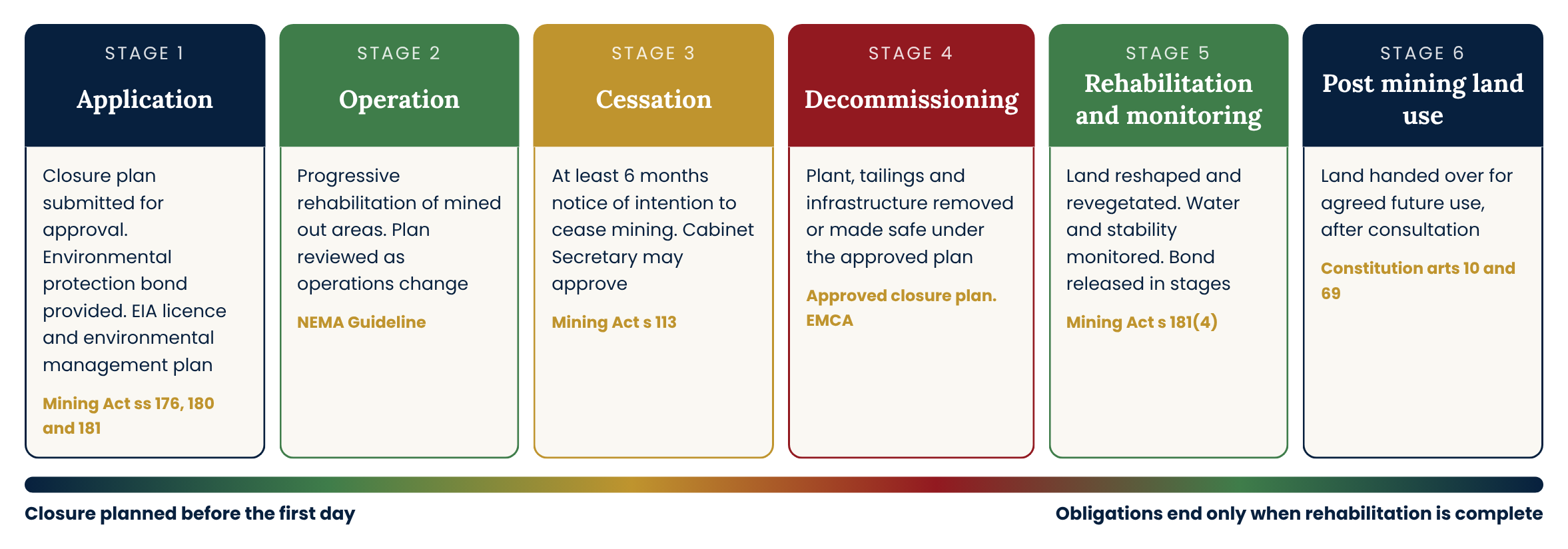
Figure 1. Closure obligations across the life of a mine under the Mining Act and environmental law
II. Foundational concepts
2.1 Why closure is a legal question
Mining changes land permanently. It removes vegetation and topsoil, reshapes the surface, alters the flow of water and leaves behind waste rock, tailings and, in some operations, chemicals such as cyanide. When mining ends, someone must decide what the land will become, carry out the work needed to make it safe and usable, and pay for that work. If the law does not settle those questions in advance, they fall by default on the host community and the State.
The constitutional foundation is clear. Every person has the right to a clean and healthy environment, which includes the right to have the environment protected for the benefit of present and future generations.2 The State is obliged to ensure the sustainable exploitation, utilisation, management and conservation of the environment and natural resources, and to eliminate processes and activities likely to endanger the environment.3 Every person has a duty to cooperate with State organs and other persons to protect and conserve the environment.4 A person who alleges that the right to a clean and healthy environment is threatened may apply to court, and the court may make any order it considers appropriate to prevent, stop or discontinue the harm, or to compensate a victim.5 The closure of a mine engages each of these provisions.
2.2 Key terms
The language of mine closure is technical, and several terms are used loosely in public debate. Table 1 sets out what they mean.
Table 1. Key terms in mine closure
| Term | What it means |
|---|---|
| Cessation | The end of mining operations under a mining licence. The licence holder must give notice and the Cabinet Secretary may approve it |
| Decommissioning | The removal or making safe of plant, buildings, equipment, tailings facilities and other infrastructure once operations end |
| Rehabilitation | Work to restore mined land to a safe, stable and usable condition, including reshaping, replacing topsoil and revegetating |
| Progressive rehabilitation | Rehabilitation carried out in stages while mining continues elsewhere on the site, rather than only at the end |
| Mine closure plan | The document that sets out how the site will be decommissioned and rehabilitated, the intended land use after mining, the cost, and how success will be measured |
| Environmental protection bond | A bond or other financial security provided by the holder to cover the cost of its environmental and rehabilitation obligations |
| Post mining land use | The use to which the land will be put after closure, such as agriculture, forestry, conservation or settlement |
| Restoration order | An order requiring a person to restore the environment, issued by the National Environment Management Authority or by a court |
| Abandoned mine | A mine where operations have ended and no person is carrying out the closure obligations, so that responsibility falls on the State |
2.3 Closure begins at the beginning
The most important principle in modern mine closure law is that closure is planned before mining begins. A plan prepared at the end of a mine, when revenue has stopped and the operator is preparing to leave, is a plan prepared at the moment of least leverage for the State and the community. The Mining Act reflects this principle. It makes a closure plan and an environmental protection bond conditions of the grant of the licence itself.6
III. Legal framework
3.1 Mining Act
Part XI of the Mining Act deals with health, safety and environment. It begins by providing that environmental laws prevail, so that a mineral right does not authorise the holder to breach any law concerning the protection of the environment.7 A mining licence shall not be granted unless the applicant has obtained an environmental impact assessment licence, a social heritage assessment and an approved environmental management plan.8 Table 2 sets out the provisions that bear most directly on closure.
Table 2. Closure provisions of the Mining Act
| Provision | What it requires |
|---|---|
| s 113 | The holder of a mining licence must give the Cabinet Secretary notice of any intention to cease or suspend mining operations or to curtail production. The notice period is 6 months for cessation and 3 months for suspension. The Cabinet Secretary may approve the cessation, suspension or curtailment |
| s 176 | Environmental laws prevail over the rights conferred by a mineral right. A mining licence requires an environmental impact assessment licence, a social heritage assessment and an approved environmental management plan |
| s 179 | Provides for the use of land within a mineral right area |
| s 180(1) | The Cabinet Secretary shall not grant a prospecting licence, a retention licence or a mining licence unless the applicant has submitted a site mitigation and rehabilitation or mine closure plan for approval |
| s 180(2) | The Cabinet Secretary may prescribe regulations for site rehabilitation and mine closure obligations |
| s 181(1) and (2) | The applicant must provide an environmental protection bond sufficient to cover the costs of its environmental and rehabilitation obligations, in a form and amount determined by the Cabinet Secretary having regard to the characteristics of the project |
| s 181(3) | In fixing the bond, the Cabinet Secretary must take into account any bond or security required under the Environmental Management and Co-ordination Act |
| s 181(4) | The bond may be released in part as rehabilitation is completed during the licence, and released in full only after successful completion of all environmental and rehabilitation obligations |
This scheme has 2 features that deserve emphasis. The first is that the bond is linked to the actual cost of rehabilitation, not to a fixed fee. Section 181 requires security sufficient to cover the costs, and it directs the Cabinet Secretary to have regard to the particular characteristics of the project.9 A bond that is set too low defeats the purpose of the section. The second is that release is staged and conditional. The State holds the security until the work is done, and full release follows only the successful completion of all obligations.10
The Act also requires a holder of a prospecting licence, when the licence ends, to fill in or make safe excavations, permanently preserve or make safe boreholes, comply with the environmental restoration and rehabilitation plan, and remove equipment, plant and buildings.11 The same logic applies with greater force at the end of a mining licence.
3.2 Environmental Management and Co-ordination Act
The Mining Act does not displace environmental law. A mining project requires an environmental impact assessment licence from the National Environment Management Authority before it begins, and the assessment must address the decommissioning phase.12 The Authority may issue an environmental restoration order requiring a person to restore the environment, and a commentator has observed that this power extends to the operator of a disused mine site.13 A person aggrieved by a restoration order may appeal to the National Environment Tribunal.14
The Authority has also published a National Guideline on Mine Site Decommissioning and Rehabilitation, developed under its general mandate in the Act.15 The Guideline treats closure as a plan prepared at the outset and revisited throughout the life of the mine. It provides that, as good practice, the plan should be submitted as part of the environmental and social impact assessment report and reviewed every 5 years or as the Authority advises, and it addresses matters such as water quality, waste management, post mining land use and financial provision for closure.16 A Guideline is not a statute, but a court asked whether an operator acted reasonably is likely to treat it as the standard against which the plan and its implementation are measured.
3.3 Shared regulation of a single site
The practical consequence is that closure is regulated by 2 authorities with overlapping mandates. Figure 2 sets out who does what.
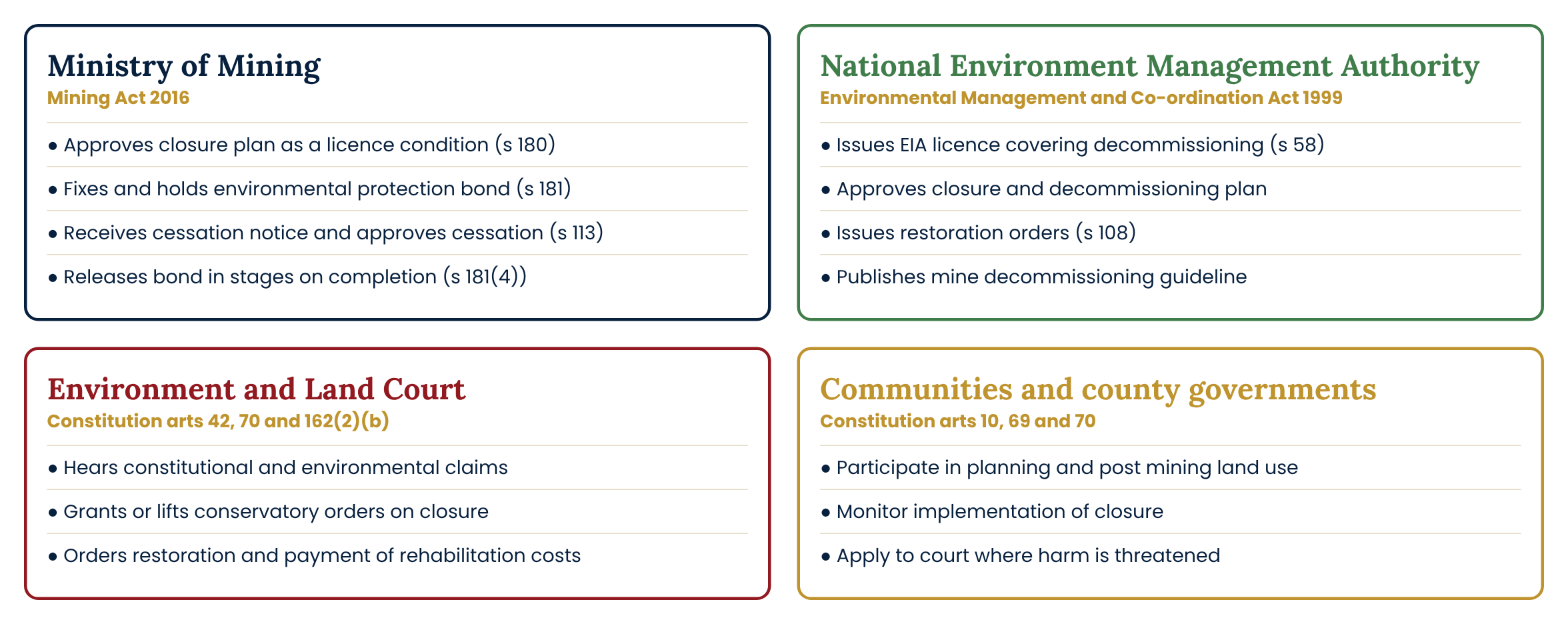
Figure 2. Who regulates mine closure in Kenya, and the powers each holds
The overlap is not, in itself, a weakness. It does create a risk that each regulator assumes the other is supervising a particular obligation, or that their requirements diverge. Section 181(3) of the Mining Act recognises the risk in relation to financial security, by requiring the Cabinet Secretary to take account of any bond required under environmental law when fixing the amount of the environmental protection bond.17 There is no equivalent provision that coordinates the approval and supervision of the closure plan itself.
3.4 Regulations still to come
Section 180(2) contemplates regulations on site rehabilitation and mine closure obligations, and a long standing criticism of the framework has been that the detail has not followed. A 2019 review for the Law Society of Kenya observed that there was no defined formula for calculating the environmental deposit bond, that post closure was not regulated, that there was no provision for community participation during decommissioning and post closure monitoring, and that draft deposit bond regulations under the environmental statute remained ungazetted.18 In 2026 the Ministry published a regulatory impact statement for proposed Mining (Mine Health, Safety and Environment) Regulations, which places emphasis on environmental protection and sustainable mine closure obligations.19 Until regulations of that kind are made, the content of closure obligations will continue to depend heavily on the conditions attached to each licence and on the plan approved for each project.
IV. Kwale experience
4.1 From production to closure
The Kwale mineral sands project was the largest mining operation in Kenya. Over 11 years it exported about 5.2 million tonnes of titanium minerals, and its wind down contributed to a fall of about 20 per cent in the value of national mineral production in 2025.20 Mining ended after depletion of the ore reserve in December 2024, and the company turned to implementing its closure plan, with an emphasis on decommissioning, rehabilitation and restoration of mined out areas.21 The company has stated that closure planning began before mining started, and that it rehabilitated land in phases while mining continued elsewhere on the site.22
In April 2025 the Principal Secretary for Mining stated that about 55 per cent of the mined land had been restored, and that the National Environment Management Authority had provided guidance to ensure the land was returned to a usable state.23 The company was reported to be seeking a 10 year extension of its special mining licence to allow post mining activities to be concluded properly.24
4.2 Post mining land use
The government established a Post Mining Land Use Committee for the Kwale project in 2024, described by the then Cabinet Secretary as the first such committee in Kenya since the Mining Act was enacted.25 In January 2026 the Cabinet Secretary launched the Advisory Report on Post Mining Land Use for the project after consulting county government leaders, as a roadmap for a transition intended to deliver long term social, economic and environmental benefits to local communities.26
The decision on post mining land use is not merely technical. It determines who will use the land, for what purpose, and on what terms. Land that was acquired from families for mining, and then rehabilitated, may be returned to agriculture, set aside for conservation, or allocated for new development. Each choice affects the people who gave up the land in the first place, and each will be measured against the constitutional values of participation, equity and sustainable development.
4.3 Challenge to decommissioning
In February 2026 residents of the Msambweni and Kinondo area sued the Ministry of Mining, the National Environment Management Authority, Base Titanium and the County Government of Kwale over environmental degradation linked to decommissioning. On 26 February 2026 the Environment and Land Court issued conservatory orders that halted dismantling, decommissioning and land disturbance.27 The residents argued that the process was opaque and that, unless the court intervened, decommissioning would irretrievably alter the environment, destroy evidence and render their petition academic.28
The evidence before the court showed that the National Environment Management Authority approved terms of reference for the closure and decommissioning of the mine on 26 June 2024, and approved the mine closure and decommissioning plan in September 2024.29 The company argued that the orders had been obtained through material misrepresentation and were disrupting lawful rehabilitation.30 Justice Naikuni set aside the conservatory orders.31 The court found that the stoppage posed greater environmental and safety risks than continuation, and it directed that decommissioning proceed strictly in line with the approved mine closure plan, the existing environmental impact assessment licences and the directions of the National Environment Management Authority.32
A half finished closure can be more dangerous than the mine it replaces.
The decision is instructive in 2 ways. First, it confirms that an approved closure plan is the reference point for the court. An operator that can show a plan approved by the regulator, and compliance with it, stands on firm ground. A community that wishes to challenge the closure must engage with the plan itself. Second, it recognises that halting decommissioning is not a neutral act. Partially dismantled plant, open excavations and unmanaged tailings may present greater risks than completion of the work, and a court asked to stop a closure will weigh those risks.
4.4 Liability after production
The end of production does not end exposure to claims. In May 2026 the Supreme Court of Kenya dismissed an appeal by Base Titanium and directed that a petition by residents of a village in Msambweni, who alleged pollution, noise and health effects and sought environmental restoration, proceed to determination on its merits in the Environment and Land Court.33 The petition will be heard after the end of mining. Whatever its outcome, it confirms that an operator who leaves the ground does not leave the jurisdiction of the court.

Figure 3. Kwale closure, from the end of production to the courtroom
V. Courts and rehabilitation
5.1 Ordering the miner to pay
The courts have already shown how they will deal with mining that leaves land damaged. In Kasigau Ranching, a ranching company in Taita Taveta County sued after a mining permit was issued to a third party over part of its land. In October 2024 Justice Kibunja held that the Ministry had illegally issued the permit, cancelled it, and awarded the landowner damages.34 The court accepted an undisputed estimate of KSh 13,000,000 for rehabilitation and decommissioning of the mining locations, ordered the miner alone to bear that cost, and directed that the money be used for restoration under the supervision of the National Environment Management Authority, even though the Authority was not a party.35
The case establishes 3 practical points. The cost of rehabilitation is recoverable as a distinct head of loss. The person who caused the damage bears that cost, in application of the principle that the polluter pays. And the court may enlist the environmental regulator to supervise the restoration it orders.
5.2 Restoration orders as a remedy
Outside mining, the Environment and Land Court has issued restoration orders with fixed timelines and reporting obligations. In Kimeu, a 2025 decision arising from pollution of land and a river, the court ordered the respondent to restore the damaged land, soil, surface and underground water and riparian habitat to its original status or to the satisfaction of the court within 120 days, and to file a report.36 At the apex, the Supreme Court has reaffirmed the constitutional right to a clean and healthy environment and held state agencies to account for failing in their duty to protect it.37 These decisions tell operators that a court asked to supervise the rehabilitation of a closed mine has the tools to do so.
5.3 When closure collides with a dispute
The Karebe gold mine in Nandi County illustrates a different risk. A dispute over the lease of the land on which the mine stood led to court orders and loss of access to part of the site. The company told the Environment and Land Court that it would need at least 3 years to neutralise cyanide in its storage facilities and rehabilitate the mine, and that the National Environment Management Authority would have to approve the closure.38 The Ministry advised the court in 2020 that the company should be given 5 years to manage the waste, because cyanide would take a long time to leach from the tailings to acceptable concentrations.39 The company warned that its tailings dam had been left unattended because of an order barring activity on the land.40
Karebe shows that closure obligations do not wait for commercial or land disputes to be resolved. A tailings facility must be managed whether or not the lease has expired. Courts dealing with land disputes on mine sites must therefore make orders that preserve the ability of someone, whether the operator or the State, to carry out the work that the environment requires.
Table 3. Lessons from the decided cases on mine closure and rehabilitation
| Case | What happened | Lesson |
|---|---|---|
| Kwale decommissioning (2026) | Conservatory orders halting decommissioning were set aside. Work to proceed strictly under the plan approved by the National Environment Management Authority | An approved closure plan is the reference point, and stopping closure carries its own risks |
| Kiswili (SC, 2026) | Pollution petition against the operator to proceed on its merits after mining ended | Liability survives the end of production |
| Kasigau Ranching (2024) | Illegally issued permit cancelled. Miner to pay KSh 13,000,000 for rehabilitation under supervision of the regulator | Rehabilitation cost is recoverable from the person who caused the damage |
| Kimeu (2025) | Restoration of land and water ordered within 120 days with a report to court | Courts can order and supervise restoration |
| Karebe (2020) | Operator sought at least 3 years to neutralise cyanide amid a land dispute | Closure obligations must continue regardless of other disputes |
VI. Who pays
6.1 Order of responsibility
The law contemplates a clear order of responsibility for the cost of closure. Figure 4 sets it out.
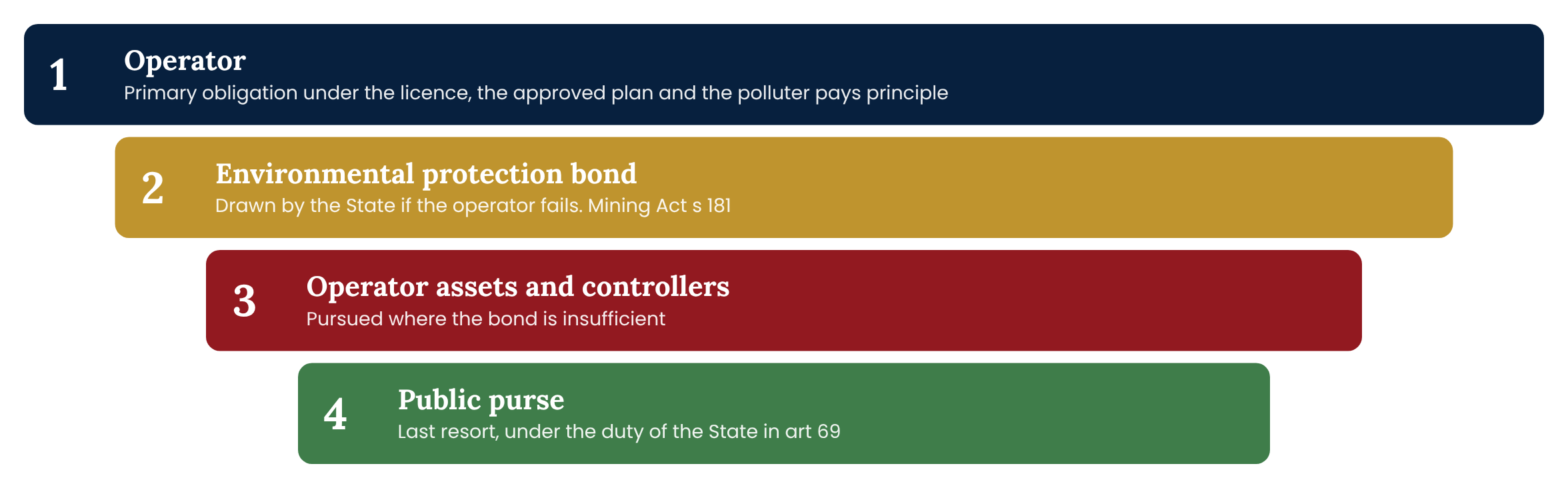
Figure 4. Who pays for closure, in the order the law contemplates
The operator bears the primary obligation, under its licence, its approved plan and the principle that the polluter pays. The environmental protection bond stands behind the operator, so that if the operator fails, the State can draw on the security. Where the bond is insufficient, the State may pursue the operator, its assets and, where the facts allow, those who controlled it. Only when all of these fail does the cost fall on the public, through the duty of the State under Article 69 to restore the environment.
6.2 Assets and exit
As the Kwale exit approached, the company stated publicly that its assets were private property, which it had the constitutional right to dispose of as it saw fit, including by selling them internationally to fund rehabilitation and mine closure costs.41 The statement captures a tension present at every closure. The operator needs to realise value from its assets to fund the work. The State and the community want assurance that the work will be completed before those assets, and the company, leave the country. The environmental protection bond is the instrument that reconciles these interests. Where it is sufficient and properly held, the State need not be concerned with the fate of individual assets. Where it is not, the State has every reason to be.
VII. Gaps in the framework
The Kwale closure has exposed several areas in which the law remains incomplete. Table 4 summarises them.
Table 4. Gaps in the mine closure framework
| Gap | Why it matters |
|---|---|
| No closure regulations under s 180(2) | The content of closure obligations depends on individual licence conditions and plans rather than a uniform standard |
| No defined formula for the bond | Without a method of calculation, bonds may be set below the true cost of rehabilitation |
| Limited rules on community participation in closure | Communities affected by closure may have no defined role in approving the plan, monitoring its implementation or agreeing post mining land use |
| Post closure monitoring not regulated | Risks such as contaminated water and unstable landforms may appear years after the operator has left |
| Dual regulators with no coordination provision on closure plans | Divergent requirements, or assumptions that the other regulator is supervising, may leave obligations unenforced |
| Abandoned and artisanal sites | Small scale operators may lack the technical and financial capacity to close sites, leaving the burden on the State |
The decided cases already point to how courts will fill some of these gaps. Where the law is silent on community participation, Articles 10 and 69 supply the principle, and a closure plan approved without meaningful consultation is open to challenge. Where the bond is inadequate, the polluter pays principle and the remedies under Article 70 allow the court to order the operator to bear the cost directly.
VIII. Next round
8.1 Questions a court will ask
Kwale will not be the last closure. Large scale gold, rare earth and industrial mineral projects now under consideration will each reach the end of production. Any court asked to examine a closure is likely to ask the questions in Table 5.
Table 5. Questions that any court is likely to ask when a mine closure is challenged
| Question | What the court will look for | Authority |
|---|---|---|
| Plan | Was a closure plan submitted and approved, and is it being followed? | Mining Act s 180. NEMA Guideline. Kwale decommissioning ruling |
| Security | Is the environmental protection bond sufficient for the actual cost, and has it been released only as obligations were met? | Mining Act s 181 |
| Process | Did the operator give notice of cessation, and were affected communities consulted on closure and post mining land use? | Mining Act s 113. Constitution arts 10 and 69 |
| Harm | Has the closure caused or threatened harm to the environment or to health, and would stopping it cause greater harm? | Constitution arts 42 and 70. Kwale decommissioning ruling. Kiswili (SC) |
| Remedy | Who should pay for restoration, and under whose supervision? | Kasigau Ranching. Kimeu. EMCA s 108 |
8.2 What each party should do
Table 6. Practical guidance drawn from the law and the decided cases
| Party | What the law and the cases counsel |
|---|---|
| Operators | Treat the closure plan as a living document, review it at least every 5 years and keep it aligned with the bond. Rehabilitate progressively. Give formal notice of cessation. Keep a complete record of approvals and compliance, because the approved plan will be the reference point in any challenge. Consult communities on post mining land use before decisions are made |
| Lenders and investors | Verify that a closure plan has been approved and that the bond reflects a credible cost estimate. Treat closure liabilities as part of the financing case, not as a matter for the end of the project. Require reporting on progressive rehabilitation |
| Ministry and National Environment Management Authority | Coordinate approval and supervision of closure plans. Set bonds on a documented cost basis and release them only on verified completion. Make the closure regulations contemplated by s 180(2). Publish closure plans and monitoring reports so that communities can follow them |
| Communities and county governments | Seek a defined role in closure planning and post mining land use. Request the approved closure plan and monitoring reports. Where harm is threatened, act early and engage with the approved plan, because courts will weigh the risks of stopping closure against the risks of allowing it to continue |
IX. Conclusion
The Mining Act 2016 adopted the modern principle that closure begins at the beginning. It requires a closure plan and an environmental protection bond before a licence is granted, notice before mining ceases, and completion of rehabilitation before security is released. Environmental law adds a licence that must address decommissioning, a regulator with power to order restoration, and a constitutional right that any person may enforce in court.
Kwale has shown that these provisions work best when they are taken seriously from the start. An operator that planned for closure, rehabilitated progressively and secured approval of its plan was able to persuade a court that its decommissioning should continue. The same experience has shown where the law is incomplete, particularly in the absence of closure regulations, a formula for bonds and a defined role for communities. The next closures will test whether those gaps are filled by Parliament and the Ministry, or by the courts on a case by case basis. For operators, lenders and communities alike, the lesson is the same. The last day of a mine is a legal event, and it is decided long before it arrives.
Benson Odiwuor is an Advocate of the High Court of Kenya based in Nairobi, whose practice focuses on dispute resolution in the regulated industries, including mining, oil and gas, banking and project finance. He is the editor of The BOLD, Benson Odiwuor’s Legal Digests, a legal newsletter on dispute strategies and legal developments in the regulated industries of Kenya. Subscribe to The BOLD here.
For inquiries, contact the author at info@bensonodiwuor.com.
References
- Base Titanium, ‘The Kwale Mineral Sands Operator’ (company website) <https://basetitanium.com/>. ↩
- Constitution of Kenya 2010 art 42. ↩
- Constitution of Kenya 2010 art 69(1)(a) and (g). ↩
- Constitution of Kenya 2010 art 69(2). ↩
- Constitution of Kenya 2010 art 70(1) and (2). ↩
- Mining Act 2016 (No 12 of 2016), now Cap 306 of the Laws of Kenya ss 180 and 181 <https://new.kenyalaw.org/akn/ke/act/2016/12/eng@2022-12-31>. ↩
- Mining Act 2016 s 176(1). ↩
- Mining Act 2016 s 176(2). ↩
- Mining Act 2016 s 181(1) and (2). ↩
- Mining Act 2016 s 181(4). ↩
- Mining Act 2016. ↩
- Environmental Management and Co-ordination Act 1999 (No 8 of 1999) s 58; Environmental (Impact Assessment and Audit) Regulations 2003. ↩
- EMCA 1999 s 108; Selelah Okoth, ‘National Mine Closure Obligations and Rehabilitation’ (LSK SIRD Training Programme, Nairobi, 16 to 17 September 2019) <https://sird.ealawsociety.org/wp-content/uploads/2023/02/Closure-Obligations-%E2%80%93-National.pdf>. ↩
- EMCA 1999 s 129. ↩
- National Environment Management Authority, National Guideline on Mine Site Decommissioning and Rehabilitation<https://www.nema.go.ke/images/Docs/Guidelines/Signed%20National%20Guidelines%20on%20Mine%20site%20decommissioning%20and%20rehabilitation-min.pdf>; EMCA 1999 s 9. ↩
- NEMA Guideline (n 15). ↩
- Mining Act 2016 s 181(3). ↩
- Okoth (n 13). ↩
- Ministry of Mining, Blue Economy and Maritime Affairs, Regulatory Impact Statement, Mining (Mine Health, Safety and Environment) Regulations 2026<https://www.nmckenya.go.ke/sites/default/files/2026-07/2A.%20RIS_Mining%20(Mine%20Health%20Safety%20and%20Environment)%20Regulations%202026.pdf>. ↩
- ‘Base Titanium’s Exit Wipes Sh5bn off Kenya’s Mining Earnings’ Daily Nation (Nairobi, 2 May 2026) <https://nation.africa/kenya/climate/base-titanium-exit-wipes-sh5bn-off-kenya-mining-earnings-5443972>. ↩
- Base Titanium website (n 1). ↩
- ‘Base Titanium Restoring Mined Out Sites’ Kenya News Agency (21 November 2024) <https://www.kenyanews.go.ke/base-titanium-restoring-mined-out-sites/>. ↩
- ‘Questions over Delayed Sh900m Royalties as Base Titanium D-Day in Kwale Beckons’ Daily Nation (Nairobi, 28 April 2025) <https://nation.africa/kenya/counties/kwale/questions-over-delayed-sh900m-royalties-base-titanium-5020192>. ↩
- ‘Questions over Delayed Sh900m Royalties’ (n 23). ↩
- ‘Base Titanium to Shut Kwale Mine in December after Resource Exhaustion’ Nairobi Review<https://nairobireview.africa/base-titanium-to-shut-kwale-mine-in-december-after-resource-exhaustion/>. ↩
- ‘State Unveils Land Use Plan after Titanium Mining Ends in Kwale’ Breaking Kenya News (10 January 2026) <https://www.breakingkenyanews.com/2026/01/10/state-unveils-land-use-plan-after-titanium-mining-ends-in-kwale/>. ↩
- Joackim Bwana, ‘Base Titanium to Decommission Kwale Mining Site despite Protest from Villagers’ The Standard (Nairobi, 2026) <https://www.standardmedia.co.ke/coast/article/2001544642/base-titanium-to-decommission-kwale-mining-site-despite-protest-from-villagers>; Joseph Wangui, ‘Court Clears Kwale Mine Shutdown with Strict Environmental Conditions’ Business Daily (Nairobi, 1 April 2026) <https://www.businessdailyafrica.com/bd/economy/court-clears-kwale-mine-shutdown-with-strict-conditions-5410376>. ↩
- Bwana (n 27). ↩
- Bwana (n 27). ↩
- Wangui (n 27). ↩
- Bwana (n 27). ↩
- Wangui (n 27). ↩
- Base Titanium Limited v Michael Kiswili & 3 others (SC Petition E040 of 2025) (Supreme Court of Kenya, 15 May 2026), Media Summary <https://supremecourt.judiciary.go.ke/wp-content/uploads/2026/06/Base-Titanium-Limited-v-Michael-Kiswili-and-3-others-SC-Petition-No.-E040-of-2025-Media-Summary-15th-May-2026-.pdf>; ‘Supreme Court Orders Pollution Case against Base Titanium to Proceed’ The Standard (Nairobi, May 2026) <https://www.standardmedia.co.ke/crime-and-justice/article/2001548599/supreme-court-orders-pollution-case-against-base-titanium-to-proceed>. ↩
- Kasigau Ranching (DA) Company Limited v Cabinet Secretary, Ministry of Petroleum & Mining & 3 others; Ngilorit (Interested Party) (Environment and Land Case 159 of 2019) [2024] KEELC 6336 (KLR) <https://new.kenyalaw.org/akn/ke/judgment/keelc/2024/6336/eng@2024-10-02>; ‘State, Miner to Pay a Rancher Sh28m for Damages from Illegal Mining’ Business Daily (Nairobi, 9 October 2024) <https://www.businessdailyafrica.com/bd/corporate/companies/state-miner-to-pay-rancher-sh28m-damages-from-illegal-mining-4789612>. ↩
- Kasigau Ranching (n 34); ‘State, Miner to Pay a Rancher Sh28m’ (n 34). ↩
- Kimeu v Kenya Pipeline Company Ltd & another (Environment and Land Petition 9 of 2019 and Petitions 8 and 12 of 2019 (Consolidated)) [2025] KEELC 5239 (KLR) <https://new.kenyalaw.org/akn/ke/judgment/keelc/2025/5239/eng@2025-07-11>. ↩
- Export Processing Zone Authority & 10 others v National Environment Management Authority & 3 others (Petition E021 of 2023) [2024] KESC 75 (KLR) <https://new.kenyalaw.org/akn/ke/judgment/kesc/2024/75/eng@2024-12-06>. ↩
- Ruling of the Environment and Land Court at Eldoret of 7 May 2020 in the Karebe mine dispute [2020] KEELC 2831 (KLR) <https://new.kenyalaw.org/akn/ke/judgment/keelc/2020/2831/eng@2020-05-07>; ‘Kenya: Disaster in Waiting at Nandi’s Karebe Mines’ AllAfrica (27 September 2020) <https://allafrica.com/stories/202009270053.html>. ↩
- ‘Disaster in Waiting at Karebe Mines’ (n 38). ↩
- Jeckonia Otieno, ‘How Politics Has Clamped Down Gold Mining at Site’ The Standard (Nairobi, 29 September 2020) <https://www.standardmedia.co.ke/business/business/article/2001388050/how-politics-has-clamped-down-gold-mining-at-site>. ↩
- ‘Questions over Delayed Sh900m Royalties’ (n 23). ↩